Have you ever wanted to describe something fancy, expensive, or luxurious but felt unsure whether to write bougie or boujee? You’re not alone. Both spellings appear in social media posts, online conversations, music, and everyday English.
The confusion exists because the two words sound almost identical and share a similar meaning. However, they have slightly different cultural associations and spelling preferences.
So, is it bougie or boujee? The short answer is that both spellings are used in modern informal English. However, bougie is the more established dictionary spelling, while boujee is a popular slang variation associated with hip-hop and contemporary popular culture.
In this guide, you’ll learn what each word means, where it comes from, how the spellings differ, and when to use each one. You’ll also find practical examples to help you choose the right word confidently.
What Does Bougie or Boujee Mean?
Both bougie and boujee describe someone or something associated with luxury, expensive tastes, fashionable lifestyles, or upper-middle-class preferences.
The words can express admiration, humor, or criticism depending on the situation.
For example:
- “That restaurant is so bougie.” (The restaurant is fancy or expensive.)
- “She has a boujee taste in clothes.” (She prefers stylish or luxurious clothing.)
- “This hotel looks too bougie for my budget.” (The hotel seems unnecessarily expensive.)
Although both words can describe luxury, they sometimes suggest different attitudes toward wealth and social status.
Bougie Meaning
Bougie is an informal adjective derived from the French word bourgeois. It generally describes someone who enjoys expensive things, appreciates luxury, or behaves as though they belong to a higher social class.
The word can have either a playful or negative meaning.
For example:
- My sister loves bougie restaurants.
- He bought a bougie coffee machine.
- That neighborhood has become pretty bougie.
In these sentences, the word suggests expensive preferences or an upscale lifestyle.
However, calling someone bougie can also imply that they are pretentious, snobbish, or overly concerned with appearances.
Boujee Meaning
Boujee is a popular slang spelling of bougie. It generally describes someone who enjoys a luxurious lifestyle, fashionable products, or expensive experiences.
The spelling became especially recognizable through hip-hop culture and the popularity of the 2016 song “Bad and Boujee” by Migos featuring Lil Uzi Vert.
For example:
- She looks boujee in that designer outfit.
- We booked a boujee hotel for the weekend.
- My friends planned a boujee birthday dinner.
The word often sounds playful, confident, and fashionable in contemporary social media conversations.
Are Bougie and Boujee Pronounced the Same?
Yes. In their slang meanings, both are generally pronounced BOO-zhee.
The pronunciation can be represented as:
- Bougie: /ˈbuːʒi/
- Boujee: /ˈbuːʒi/
The first syllable sounds like “boo,” while the second sounds like “zhee.”
The spelling changes, but the pronunciation usually stays the same.
Bougie or Boujee: What Is the Difference?
The main difference between bougie and boujee is their spelling, conventional usage, and cultural associations.
Both words communicate similar ideas, but they can create slightly different impressions.
| Feature | Bougie | Boujee |
|---|---|---|
| Spelling | More established spelling | Popular slang variation |
| Meaning | Fancy, expensive, or pretentious | Luxurious, fashionable, or high-class |
| Origin | Shortened from bourgeois | Modern slang respelling of bougie |
| Tone | Sometimes critical or sarcastic | Often playful or expressive |
| Common usage | General informal English | Social media and popular culture |
| Pronunciation | BOO-zhee | BOO-zhee |
When Should You Use Bougie?
Choose bougie when you want the more established spelling or are writing about expensive tastes, middle-class attitudes, or pretentious behavior.
Examples:
- My parents think this restaurant is too bougie.
- He always chooses bougie hotels when traveling.
- That boutique sells expensive and bougie accessories.
- Her apartment looks simple but has a few bougie decorations.
This spelling is also a practical choice when you want your writing to match established dictionary usage.
When Should You Use Boujee?
Choose boujee when you’re writing casually, especially in social media captions, humorous conversations, or lifestyle-related content.
Examples:
- Feeling boujee with my new handbag.
- We had a boujee dinner last night.
- This coffee shop is giving boujee vibes.
- She’s living her best boujee life.
The spelling can make a sentence feel more playful and connected to contemporary slang.
Is One Spelling More Correct Than the Other?
Neither spelling is automatically wrong when you’re using the informal slang meaning.
However, bougie is the more established dictionary spelling, and Dictionary.com identifies boujee as an alternative spelling.
Therefore, if you’re writing an educational article, formal explanation, or general English content, bougie is usually the safer choice. For casual online communication, boujee is perfectly understandable.
Where Do Bougie and Boujee Come From?
To understand these spellings, it’s helpful to look at their linguistic history.
Both are connected to the French word bourgeois, which historically referred to members of the middle class.
The related French noun bourgeoisie refers to the social class itself.
Over time, bourgeois developed associations with wealth, social status, material possessions, and middle-class values. Its shortened slang form, bougie, eventually became a way to describe people who displayed expensive tastes or acted as though they belonged to a higher social class.
The Historical Origin of Bougie
The slang spelling bougie emerged from the shortening and alteration of bourgeois.
Dictionary.com dates this slang usage to approximately 1965–1970.
Initially, the word often carried a critical meaning. It could describe someone who appeared overly concerned with wealth, possessions, or social standing.
For example:
“He’s acting bougie because he refuses to shop anywhere except expensive stores.”
The sentence suggests that the person considers ordinary shopping places beneath them.
How Boujee Became Popular
The spelling boujee became especially recognizable through African American Vernacular English (AAVE) and hip-hop culture.
A major moment in its mainstream popularity came in October 2016, when Migos released “Bad and Boujee” featuring Lil Uzi Vert.
The song helped introduce the spelling to a much wider audience. It subsequently appeared frequently in social media captions, memes, fashion discussions, and everyday online conversations.
However, boujee’s cultural background is important. It is not simply a fashionable replacement spelling. Its associations with Black American culture and experiences of social mobility deserve recognition.
Why Both Spellings Still Exist
Language changes as people communicate across different communities and platforms.
Bougie and boujee continue to exist because different speakers prefer different spellings and tones.
For example:
- A dictionary-based article might use bougie.
- A fashion influencer might write boujee.
- A friend might use either spelling in a text message.
The meaning is usually clear from the context.
How to Use Bougie and Boujee in Everyday Sentences
Understanding definitions is useful, but seeing these words in real situations makes their usage easier.
Both spellings can describe people, places, products, experiences, and personal preferences.
Examples of Bougie in Sentences
Here are some natural examples:
- That restaurant is too bougie for a casual lunch. The restaurant seems overly fancy or expensive.
- My brother has a bougie taste in watches. He prefers expensive or fashionable watches.
- She bought a bougie coffee machine for her kitchen. The coffee machine is luxurious or high-end.
- This hotel looks beautiful but a little bougie. The hotel seems fancy and possibly expensive.
- I don’t need a bougie apartment to feel comfortable. The speaker doesn’t need an expensive or luxurious home.
Examples of Boujee in Sentences
Here are some examples using the alternative spelling:
- We’re having a boujee dinner tonight. The dinner will probably be fancy or luxurious.
- She looks so boujee in that dress. Her outfit looks stylish and expensive.
- This is my boujee weekend treat. The speaker is enjoying something special or luxurious.
- They booked a boujee resort for their vacation. The resort is upscale or luxurious.
- I’m feeling boujee after buying these new shoes. The speaker is joking about enjoying an expensive purchase.
Common Mistakes to Avoid
Although both spellings are acceptable in slang, there are a few mistakes worth avoiding.
- Don’t confuse bougie with boogie. Boogie is a different word associated with dancing or music.
- Don’t assume boujee is the only correct spelling.
- Don’t use either slang spelling in formal academic writing when a clearer word such as luxurious, pretentious, or upscale would work better.
- Don’t assume every expensive product is automatically bougie. The word often carries an additional suggestion about attitude, lifestyle, or social status.
Bougie or Boujee: Which Spelling Is More Popular in 2026?
Both spellings remain recognizable in contemporary English, particularly in online conversations about fashion, lifestyle, food, and luxury.
However, there is an important difference between popularity in casual communication and acceptance in dictionaries.
What Do Recent Language Trends Show?
A notable 2026 language discussion published by the University of Pennsylvania’s Language Log highlighted bougie after it appeared at the top of a list of America’s most misspelled words in 2026.
This is interesting because the spelling is not especially intuitive. People may hear the word and write boujee because that version appears familiar from music and social media.
The discussion also highlights the alternative forms associated with the word, including boujee and bourgie.
Is There Reliable Search Data Comparing Both Words?
There is no verified public 2025–2026 search-volume figure established here that proves one spelling receives more searches than the other.
Google Trends can help compare search interest over time, but its data represents relative search interest rather than an exact count of searches.
For a meaningful comparison, researchers should:
- Compare both search terms over the same period.
- Select the same geographic location.
- Use the same search category.
- Examine both long-term and recent interest.
- Avoid treating relative search interest as actual search volume.
The practical takeaway: Bougie remains the more established dictionary spelling, while boujee retains a strong presence in contemporary slang and popular culture.
How to Choose Between Bougie and Boujee
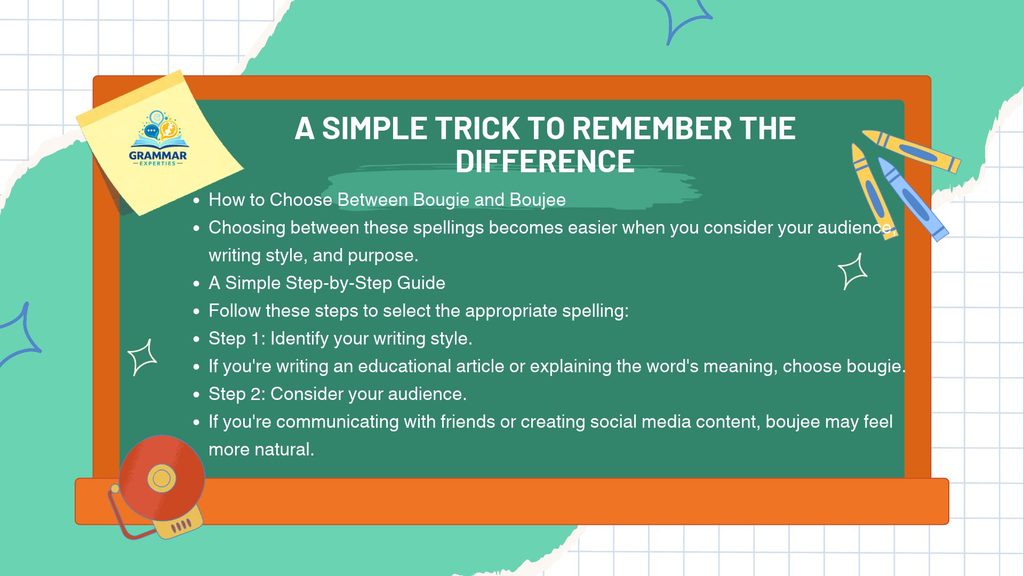
Choosing between these spellings becomes easier when you consider your audience, writing style, and purpose.
A Simple Step-by-Step Guide
Follow these steps to select the appropriate spelling:
Step 1: Identify your writing style.
If you’re writing an educational article or explaining the word’s meaning, choose bougie.
Step 2: Consider your audience.
If you’re communicating with friends or creating social media content, boujee may feel more natural.
Step 3: Understand the intended meaning.
If you’re describing expensive tastes, luxury, or pretentious behavior, either spelling can communicate the idea.
Step 4: Maintain consistency.
Avoid switching between bougie and boujee unnecessarily within the same article or paragraph.
Real-Life Example: Choosing the Right Word for a Lifestyle Blog
Imagine you’re writing a lifestyle blog about expensive restaurants, fashionable clothing, and luxury travel experiences.
You want to describe a newly opened restaurant with elegant decorations, premium food, and expensive menus.
You could write:
“This restaurant has a bougie atmosphere, with elegant furniture, premium dishes, and beautiful interior design.”
This sentence works well because bougie communicates the restaurant’s luxurious and somewhat upscale character.
Now imagine you’re writing an Instagram caption about visiting the same restaurant with friends.
You might write:
“Enjoying a boujee dinner with my favorite people!”
Both sentences communicate a similar idea, but they create slightly different impressions.
The first example sounds descriptive and suitable for general blog writing. The second feels relaxed, playful, and appropriate for social media.
Consider another situation. Suppose you’re writing about someone who only buys designer clothing and refuses to purchase affordable alternatives. You might describe that person as bougie if you’re criticizing their expensive preferences.
However, if the person proudly enjoys fashionable clothing and luxury experiences, boujee might better match the playful tone you’re trying to create.
This example demonstrates why context matters more than the spelling alone. Neither word is universally better. Your choice should depend on the audience, tone, and message you want to communicate.
Better Alternatives for Formal Writing
If you’re writing an academic paper, professional email, or formal business document, consider using these alternatives:
| Alternative | Meaning |
|---|---|
| Luxurious | Extremely comfortable or expensive |
| Upscale | Belonging to a higher-quality market |
| Elegant | Attractive and stylish |
| Sophisticated | Refined and cultured |
| Pretentious | Trying to appear more important or impressive |
| Extravagant | Spending more than necessary |
| High-end | Expensive and premium quality |
For example:
- Informal: “This is a bougie hotel.”
- Formal: “This is a luxurious hotel.”
The second sentence is more appropriate for professional writing.
Mini Quiz: Bougie or Boujee?
1. Which spelling is more established in dictionaries?
A) Boujee
B) Bougie
C) Boogie
D) Bougii
Answer: B) Bougie
2. What does “bougie” generally mean in modern slang?
A) Cheap
B) Simple
C) Fancy or luxurious
D) Traditional
Answer: C) Fancy or luxurious
3. Which French word is the origin of “bougie”?
A) Bonjour
B) Bourgeois
C) Beauté
D) Bonsoir
Answer: B) Bourgeois
4. Are “bougie” and “boujee” usually pronounced the same way?
A) Yes
B) No
Answer: A) Yes
5. Which spelling is strongly associated with hip-hop slang and popular culture?
A) Bougie
B) Boujee
C) Boogie
D) Boug
Answer: B) Boujee
6. Which song helped popularize the spelling “Boujee”?
A) God’s Plan
B) Bad and Boujee
C) Humble
D) Rockstar
Answer: B) Bad and Boujee
7. Choose the correct sentence.
A) That restaurant is too bougie.
B) That restaurant is too bougii.
C) That restaurant is too boug.
D) That restaurant is too boujiee.
Answer: A) That restaurant is too bougie.
8. Which word is a suitable formal alternative to “bougie”?
A) Luxurious
B) Tiny
C) Ordinary
D) Basic
Answer: A) Luxurious
9. Does someone have to be wealthy to be described as bougie?
A) Yes
B) No
Answer: B) No
10. What can “bougie” suggest when used critically?
A) Kindness
B) Pretentious behavior
C) Laziness
D) Confusion
Answer: B) Pretentious behavior
11. Which sentence sounds natural as a casual social media caption?
A) Feeling boujee with my new handbag!
B) Feeling bougii with my new handbag!
C) Feeling boogie with my new handbag!
D) Feeling boug with my new handbag!
Answer: A) Feeling boujee with my new handbag!
12. What does “bourgeois” historically refer to?
A) A type of food
B) A social class
C) A musical instrument
D) A clothing brand
Answer: B) A social class
13. Which of these could be described as bougie?
A) A luxury hotel
B) A designer outfit
C) An expensive restaurant
D) All of the above
Answer: D) All of the above
14. Which word is different from “bougie” and “boujee”?
A) Bougie
B) Boujee
C) Boogie
D) Both A and B
Answer: C) Boogie
15. Which spelling is generally more suitable for an educational article?
A) Bougie
B) Boujee
C) Boogie
D) Bougii
Answer: A) Bougie
16. Where is “boujee” commonly used?
A) Social media captions
B) Casual conversations
C) Popular culture
D) All of the above
Answer: D) All of the above
17. What does “giving boujee vibes” usually mean?
A) Looking inexpensive
B) Creating a luxurious or fashionable impression
C) Feeling tired
D) Acting confused
Answer: B) Creating a luxurious or fashionable impression
18. What is the noun related to “bourgeois”?
A) Bourgeoisie
B) Bourgeoise
C) Bouginess
D) Boujeeness
Answer: A) Bourgeoisie
19. Choose the correct sentence.
A) They planned a boujee birthday dinner.
B) They planned a boujii birthday dinner.
C) They planned a bougiee birthday dinner.
D) They planned a boug birthday dinner.
Answer: A) They planned a boujee birthday dinner.
20. What does Google Trends show when comparing search interest for “bougie” and “boujee”?
A) Exact search counts
B) Relative search interest
C) Website rankings
D) Grammar scores
Answer: B) Relative search interest
21. What tone does “boujee” often create in casual writing?
A) Playful and expressive
B) Strictly academic
C) Scientific
D) Legal
Answer: A) Playful and expressive
22. Which group contains suitable alternatives to “bougie” in formal writing?
A) Luxurious, upscale, sophisticated
B) Cheap, poor, simple
C) Angry, upset, worried
D) Quick, fast, rapid
Answer: A) Luxurious, upscale, sophisticated
23. What is the best way to use “bougie” and “boujee” in an article?
A) Use both randomly
B) Choose the spelling that fits the context and stay consistent
C) Always replace them with “boogie”
D) Avoid explaining their meanings
Answer: B) Choose the spelling that fits the context and stay consistent
24. Which sentence uses “bougie” to describe an expensive lifestyle?
A) She loves staying in bougie hotels.
B) She loves staying in sleepy hotels.
C) She loves staying in noisy hotels.
D) She loves staying in empty hotels.
Answer: A) She loves staying in bougie hotels.
25. What is the main difference between “bougie” and “boujee”?
A) They always have completely different meanings.
B) Bougie is more established, while boujee is a popular slang variation.
C) Boujee is always formal.
D) Bougie is never used in casual conversations.
Answer: B) Bougie is more established, while boujee is a popular slang variation.
Frequently Asked Questions (FAQs)
Q1: Is It Bougie or Boujee?
Both spellings are used in informal English. However, bougie is the more established dictionary spelling, while boujee is a popular slang variation associated with hip-hop and social media culture.
Q2: Is Boujee a Real Word?
Yes. Boujee is a recognized slang spelling of bougie. It is widely understood in contemporary informal communication, although it is less established than bougie in traditional dictionaries.
Q3: Does Bougie Mean Rich?
Not necessarily. Bougie generally describes someone or something associated with expensive tastes, luxury, or middle-class attitudes. A person doesn’t have to be wealthy to be described as bougie.
Q4: What Is the Difference Between Bougie and Boujee?
The main difference is spelling and cultural association. Bougie is the more established spelling and can suggest pretentious or expensive tastes. Boujee is a popular slang variation that often sounds playful and fashionable.
Q5: How Do You Pronounce Bougie and Boujee?
Both are generally pronounced BOO-zhee. The first syllable sounds like “boo,” and the second sounds like “zhee.”
Q6: Is Bougie an Insult?
Sometimes. Bougie can be used humorously or critically to describe someone who appears snobbish, materialistic, or overly concerned with social status. However, it can also simply describe something fancy or luxurious.
Q7: Can I Use Boujee in Formal Writing?
It’s better to avoid boujee in formal writing because it is an informal slang expression. Consider alternatives such as luxurious, upscale, elegant, or sophisticated, depending on your intended meaning.
Q8: Is Bougie More Common Than Boujee?
Bougie is the more established dictionary spelling. Boujee is particularly recognizable in popular culture and online slang. However, exact current usage rankings depend on the source, region, and platform being measured.
Conclusion: Bougie or Boujee – Which One Should You Use?
So, bougie or boujee—which spelling should you choose?
The answer depends on your writing style and audience.
Bougie is the more established spelling and is generally the better choice for educational articles, general informal writing, and explanations of the word’s meaning.
Boujee is a popular alternative that works particularly well in casual conversations, social media captions, and contemporary slang.
Both spellings describe expensive tastes, luxurious lifestyles, and fashionable preferences. However, their cultural associations and tones can differ depending on the context.
Remember, choosing the right word isn’t just about spelling. It’s also about understanding your audience and communicating your intended meaning clearly.
Explore more easy grammar lessons and improve your English with Grammar Expertise
References

Maimoona Mughal is an English grammar enthusiast dedicated to simplifying confusing words, grammar rules, and vocabulary through clear, accurate, and learner-friendly content that helps readers write and communicate with confidence.