Have you ever wondered whether the correct spelling is puddy or putty? These two words look almost identical, but they do not have the same meaning or everyday usage. Choosing the wrong spelling can make your writing confusing, especially when discussing home repairs, construction materials, or everyday English vocabulary.
The correct word for a soft material used to fill holes, seal gaps, and hold glass in window frames is putty. However, puddy is also recorded as a rare British English adjective meaning short and podgy.
In this guide, you will learn the difference between puddy and putty, their meanings, pronunciation, examples, and common spelling mistakes. By the end, you will know exactly which word to use in different situations.
Puddy or Putty: Which Spelling Is Correct?
Is Putty the Correct Spelling?
Putty is the correct and standard spelling when referring to a soft, workable substance used for filling holes, repairing surfaces, or securing glass in window frames.
It is a recognized English noun and can also function as a verb.
For example:
- The carpenter used putty to fill the small holes in the wooden door.
- We need fresh putty to repair the old window.
- She applied putty around the edges of the glass.
- The worker used a putty knife to smooth the surface.
The word is widely used in construction, woodworking, home improvement, and DIY projects.
Is Puddy a Real Word?
Yes, puddy is a real but uncommon English word. It is recorded as a rare British English adjective meaning short and podgy.
However, it is not the standard spelling of the material called putty.
For example:
- The dictionary lists puddy as a rare adjective.
- Putty is the material used to repair the window frame.
Therefore, the two words should not be treated as interchangeable.
Quick Answer: Puddy vs Putty
| Word | Meaning | Usage |
|---|---|---|
| Putty | A soft material used for filling, sealing, and repairing | Standard English |
| Puddy | A rare British adjective meaning short and podgy | Uncommon usage |
The easiest way to remember: If you are talking about a repair material, always write putty.
What Does Putty Mean?
Definition of Putty
Putty is a soft substance similar to clay, commonly used to hold glass in window frames or fill small holes in wood.
It usually starts as a soft, workable material and becomes firmer as it dries or cures, depending on its formulation.
Putty is commonly used in repair and construction work because it helps fill gaps, create smooth surfaces, and secure certain materials.
For example:
- The painter filled the cracks with putty before applying paint.
- The old window needed new putty around its glass.
- He purchased a container of wood putty for the furniture repair.
Different Types of Putty
Putty comes in different forms depending on the job. Each type serves a particular purpose.
1. Window Putty
Window putty is used to secure glass in traditional window frames and seal the edges around the glass.
Example: The homeowner replaced the damaged window putty before repainting the frame.
2. Wood Putty
Wood putty is used to fill small holes, scratches, and imperfections in wooden surfaces.
Example: She applied wood putty to hide the nail holes in the cabinet.
3. Wall Putty
Wall putty is a surface-preparation material used to create a smoother finish before painting.
Example: The workers applied wall putty before painting the bedroom.
4. Epoxy Putty
Epoxy putty is a repair compound that can be shaped before hardening. Depending on the product, it can be used for repairing different materials and surfaces.
Example: He used epoxy putty to repair a small crack in the damaged pipe.
Putty as a Noun and Verb
Putty is primarily used as a noun, but it can also work as a verb.
As a noun, it identifies the material itself.
Example: The putty around the window has become damaged.
As a verb, it describes the action of applying putty to a surface.
Example: The worker will putty the gaps before painting the frame.
Understanding both forms helps you use the word correctly in different sentences.
What Does Puddy Mean?
Definition and Usage of Puddy
Unlike putty, puddy is not commonly used in modern everyday English.
It is recorded as a rare British adjective meaning short and podgy. The comparative and superlative forms are puddier and puddiest.
The word is therefore not simply a spelling mistake in every possible context. However, its meaning is very different from the meaning of putty.
For example:
- The historical dictionary records puddy as a rare adjective.
- The writer encountered the unusual word puddy while researching old vocabulary.
- Puddy is an uncommon word that most everyday readers may not recognize.
If you are writing about construction, repairs, or filling materials, using puddy would be incorrect.
Why Do People Confuse Puddy and Putty?
There are several reasons people mix up these spellings.
1. Similar Pronunciation
Both words begin with the same letter and have similar-looking structures. This can make them confusing when someone is writing quickly.
2. Only One Letter Changes
The main spelling difference is the consonant used before the letter Y:
- Puddy: D-D-Y
- Putty: T-T-Y
This small difference can easily lead to typing mistakes.
3. Limited Vocabulary Knowledge
People who have not encountered the word putty before may be unsure about its spelling.
4. Unfamiliarity With Rare Words
Some writers may assume that puddy is always incorrect. However, its rare dictionary-recognized meaning shows why context matters.
Is Puddy a Typo for Putty?
In most everyday situations involving repair materials, yes.
If someone writes, “I need puddy to repair the window,” they most likely mean “putty.”
However, context is important. Since puddy has a rare dictionary-recognized meaning, it should not automatically be treated as a spelling error in every sentence.
Puddy vs Putty: Differences, Examples, and Usage
Side-by-Side Comparison
The following table makes the difference between these words easier to understand.
| Feature | Puddy | Putty |
|---|---|---|
| Word status | Rare English adjective | Standard English word |
| Meaning | Short and podgy | Soft repair material |
| Main usage | Rare British vocabulary | Construction and repairs |
| Word type | Adjective | Noun and verb |
| Commonness | Very uncommon | Widely recognized |
| Appropriate for repair materials? | No | Yes |
Example Sentences Using Putty
Here are some practical sentences showing how to use putty correctly.
- The carpenter used putty to repair the damaged wooden table.
- We need to replace the old putty around the window.
- She bought wall putty before starting the painting project.
- The painter applied putty to make the surface smooth.
- He used a putty knife to fill the small holes.
- The putty became firm after drying.
- They removed the damaged putty from the window frame.
- You should apply the putty evenly for a smooth finish.
Example Sentences Using Puddy
Because puddy is rare, its use is limited.
- The historical dictionary records puddy as a British adjective.
- The writer encountered the unusual word puddy while researching old vocabulary.
- Puddy is listed as a rare word meaning short and podgy.
These examples demonstrate why putty is the appropriate choice in ordinary writing about repair materials.
Real-Life Example: Choosing Between Puddy and Putty
Imagine that a homeowner is renovating an older house. During the renovation, they discover that the wooden window frames have cracks and the material around the glass has started to deteriorate.
They visit a hardware store to purchase supplies. Before leaving, they write a shopping list on their phone.
The list includes:
- Paint
- Sandpaper
- A putty knife
- Window puddy
- Wood filler
The homeowner is unsure whether “window puddy” is correct. They search online and discover that the standard spelling for the repair material is putty.
They correct their shopping list to read “window putty.”
Later, they use the material to secure the glass and fill small gaps around the window frame. They also use wood filler to repair imperfections in a wooden cabinet.
This simple example demonstrates how a small spelling difference can affect clear communication. Although puddy exists as a rare English adjective, it does not describe the material required for the renovation.
The important lesson is to consider the meaning of a word before choosing its spelling. If you are discussing window repairs, woodworking, wall preparation, or similar tasks, putty is the appropriate word.
How to Choose the Correct Word
Follow these simple steps whenever you are unsure:
- Identify what you are trying to describe.
- If you mean a soft material used for repairs, choose putty.
- If you encounter puddy in a historical or unusual British English context, check its intended meaning.
- Read the complete sentence to make sure the word fits.
- Use a reliable dictionary when you are uncertain.
This approach can help prevent spelling mistakes in professional documents, blog posts, emails, and everyday communication.
Puddy or Putty: Pronunciation, Spelling, and Grammar Rules
How Do You Pronounce Putty?
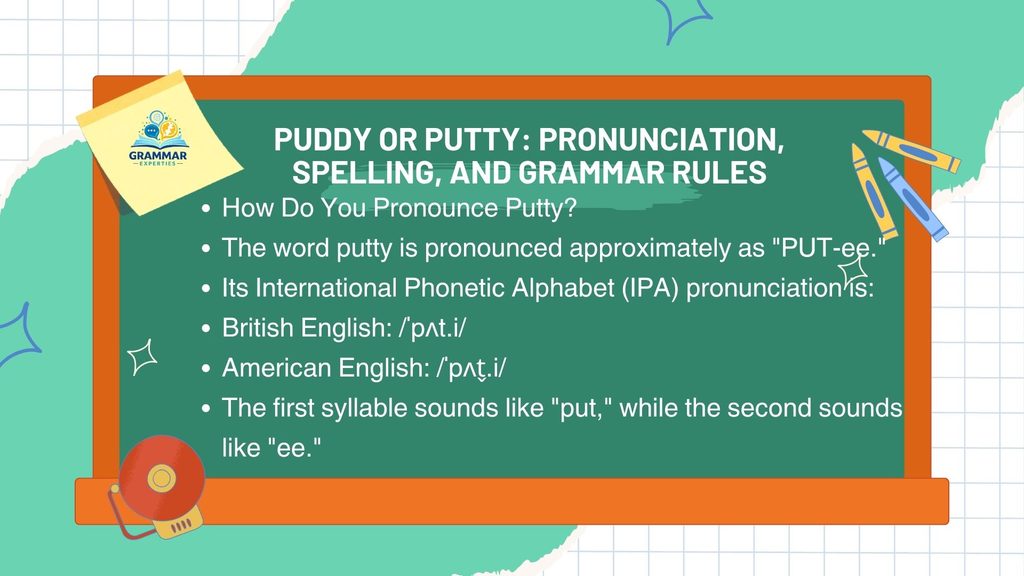
The word putty is pronounced approximately as “PUT-ee.”
Its International Phonetic Alphabet (IPA) pronunciation is:
- British English: /ˈpʌt.i/
- American English: /ˈpʌt̬.i/
The first syllable sounds like “put,” while the second sounds like “ee.”
The pronunciation is similar in British and American English, although the exact sound of the T can vary.
How Do You Spell Putty Correctly?
The correct spelling is:
P-U-T-T-Y
Remember that putty contains two consecutive T letters.
A common mistake is replacing the T letters with D letters, producing “puddy.”
Here is an easy spelling comparison:
- Correct: Putty
- Incorrect for the repair material: Puddy
For example:
Incorrect: The carpenter applied puddy to the wooden surface.
Correct: The carpenter applied putty to the wooden surface.
Is Putty Singular or Plural?
Putty is generally an uncountable noun when referring to the material.
For example:
- The putty is still wet.
- We need more putty for the repair.
- She applied some putty to the wall.
When referring to different types or quantities, the plural form putties can also be used.
Example: The store sells several types of industrial putties.
2025–2026 Spelling and Search Data: What Do We Know?
Is There Recent Data About Puddy vs Putty?
When researching spelling differences, it is important to distinguish between verified statistics and assumptions.
There is no verified, publicly available 2025–2026 statistic establishing the exact number of searches for “puddy” compared with “putty.”
Therefore, assigning percentages or claiming that one spelling receives a specific number of searches would be misleading.
However, several reliable resources help explain how spelling and word usage can be researched.
1. Google Trends
Google Trends provides information about relative search interest over selected periods and locations. Its data is normalized on a scale from 0 to 100 rather than representing absolute search volumes.
This means writers can compare interest in different terms, but should not interpret the numbers as exact search counts.
2. Cambridge Dictionary
Cambridge Dictionary identifies putty as a standard English noun and provides its pronunciation, definition, and examples. This supports the use of putty in everyday writing about repair materials.
3. Oxford Learner’s Dictionaries
Oxford also recognizes putty as a noun and explains its use in securing glass in window frames. Its dictionary entry additionally records the expression “like putty in somebody’s hands.”
What Can Writers Learn From This Information?
For writers, students, and English learners, the practical lesson is simple:
- Use established dictionaries to verify spelling and meaning.
- Check the context before deciding whether a word is correct.
- Avoid treating every unfamiliar word as a spelling mistake.
- Do not invent search statistics when reliable data is unavailable.
Accurate spelling is more important than forcing an unsupported statistical claim into an article.
Mini Quiz:Puddy or Putty
1. Which spelling is correct for the material used to repair windows?
A) Puddy
B) Putty
C) Puti
D) Putie
Answer: B) Putty
2. Complete the sentence: The carpenter used _____ to fill the small holes in the wood.
A) Puddy
B) Putty
Answer: B) Putty
3. Is “putty” a standard English word?
A) Yes
B) No
Answer: A) Yes
4. What does putty usually refer to?
A) A type of clothing
B) A soft material used for filling or sealing gaps
C) A cooking ingredient
D) A musical instrument
Answer: B) A soft material used for filling or sealing gaps
5. Which spelling should you use in formal writing when referring to window repair material?
A) Puddy
B) Putty
Answer: B) Putty
6. True or False: “Puddy” is the standard spelling of the repair material.
Answer: False
7. Complete the sentence: She applied window _____ around the glass.
A) puddy
B) putty
Answer: B) putty
8. What part of speech can “putty” function as?
A) Noun and verb
B) Only an adjective
C) Only an adverb
D) Only a preposition
Answer: A) Noun and verb
9. Which sentence is correct?
A) He filled the crack with puddy.
B) He filled the crack with putty.
Answer: B) He filled the crack with putty.
10. What is the approximate pronunciation of “putty”?
A) PUT-ee
B) POO-tie
C) PUD-eye
D) PEE-tee
Answer: A) PUT-ee
11. What is putty commonly used for?
A) Filling holes and sealing gaps
B) Washing clothes
C) Preparing drinks
D) Cutting paper
Answer: A) Filling holes and sealing gaps
12. True or False: Putty can be used in woodworking.
Answer: True
13. Which word is associated with window installation and repair?
A) Puddy
B) Putty
Answer: B) Putty
14. Choose the correct sentence.
A) The worker applied putty to the wall.
B) The worker applied puddy to the wall.
Answer: A) The worker applied putty to the wall.
15. What is the plural form of “putty” when referring to different types?
A) Puttys
B) Putties
C) Puttyes
D) Puddies
Answer: B) Putties
16. True or False: “Putty” can also be used as a verb.
Answer: True
17. Which spelling is recognized as a rare British adjective meaning short and podgy?
A) Putty
B) Puddy
Answer: B) Puddy
18. Complete the sentence: The painter used wood _____ before painting the surface.
A) putty
B) puddy
Answer: A) putty
19. Which word should you use in an article about home repairs?
A) Puddy
B) Putty
Answer: B) Putty
20. True or False: “Puddy” and “putty” are interchangeable in standard writing.
Answer: False
21. What does putty help create?
A) A smoother surface
B) A louder sound
C) A stronger smell
D) A brighter light
Answer: A) A smoother surface
22. Which phrase is correct?
A) Window puddy
B) Window putty
Answer: B) Window putty
23. What is the best way to avoid confusing “puddy” and “putty”?
A) Use either spelling
B) Remember that “putty” is the standard spelling for the repair material
C) Avoid using both words
D) Always write “puddy”
Answer: B) Remember that “putty” is the standard spelling for the repair material
24. Complete the sentence: The old window needed fresh _____ around the glass.
A) puddy
B) putty
Answer: B) putty
25. What is the main spelling lesson from this guide?
A) Puddy is always correct
B) Putty is the standard spelling for the repair material
C) Both spellings have exactly the same meaning
D) Putty is not an English word
Answer: B) Putty
Frequently Asked Questions (FAQs)
Q1: Is It Puddy or Putty?
Putty is the correct spelling when referring to a soft material used for filling holes, sealing gaps, or holding glass in window frames. Puddy is a rare British English adjective with a different meaning.
Q2: Is Puddy a Correct English Word?
Yes. Puddy is recorded as a rare British adjective meaning short and podgy. However, it is not the correct spelling of the repair material.
Q3: What Does Putty Mean?
Putty is a soft substance used for filling holes, repairing surfaces, and securing glass in window frames. It is commonly used in construction, woodworking, and home improvement.
Q4: Is Putty a Noun or a Verb?
Putty can be both a noun and a verb. As a noun, it refers to the repair material. As a verb, it describes the action of applying putty to a surface.
Q5: How Do You Pronounce Putty?
Putty is pronounced “PUT-ee.” Its British IPA pronunciation is /ˈpʌt.i/, while its American pronunciation is /ˈpʌt̬.i/.
Q6: Is Wall Putty or Wall Puddy Correct?
Wall putty is correct. It refers to a surface-preparation material used to smooth walls before painting. Wall puddy is an incorrect spelling for this material.
Q7: Why Do People Spell Putty as Puddy?
People may confuse these words because they look similar and differ mainly in their middle consonants. Typing quickly, unfamiliarity with the word, and uncertainty about spelling can also cause mistakes.
Q8: What Is the Plural of Putty?
Putty is usually an uncountable noun, so it does not normally require a plural form. However, putties can be used when referring to different types or varieties of putty.
Conclusion: Puddy or Putty Which One Should You Use?
The difference between puddy and putty becomes simple once you understand their meanings.
Putty is the standard and correct spelling for the soft material used in construction, woodworking, window repairs, and surface preparation.
Puddy is a rare British English adjective meaning short and podgy. Although it is a recognized word, it should not replace putty when describing a repair material.
Remember the spelling P-U-T-T-Y whenever you write about window putty, wall putty, wood putty, or other repair compounds.
Improving your spelling starts with understanding words in context. Keep learning, check unfamiliar words in reliable dictionaries, and use the correct spelling to make your writing clear and professional.
Explore more easy grammar lessons and improve your English with Grammar Expertise
References
https://dictionary.cambridge.org/dictionary/english/putty
https://www.collinsdictionary.com/dictionary/english/putty

Maimoona Mughal is an English grammar enthusiast dedicated to simplifying confusing words, grammar rules, and vocabulary through clear, accurate, and learner-friendly content that helps readers write and communicate with confidence.