Introduction
Have you ever wondered whether you should say “constant effort” or “consistent effort”? These words look similar because both can describe something that stays steady or happens repeatedly. However, constant vs consistent is an important distinction in English.
In simple terms, constant usually emphasizes something that continues, happens frequently, or does not change. Consistent, on the other hand, usually emphasizes reliability, regularity, uniformity, or agreement.
For example:
- The constant noise made it difficult to sleep.
- Her consistent effort helped her improve.
The first sentence focuses on something that keeps happening. The second focuses on reliable effort over time.
Once you understand this small difference, choosing between constant and consistent becomes much easier. This guide explains their meanings, differences, grammar, common expressions, examples, and practical usage so you can use both words confidently.
What Does Constant Mean?
Constant is an adjective that generally describes something that remains unchanged or happens very frequently or continuously.
Cambridge Dictionary gives two particularly useful meanings: something can be frequent or happening all the time, or it can remain at the same level without changing.
Constant Meaning in Simple English
Think of constant as:
always there, happening repeatedly, or staying unchanged.
For example:
- The constant rain ruined our picnic.
- She was distracted by the constant noise.
- The machine operates at a constant speed.
- His support has been a constant source of encouragement.
Notice that constant can describe both frequency and stability.
Constant as “Happening Again and Again”
When constant describes an event, activity, sound, problem, or situation, it often suggests that it happens very frequently or almost continuously.
Examples:
- The constant interruptions made the meeting difficult.
- We were tired of the constant traffic noise.
- He complained about her constant questions.
- The company faces constant pressure to reduce costs.
Here, constant does not necessarily mean literally without a single second of interruption. It can mean that something happens so frequently that it feels continuous.
Merriam-Webster similarly defines constant as something that continually occurs or recurs and also as something invariable or uniform.
Constant as “Unchanging”
Constant can also describe something that stays at the same level or value.
Examples:
- The temperature remained constant.
- The car maintained a constant speed.
- The experiment requires a constant pressure.
- The value of the variable remained constant.
In mathematics and science, constant has an especially precise meaning: a quantity that does not change under the conditions being considered.
What Does Consistent Mean?
Consistent is an adjective that describes something that behaves, happens, or performs in a similar and reliable way.
Cambridge defines consistent as behaving or happening in a similar way, particularly in a positive sense. It can also mean that something agrees with another fact, statement, or principle.
Consistent Meaning in Simple English
Think of consistent as:
reliable, regular, steady, or staying similar over time.
For example:
- She makes consistent progress.
- He delivers consistent results.
- The student shows consistent improvement.
- Her writing style is consistent throughout the book.
The focus is usually on reliability or uniformity, rather than simply the fact that something continues.
Consistent as Reliable Performance
We often use consistent when talking about people, habits, work, performance, results, or quality.
Examples:
- He is a consistent performer.
- She puts in consistent effort every day.
- The restaurant provides consistent service.
- The team has shown consistent improvement.
- You need consistent practice to improve your English.
A person doesn’t have to work every minute to be consistent. Instead, their behavior or results follow a reliable pattern.
Consistent as “In Agreement”
Another important meaning is in agreement with something else.
The common structure is:
consistent with + noun
Examples:
- His explanation is consistent with the evidence.
- The results are consistent with our original findings.
- Her actions are not consistent with her promises.
- The decision is consistent with company policy.
This meaning makes consistent different from constant.
You would not normally say:
❌ His explanation is constant with the evidence.
The correct expression is:
✅ His explanation is consistent with the evidence.
Constant vs Consistent: The Main Difference
The easiest way to remember constant vs consistent is to focus on what each word emphasizes.
Constant emphasizes continuation, frequent occurrence, or lack of change.
Consistent emphasizes reliability, regularity, uniformity, or agreement.
Constant vs Consistent at a Glance
| Feature | Constant | Consistent |
|---|---|---|
| Basic idea | Continues or stays unchanged | Remains reliable or similar |
| Main focus | Continuity or stability | Regularity or reliability |
| Can mean “unchanging”? | Yes | Yes, depending on context |
| Can mean “frequent”? | Yes | Sometimes, but less directly |
| Can describe performance? | Less common | Very common |
| Can mean “in agreement with”? | No | Yes |
| Common phrase | constant noise | consistent effort |
| Common phrase | constant pressure | consistent results |
| Common phrase | constant temperature | consistent quality |
A Simple Memory Trick
Use this shortcut:
Constant = keeps going or stays the same.
Consistent = keeps performing in a reliable way.
For example:
Constant rain = rain that keeps falling or occurs very frequently.
Consistent rainfall = rainfall that follows a relatively regular or predictable pattern.
Similarly:
Constant noise = noise that keeps occurring.
Consistent performance = performance that remains reliably good or similar.
When to Use Constant vs Consistent
Knowing the definitions is helpful, but seeing the words in real situations makes the distinction much clearer.
Use Constant for Ongoing or Frequent Things
Choose constant when you want to emphasize that something is always present, repeatedly happening, or continuing for a long time.
Examples:
- constant noise
- constant pressure
- constant change
- constant communication
- constant attention
- constant movement
- constant criticism
- constant pain
- constant demand
For example:
The constant noise from the construction site disturbed the neighborhood.
The emphasis is on the repeated or ongoing noise.
Use Consistent for Habits and Performance
Choose consistent when you are talking about reliable behavior, quality, results, effort, or performance.
Examples:
- consistent effort
- consistent results
- consistent quality
- consistent performance
- consistent practice
- consistent improvement
- consistent behavior
- consistent communication
For example:
Her consistent effort helped her achieve her goals.
The sentence emphasizes the reliability of her effort over time.
Use Consistent With for Agreement
If you mean that one thing matches another, use consistent with.
Examples:
The evidence is consistent with his explanation.
Her actions are consistent with her values.
The findings are consistent with previous research.
This is one of the strongest clues that you need consistent, not constant.
Constant vs Consistent Examples in Everyday English
The difference becomes much easier when you compare similar sentences.
Example 1: Effort
Constant effort can suggest effort that continues frequently or persistently.
Consistent effort suggests reliable effort maintained over time.
She made a constant effort to solve the problem.
She made a consistent effort to improve her writing.
The second sentence sounds more natural when discussing a habit or long-term improvement.
Example 2: Noise
The constant noise made it impossible to concentrate.
Here, constant is the natural choice because the focus is on noise that keeps occurring.
The consistent noise made it impossible to concentrate.
This is possible in a special context, but it sounds less natural if you simply mean ongoing noise.
Example 3: Performance
The athlete delivered consistent performances throughout the season.
This means the athlete repeatedly performed at a similar or reliable level.
The athlete delivered constant performances throughout the season.
This sounds unnatural because constant doesn’t normally describe repeated performance in this way.
Example 4: Change
Technology is in constant change.
This is not the most natural phrasing.
Better:
Technology is constantly changing.
But:
The company has maintained a consistent approach to technology.
Here, consistent describes the company’s reliable approach.
Example 5: Temperature
The laboratory maintained a constant temperature.
This means the temperature did not change.
You could also say:
The laboratory maintained a consistent temperature.
This can work when the emphasis is on maintaining a stable or uniform temperature. However, constant is especially natural when the intended meaning is that the value itself remained unchanged.
Constant vs Consistent in Different Contexts
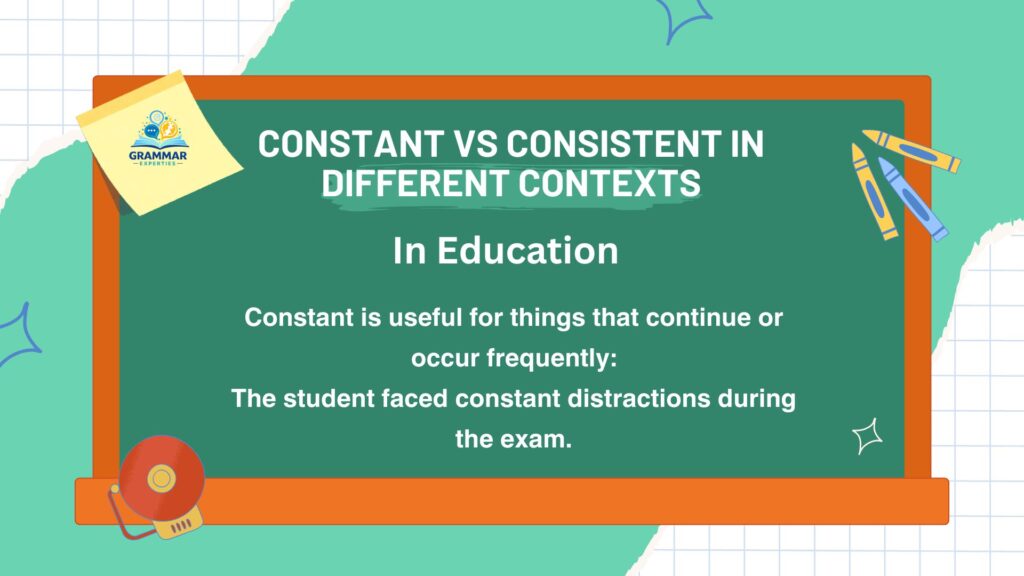
The right choice often depends on the context rather than a strict grammar rule.
In Education
Constant is useful for things that continue or occur frequently:
The student faced constant distractions during the exam.
Consistent is useful for habits and performance:
The student showed consistent improvement throughout the semester.
A teacher might also say:
Consistent practice is the key to improving vocabulary.
In Business
Constant often describes pressure, change, demand, or communication:
Businesses operate under constant pressure to adapt.
Consistent commonly describes quality, service, results, or performance:
Customers expect consistent service.
The company has delivered consistent results for several years.
In Sports
Constant can describe movement or pressure:
The defense put constant pressure on the opposing team.
Consistent is particularly common when discussing performance:
The player has been one of the team’s most consistent performers.
In Science and Mathematics
Constant often has a technical meaning involving a quantity that doesn’t change.
Examples:
The experiment was conducted at a constant temperature.
The speed was kept constant throughout the test.
The value of the constant remained unchanged.
Consistent, meanwhile, can describe findings or results that agree with one another:
The new results are consistent with earlier observations.
This distinction is especially important in academic writing.
In Writing
You can use constant for something that repeatedly interrupts or affects your writing:
Constant notifications made it difficult to focus on the article.
Use consistent for style, tone, quality, or formatting:
The writer maintained a consistent tone throughout the article.
Use consistent capitalization across all headings.
A Real-Life Example: Building a Consistent Study Habit
Imagine a student named Sara who wants to improve her English vocabulary.
During the first week, Sara studies for six hours on Monday. She then becomes busy and doesn’t study again until Saturday. The following week, she studies for five hours on Sunday but does nothing during the rest of the week.
Sara is certainly making an effort, but her study routine isn’t very consistent. Her schedule changes significantly from week to week.
Now imagine that Sara changes her approach. Instead of studying for several hours occasionally, she studies for 30 minutes every evening from Monday through Friday. Some days she learns ten words, while on other days she reviews five. The amount isn’t exactly identical, but her habit is reliable.
We can now say:
Sara has developed a consistent study routine.
The routine doesn’t have to be constant. She isn’t studying every second of the day, and she isn’t even studying for exactly the same amount of time each day. What matters is that she follows a regular and dependable pattern.
This example shows the practical difference between constant and consistent. Constant would emphasize something that continues or doesn’t change, while consistent emphasizes a reliable pattern over time.
The same principle applies to exercise, writing, business, language learning, and many other activities. You don’t need to do something constantly to be consistent. In fact, consistency usually means creating a sustainable pattern rather than doing something continuously.
Common Expressions With Constant and Consistent
Learning common word combinations can help you choose the correct word naturally.
Common Expressions With Constant
Here are some natural combinations:
- constant attention
- constant change
- constant communication
- constant demand
- constant pressure
- constant noise
- constant reminder
- constant support
- constant temperature
- constant movement
- constant concern
- constant pain
Examples:
The project requires constant attention.
The company is under constant pressure to reduce costs.
The machine must operate at a constant temperature.
Common Expressions With Consistent
Common combinations include:
- consistent effort
- consistent improvement
- consistent quality
- consistent performance
- consistent results
- consistent behavior
- consistent practice
- consistent communication
- consistent approach
- consistent style
- consistent service
- consistent growth
Examples:
Consistent practice improved her pronunciation.
The company is known for consistent quality.
His consistent performance earned him a promotion.
The report uses a consistent writing style.
Constant vs Consistent: Common Mistakes to Avoid
Because these words overlap, learners sometimes use them interchangeably. In some contexts, either word can work, but the meaning or emphasis may change.
Mistake 1: Using Constant for Reliable Performance
Incorrect or awkward:
She is a constant performer.
If you mean that she performs reliably well, use:
She is a consistent performer.
Mistake 2: Using Consistent for Continuous Noise
Less natural:
The consistent noise kept me awake.
More natural when you mean ongoing or frequent noise:
The constant noise kept me awake.
Mistake 3: Confusing “Constant” With “Consistent With”
Remember:
The evidence is consistent with the theory.
Not:
❌ The evidence is constant with the theory.
Consistent with means “in agreement with” or “compatible with.”
Mistake 4: Assuming Consistent Means Exactly Identical
Something can be consistent without being exactly the same every time.
For example:
She makes consistent progress.
Her progress might be faster one week and slower the next. It can still be consistent if the overall pattern is steady and reliable.
Mistake 5: Assuming Constant Always Means Positive
Constant can describe something useful or unpleasant.
Positive:
He received constant support from his family.
Negative:
The constant interruptions were frustrating.
So the word itself doesn’t automatically express approval or criticism.
Constant vs Consistent: 2025–2026 Language Data and Evidence
There isn’t a single authoritative 2025–2026 statistic that measures how often English speakers confuse constant and consistent specifically. It would be misleading to invent a percentage or claim that one word is universally more common in this comparison.
However, current authoritative dictionary resources continue to distinguish the words by meaning.
Cambridge’s current entries separate constant into meanings involving frequent occurrence and remaining unchanged, while consistent emphasizes similar behavior, reliable patterns, and agreement with something else.
Merriam-Webster’s current 2026 entries likewise distinguish constant as continually occurring or invariable, while consistent is associated with regularity, freedom from variation or contradiction, and compatibility.
The distinction is also reflected in current learner-focused resources: Cambridge gives examples such as constant temperature and consistent effort/improvement, which neatly demonstrate the practical difference between the two words.
One useful takeaway from the current evidence is that these aren’t simply interchangeable synonyms. Their meanings overlap around the idea of stability, but their semantic focus differs.
How to Choose Between Constant and Consistent
When you’re unsure which word to use, ask yourself one simple question.
Ask: “Am I Talking About Continuation or Reliability?”
Choose constant when the idea is:
- happening repeatedly
- always present
- continuing
- remaining unchanged
- staying at the same value
Choose consistent when the idea is:
- reliable
- regular
- similar over time
- uniform
- compatible with something else
- following the same pattern
A Quick Decision Guide
Use constant:
“Does it keep happening or stay unchanged?”
Use consistent:
“Does it remain reliable, regular, or in agreement?”
For example:
The constant rain lasted all afternoon.
The focus is ongoing or frequent rain.
The team showed consistent improvement.
The focus is reliable improvement over time.
Constant vs Consistent: Synonyms
Knowing synonyms can make the distinction even clearer.
Synonyms for Constant
Depending on the context, synonyms include:
- continuous
- continual
- persistent
- ongoing
- unchanging
- steady
- permanent
- frequent
- incessant
However, these words aren’t always interchangeable. For example, continuous often emphasizes an uninterrupted process, while constant can also mean frequent or unchanging. Merriam-Webster distinguishes continuous as especially emphasizing uninterrupted extension or flow.
Synonyms for Consistent
Depending on the context, synonyms include:
- reliable
- steady
- regular
- uniform
- predictable
- stable
- dependable
- compatible
- coherent
Again, context matters. Reliable often focuses on dependability, while consistent can focus on similarity, regularity, or agreement.
Are Constant and Consistent Synonyms?
They Can Overlap, but They Are Not Identical
Constant and consistent can sometimes describe similar situations, particularly when something remains stable.
For example:
The temperature remained constant.
The temperature remained consistent.
Both may communicate stability, although constant more strongly suggests that the temperature did not change, while consistent can emphasize that it remained reliably uniform.
The distinction becomes clearer with other nouns:
constant noise ✅
consistent noise possible, but usually a different emphasis
and:
consistent performance ✅
constant performance generally not the natural choice
Therefore, don’t treat the two words as perfect synonyms.
Mini Quiz: Constant vs Consistent
1. The Noise Battle
The _____ noise from the construction site kept me awake.
A) Consistent
B) Constant
C) Reliable
D) Regular
Answer: B) Constant
2. Study Smart
She made _____ effort to improve her English every day.
A) Constant
B) Consistent
C) Permanent
D) Incessant
Answer: B) Consistent
3. Sports Star
The athlete is known for her _____ performance throughout the season.
A) Constant
B) Consistent
C) Continuous
D) Permanent
Answer: B) Consistent
4. Science Check
The experiment must be conducted at a _____ temperature.
A) Consistent
B) Constant
C) Reliable
D) Regular
Answer: B) Constant
5. Evidence Detective
The new findings are _____ with previous research.
A) Constant
B) Continuous
C) Consistent
D) Permanent
Answer: C) Consistent
6. Business Boost
Customers expect _____ quality from a trusted brand.
A) Constant
B) Consistent
C) Incessant
D) Permanent
Answer: B) Consistent
7. Traffic Trouble
The _____ traffic made it difficult to reach work on time.
A) Consistent
B) Constant
C) Reliable
D) Uniform
Answer: B) Constant
8. Progress Power
_____ practice can help you become a better writer.
A) Constant
B) Consistent
C) Permanent
D) Unchanging
Answer: B) Consistent
9. Meaning Master
Which word usually means “continuing, frequent, or unchanged”?
A) Consistent
B) Constant
C) Reliable
D) Compatible
Answer: B) Constant
10. Vocabulary Victory
Which word usually means “reliable, regular, or uniform”?
A) Constant
B) Consistent
C) Continuous
D) Permanent
Answer: B) Consistent
11. Interruption Alert
The teacher was frustrated by the students’ _____ interruptions.
A) Consistent
B) Constant
C) Reliable
D) Uniform
Answer: B) Constant
12. Writing Wisdom
The author maintained a _____ tone throughout the article.
A) Constant
B) Consistent
C) Incessant
D) Permanent
Answer: B) Consistent
13. Business Results
The company has produced _____ results for several years.
A) Constant
B) Consistent
C) Incessant
D) Unchanging
Answer: B) Consistent
14. Pressure Point
The team was under _____ pressure to meet the deadline.
A) Consistent
B) Constant
C) Uniform
D) Reliable
Answer: B) Constant
15. Grammar Detective
Which sentence is correct?
A) The evidence is constant with the theory.
B) The evidence is consistent with the theory.
C) The evidence is constantly with the theory.
D) The evidence is consistency with the theory.
Answer: B) The evidence is consistent with the theory.
16. Habit Hero
Which phrase best describes a reliable exercise routine?
A) Constant exercise routine
B) Consistent exercise routine
C) Incessant exercise routine
D) Permanent exercise routine
Answer: B) Consistent exercise routine
17. Keep It Going
Which word best describes something that happens again and again?
A) Constant
B) Consistent
C) Compatible
D) Reliable
Answer: A) Constant
18. Trust Factor
Which word best describes someone who can be depended on to perform well?
A) Constant
B) Consistent
C) Continuous
D) Incessant
Answer: B) Consistent
19. Student Success
Sara studies for 30 minutes every weekday. Her study habit is _____.
A) Constant
B) Consistent
C) Incessant
D) Permanent
Answer: B) Consistent
20. Weather Watch
The _____ rain lasted throughout the afternoon.
A) Consistent
B) Constant
C) Reliable
D) Uniform
Answer: B) Constant
21. Pick the Perfect Pair
Which pair is correctly matched?
A) Constant noise — Consistent performance
B) Consistent noise — Constant performance
C) Constant performer — Consistent quality
D) Constant results — Consistent interruptions
Answer: A) Constant noise — Consistent performance
22. Improvement Challenge
Which sentence sounds most natural?
A) She showed constant improvement in her writing.
B) She showed consistent improvement in her writing.
C) She showed constant performer in her writing.
D) She showed consistent noise in her writing.
Answer: B) She showed consistent improvement in her writing.
23. Workplace Word Choice
The manager praised Tom for his _____ communication with the team.
A) Constant
B) Consistent
C) Incessant
D) Permanent
Answer: B) Consistent
24. Tricky One!
Which sentence focuses on something that does NOT change?
A) She gives consistent advice.
B) He delivers consistent results.
C) The machine operates at a constant speed.
D) She makes consistent progress.
Answer: C) The machine operates at a constant speed.
25. Final Word Challenge
Which sentence correctly shows the main difference between the two words?
A) Constant describes reliability, while consistent describes continuous noise.
B) Constant describes continuation or lack of change, while consistent describes reliability or regularity.
C) Constant and consistent always have exactly the same meaning.
D) Consistent can only describe people.
Answer: B) Constant describes continuation or lack of change, while consistent describes reliability or regularity.
FAQs About Constant vs Consistent
Q1. What is the difference between constant and consistent?
Constant usually means continuing, frequently occurring, or remaining unchanged. Consistent usually means reliable, regular, uniform, or in agreement with something else.
Q2. Is constant the same as consistent?
No. They overlap in some contexts, but they aren’t identical. Constant emphasizes continuity or lack of change, while consistent emphasizes reliability, regularity, or agreement.
Q3. Is it “constant effort” or “consistent effort”?
Both can be grammatically possible, but consistent effort is usually better when you mean reliable effort maintained over time.
Consistent effort leads to better results.
Q4. Is it “constant improvement” or “consistent improvement”?
Both can work, but they carry different shades of meaning. Constant improvement can suggest ongoing improvement, while consistent improvement emphasizes steady or reliable progress.
The student made consistent improvement throughout the semester.
Q5. Should I say “constant performance” or “consistent performance”?
Consistent performance is normally the better choice when you mean that someone performs reliably at a similar level.
She has delivered consistent performance throughout the season.
Q6. What does “consistent with” mean?
Consistent with means that something agrees with, matches, or is compatible with something else.
His explanation is consistent with the available evidence.
Q7. Can constant describe a person?
Yes. Constant can describe someone who is loyal, faithful, or reliably present, although this use is less common in everyday conversation.
For example:
She has been a constant friend throughout my life.
Q8. Which word should I use in formal writing?
Use whichever word precisely matches your meaning. Constant is appropriate for continuity or unchanging conditions, while consistent is useful for reliability, uniformity, performance, and agreement. Precise word choice matters more than choosing the word that sounds more formal.
Final Takeaway: Constant vs Consistent
The difference between constant vs consistent becomes simple once you focus on the main idea behind each word.
Constant describes something that continues, occurs frequently, or remains unchanged.
Consistent describes something that is reliable, regular, uniform, or in agreement with something else.
Remember this quick rule:
Constant = keeps happening or stays unchanged.
Consistent = keeps behaving or performing reliably.
So you might have constant noise, constant pressure, and a constant temperature. But you usually talk about consistent effort, consistent performance, consistent quality, and consistent improvement.
When you’re writing, don’t automatically choose one because it sounds similar to the other. Stop and ask what you actually want to communicate: continuity or reliability? That one question will usually point you to the right word.
Want to sharpen your English even further? Explore more confusing-word guides and practical grammar tips to build a stronger vocabulary and make your everyday writing clearer and more precise.
Explore more easy grammar lessons and improve your English with Grammar Expertise
References:

Maimoona Mughal is an English grammar enthusiast dedicated to simplifying confusing words, grammar rules, and vocabulary through clear, accurate, and learner-friendly content that helps readers write and communicate with confidence.