Have you ever paused while writing and wondered, “Is it of course or ofcourse?” It may seem like a tiny spelling question, but this mistake appears frequently in emails, school assignments, social media posts, and everyday writing.
The correct form is of course two separate words. Ofcourse is not the standard spelling.
But why is this phrase so often written incorrectly? What exactly does of course mean? Should you put a comma after it? And can you use it in formal writing?
This complete guide answers all of these questions with simple explanations and practical examples.
Of Course or Ofcourse: Which Is Correct?
The correct spelling is “of course”
If you’re wondering of course or ofcourse, always choose:
Of course ✅
The phrase consists of two words: of and course.
Examples:
- Of course, I’ll help you.
- Of course, you can come.
- She will, of course, attend the meeting.
- “Can I ask you something?” — “Of course!”
The following forms are not standard:
- ❌ ofcourse
- ❌ Ofcourse
- ❌ ofCourse
- ❌ Of Course
The last form, Of Course, can appear in a title depending on the chosen capitalization style. However, in an ordinary sentence, write of course.
Is “ofcourse” a correct English word?
No. Ofcourse is not the standard spelling of the expression.
If you want to express certainty, agreement, permission, or something expected, use of course.
For example:
❌ Ofcourse, you can use my laptop.
✅ Of course, you can use my laptop.
What Does “Of Course” Mean?
“Of course” means “certainly”
The most common meaning of of course is certainly.
For example:
“Can you help me with my homework?”
“Of course!”
Here, of course means “certainly” or “yes.”
More examples:
- “Will you attend the party?” — “Of course.”
- “Can I borrow your pen?” — “Of course.”
- “May I sit here?” — “Of course.”
“Of course” means “naturally”
The expression can also mean naturally or as expected.
For example:
She prepared carefully and, of course, performed well.
The speaker believes that her good performance was an expected result of her preparation.
Another example:
It was raining, so of course we took an umbrella.
Here, of course communicates that taking an umbrella was a natural or expected choice.
“Of course not” gives an emphatic negative answer
You can combine of course with not to give a strong negative response.
Examples:
- “Are you disappointed?” — “Of course not!”
- “Did I make you angry?” — “Of course not.”
- “Would I forget your birthday?” — “Of course not!”
Depending on the situation and tone, of course not can sound reassuring, emphatic, or slightly defensive.
Of Course Grammar: How Should You Use It?
Of course or ofcourse in a sentence
The spelling doesn’t change according to the position of the phrase.
Always write:
of course
Examples:
- Of course, I’ll call you later.
- I’ll of course let you know.
- She will, of course, be there.
- He knew the answer, of course.
What part of speech is “of course”?
In practical grammar, of course works as an adverbial expression. It comments on a statement and can express certainty, expectation, or the speaker’s attitude.
For example:
He will of course understand.
The phrase tells the reader that the speaker considers his understanding certain or expected.
Although of is a preposition and course is a noun, together they form the established expression of course.
Why isn’t “ofcourse” written as one word?
English contains many compound words, so it’s natural to wonder why of course isn’t one.
The answer is simple: standard English spelling preserves this expression as two words.
Pronunciation can be misleading. In fast speech, the two words may sound closely connected, but that doesn’t turn them into one written word.
For example:
- of course → two words
- at least → two words
- a lot → two words
- in fact → two words
Learning the standard written form is therefore more reliable than spelling according to pronunciation.
Of Course vs. Ofcourse: Quick Comparison
| Point | Of course | Ofcourse |
|---|---|---|
| Standard English spelling | ✅ Yes | ❌ No |
| Written as two words | ✅ Yes | ❌ No |
| Means “certainly” | ✅ Yes | ❌ No |
| Appropriate in professional writing | ✅ Yes | ❌ No |
| Commonly recognized expression | ✅ Yes | ❌ No |
| Recommended form | Yes | No |
The easiest rule to remember
Think of the phrase as:
OF + COURSE
Never remove the space.
If you’re writing a sentence and mean certainly or naturally, choose of course.
How to Use Commas With “Of Course”
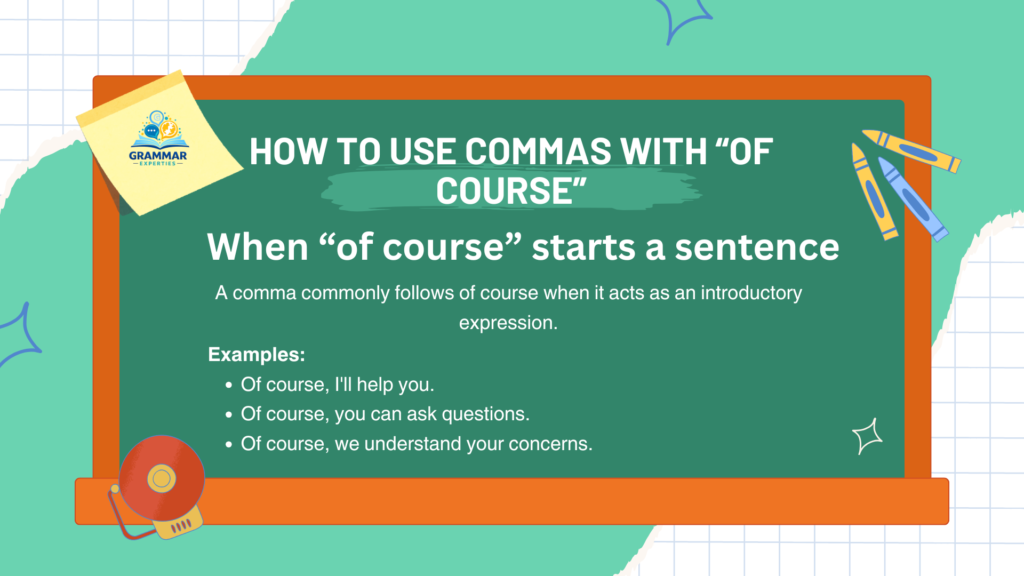
When “of course” starts a sentence
A comma commonly follows of course when it acts as an introductory expression.
Examples:
- Of course, I’ll help you.
- Of course, you can ask questions.
- Of course, we understand your concerns.
When “of course” appears in the middle
When it interrupts a sentence, commas can separate it from the rest of the sentence.
Examples:
- She is, of course, a talented writer.
- The answer is, of course, correct.
- We can, of course, discuss this tomorrow.
When “of course” appears at the end
It can also be placed at the end of a sentence.
Examples:
- I’ll help you, of course.
- She knew about it, of course.
- You can join us, of course.
Don’t assume that every occurrence requires exactly the same punctuation. The comma depends on how of course functions within the sentence.
Common Mistakes With “Of Course”
Mistake 1: Combining the words
❌ Ofcourse, I’ll be there.
✅ Of course, I’ll be there.
This is the main spelling error to avoid.
Mistake 2: Treating “Of Course” as one word because it sounds like one
When people speak quickly, of course can sound almost like a single word.
However, spoken pronunciation doesn’t change standard spelling.
Remember:
Sounding connected ≠ being written together.
Mistake 3: Using unnecessary commas
❌ Of course, I’ll, finish the work.
✅ Of course, I’ll finish the work.
Don’t place a comma between the subject and verb unless the sentence structure requires it.
Mistake 4: Overusing the phrase
Correct spelling isn’t the only consideration. Sometimes of course can make a statement sound unnecessarily obvious.
For example:
“Of course, you should follow the instructions.”
Depending on the context, this could sound slightly dismissive.
A more neutral alternative might be:
“You should follow the instructions.”
Good writing considers both grammar and tone.
Real-Life Case Study: A Small Error in a Professional Email
Consider a student named Emma who is applying for a summer internship. After receiving an interview invitation, she quickly writes a response:
Thank you for inviting me to the interview. Ofcourse, I would be happy to attend on Tuesday. I look forward to meeting the team.
The message is understandable, but Ofcourse is incorrectly written as one word.
Before sending the email, Emma reviews it and notices the error. She changes it to:
Thank you for inviting me to the interview. Of course, I would be happy to attend on Tuesday. I look forward to meeting the team.
The revised version is grammatically cleaner and follows standard English spelling.
This example doesn’t mean that one spelling error will automatically ruin an application. However, professional communication often involves many small details. Correct spelling, punctuation, formatting, and word choice all contribute to a polished message.
The same lesson applies to students writing assignments, bloggers publishing articles, employees sending emails, and businesses communicating with customers.
A useful proofreading habit is to search your document for words and phrases that you frequently confuse. If ofcourse is one of your recurring mistakes, simply search for it before publishing and replace it with of course.
A few seconds of proofreading can prevent an avoidable spelling error.
2025–2026 Data: Why Writing Accuracy Matters
Professional communication depends on clear writing
Written communication remains an important part of modern work. Professionals communicate through emails, reports, documents, presentations, chat messages, and other written channels.
A 2025 Grammarly study involving more than 450 professional workers examined workplace communication and reported a 20% reduction in errors among users with access to Grammarly’s writing assistance.
This research does not specifically measure the phrase of course. Instead, it demonstrates a broader point: writing accuracy is a measurable part of effective workplace communication.
Why small spelling mistakes are worth fixing
A single mistake such as ofcourse might appear insignificant. Nevertheless, learning common spelling distinctions can improve your overall writing.
Accurate writing helps you:
- communicate ideas more clearly
- create professional emails
- produce polished academic work
- build reader confidence
- avoid distracting spelling errors
Therefore, learning the correct form of everyday expressions is a useful part of improving English.
Step-by-Step Guide to Remember “Of Course”
Step 1: Think about the meaning
If you mean:
- certainly
- naturally
- yes
- as expected
then you may need of course.
Step 2: Keep the words separate
Write:
of course
Not:
ofcourse
Step 3: Check punctuation
Beginning:
Of course, I’ll help.
Middle:
She will, of course, help.
End:
She will help, of course.
Step 4: Proofread
Search your document for ofcourse before you submit or publish it.
Replace it with:
of course
This simple habit can help eliminate the mistake from your writing.
Examples of “Of Course” in Different Situations
In everyday conversation
- Of course, I’ll come.
- Of course you can.
- Of course not!
- Of course I remember.
- Of course, that’s okay.
In professional communication
- Of course, we can arrange another meeting.
- We would, of course, be happy to assist you.
- Of course, we can review the proposal.
- The schedule can, of course, be adjusted.
In academic writing
- The findings were, of course, influenced by several factors.
- Of course, additional research is necessary.
- The results should, of course, be interpreted carefully.
In text messages
- Of course!
- Of course I will.
- Of course not!
- Yeah, of course.
The situation may change, but the spelling stays the same: of course.
Mini Quiz: Of Course or Ofcourse
1. The Spelling Showdown
Which spelling is correct?
A) Ofcourse
B) Of course
C) Of-course
D) OfCourse
✅ Answer: B) Of course
2. One Word or Two?
How many words are in the correct expression?
A) One
B) Two
C) Three
D) Four
✅ Answer: B) Two
3. Pick the Perfect Sentence
Which sentence is correct?
A) Ofcourse, I’ll help you.
B) Of course, I’ll help you.
C) Of-course, I’ll help you.
D) Of Course, I’ll help you.
✅ Answer: B) Of course, I’ll help you.
4. Meaning Match
What does “of course” usually mean?
A) Certainly
B) Rarely
C) Maybe
D) Never
✅ Answer: A) Certainly
5. Spot the Sneaky Error
Which sentence contains a spelling mistake?
A) Of course, she knows.
B) I will help you, of course.
C) Ofcourse, he agreed.
D) Of course not!
✅ Answer: C) Ofcourse, he agreed.
6. Permission Please!
Which response correctly gives permission?
“Can I use your phone?”
A) Ofcourse!
B) Of course!
C) Of-course!
D) Of Course!
✅ Answer: B) Of course!
7. Negative Power
What does “Of course not!” usually express?
A) A strong no
B) A weak yes
C) Uncertainty
D) A question
✅ Answer: A) A strong no
8. Comma Challenge
Choose the correctly punctuated sentence.
A) Of course I’ll help.
B) Of course, I’ll help.
C) Of, course I’ll help.
D) Of course I’ll, help.
✅ Answer: B) Of course, I’ll help.
9. Middle-Man Mystery
Which sentence correctly uses of course in the middle?
A) She is, of course, talented.
B) She is, ofcourse, talented.
C) She is of-course, talented.
D) She is of Course talented.
✅ Answer: A) She is, of course, talented.
10. End Game
Which sentence correctly places of course at the end?
A) I’ll help you ofcourse.
B) I’ll help you, of course.
C) I’ll help you of-course.
D) I’ll help you, of Course.
✅ Answer: B) I’ll help you, of course.
11. Why the Confusion?
Why do people often write “ofcourse” incorrectly?
A) It is an old spelling
B) It sounds connected in fast speech
C) Dictionaries prefer it
D) It is a British spelling
✅ Answer: B) It sounds connected in fast speech
12. Formal Writing Test
Which sentence is appropriate for a professional email?
A) Ofcourse, I’ll attend!!!
B) Of course, I would be happy to attend.
C) Of-course, I’ll totally come.
D) Of Course, I come maybe.
✅ Answer: B) Of course, I would be happy to attend.
13. Meaning Detective
In this sentence, what does of course mean?
“She studied hard and, of course, passed the exam.”
A) Unexpectedly
B) Naturally or as expected
C) Rarely
D) Accidentally
✅ Answer: B) Naturally or as expected
14. Capitalization Check
Which is correct in the middle of a normal sentence?
A) Of Course
B) Ofcourse
C) of course
D) Of-course
✅ Answer: C) of course
15. Grammar Guru
Which statement is true?
A) “Ofcourse” is the standard form.
B) “Of course” is written as two words.
C) “Of course” must always be hyphenated.
D) “Ofcourse” is preferred in formal writing.
✅ Answer: B) “Of course” is written as two words.
16. Fill the Space!
Complete the sentence:
“_____ , you can join us.”
A) Ofcourse
B) Of-course
C) Of course
D) OfCourse
✅ Answer: C) Of course
17. Quick Fix
Correct this sentence:
“Ofcourse, I remember you.”
A) Of course, I remember you.
B) Of-course, I remember you.
C) Of Course, I remember you.
D) Ofcourse, I remember you.
✅ Answer: A) Of course, I remember you.
18. Which One Doesn’t Belong?
Which option is incorrect?
A) Of course
B) Of course not
C) Ofcourse
D) Of course!
✅ Answer: C) Ofcourse
19. Everyday English Challenge
Which reply sounds natural?
“Can I ask you a question?”
A) Ofcourse
B) Of course!
C) Of-course!
D) Of Course!
✅ Answer: B) Of course!
20. The Space Saver?
Should you remove the space in “of course”?
A) Yes
B) No
C) Only in emails
D) Only in text messages
✅ Answer: B) No
21. Choose the Professional Version
Which sentence is best written?
A) Ofcourse, we can discuss the proposal.
B) Of course, we can discuss the proposal.
C) Of-course, we can discuss the proposal.
D) Of Course, we can discuss the proposal.
✅ Answer: B) Of course, we can discuss the proposal.
22. True or False?
“Ofcourse” is the standard English spelling of the phrase meaning “certainly.”
A) True
B) False
✅ Answer: B) False
23. True or False?
“Of course” can be used in both casual and formal English.
A) True
B) False
✅ Answer: A) True
24. Final Boss Battle
Which sentence is completely correct?
A) Ofcourse, she will, of course attend.
B) Of course, she will, of course, attend.
C) Of Course, she will ofcourse attend.
D) Of-course, she will attend.
✅ Answer: B) Of course, she will, of course, attend.
25. The Golden Rule
What’s the easiest rule to remember?
A) Write ofcourse as one word.
B) Always hyphenate it.
C) Remember OF + COURSE = OF COURSE.
D) Capitalize both words.
✅ Answer: C) Remember OF + COURSE = OF COURSE
Frequently Asked Questions
Q1:Is “ofcourse” correct?
No. The standard spelling is of course, written as two words.
Q2:Is “of course” one word or two?
It is two words: of course.
Q3:What does “of course” mean?
It can mean certainly, naturally, yes, or as expected, depending on the context.
Q4:Is “of course” grammatically correct?
Yes. Of course is a standard English expression that can function as an adverbial expression in a sentence.
Q5:Should “of course” have a comma?
It depends on its position and function.
For example:
Of course, I’ll help.
But:
She will, of course, help.
The punctuation changes according to sentence structure.
Q6:Can I use “of course” in formal writing?
Yes. The expression is acceptable in professional and formal writing. However, use it when it adds meaning rather than simply filling space.
Q7:Why do people write “ofcourse”?
The mistake often occurs because the phrase can sound like one unit when spoken quickly. However, standard written English keeps the words separate.
Q8:What is the difference between “of course” and “ofcourse”?
Of course is the correct standard form. Ofcourse is a common spelling error.
Conclusion: Of Course or Ofcourse?
So, of course or ofcourse which is correct?
The answer is straightforward: of course is correct, and ofcourse is not the standard spelling.
Use of course when you mean certainly, naturally, yes, or as expected. Most importantly, remember that the expression contains two separate words.
Of course ✅
Ofcourse ❌
Whether you’re writing a school assignment, professional email, blog article, application, or casual message, choosing the correct form will make your writing more accurate and polished.
Keep improving your English by exploring more confusing words, spelling mistakes, and grammar guides on Grammar Experties.
Explore more easy grammar lessons and improve your English with Grammar Expertise
References:

Maimoona Mughal is an English grammar enthusiast dedicated to simplifying confusing words, grammar rules, and vocabulary through clear, accurate, and learner-friendly content that helps readers write and communicate with confidence.