Have you ever written “a big congratulations” and then stopped to wonder, Is this actually correct English? You’re not alone. The expression appears frequently in messages, social media posts, announcements, greeting cards, and everyday conversations.
The a big congratulations meaning is simple: it is a warm and enthusiastic way to praise someone for an achievement, success, or happy event. However, the grammar behind the phrase is more interesting because “congratulations” is normally used as a plural expression, while “a” is normally associated with singular countable nouns.
So, is “a big congratulations” correct? The phrase is understandable and widely used, particularly in informal English, but “big congratulations,” “many congratulations,” or simply “congratulations” are safer choices when you want polished, standard wording.
This guide explains the meaning, grammar, correct usage, examples, common mistakes, alternatives, and the difference between “a big congratulations” and “big congratulations.”
What Does “A Big Congratulations” Mean?
A Big Congratulations Meaning
“A big congratulations” means a very warm, enthusiastic, or emphatic expression of praise and good wishes toward someone who has achieved something or experienced a happy event.
The word “big” doesn’t describe physical size. Instead, it strengthens the emotional meaning of congratulations.
For example:
A big congratulations to Sarah on her promotion!
This means:
Congratulations, Sarah! Your promotion is a wonderful achievement, and I’m very happy for you.
Other examples include:
- A big congratulations to the winning team.
- A big congratulations on your graduation.
- A big congratulations to everyone who passed the exam.
- A big congratulations to the newly married couple.
- A big congratulations on your new job.
In each example, “big” adds enthusiasm and warmth.
What Does “Big” Add to the Expression?
Compare these sentences:
Congratulations on your promotion.
Big congratulations on your promotion!
The first is neutral and perfectly natural. The second sounds more enthusiastic.
You can think of “big” as an emotional intensifier. Similar expressions include:
- huge congratulations
- heartfelt congratulations
- warm congratulations
- sincere congratulations
- many congratulations
- massive congratulations
For example:
Huge congratulations on completing your degree!
This communicates stronger excitement than a simple:
Congratulations on completing your degree!
Is “A Big Congratulations” the Same as “Big Congratulations”?
The intended meaning is almost identical, but the grammatical structure is different.
Big congratulations is a straightforward expression:
Big congratulations to Emma on her achievement!
A big congratulations is also easily understood:
A big congratulations to Emma on her achievement!
However, some readers may find the second version less conventional because “congratulations” normally appears in its plural form.
Therefore, if you’re writing something formal or want to avoid any grammatical debate, “big congratulations” is the safer option.
Is “A Big Congratulations” Grammatically Correct?
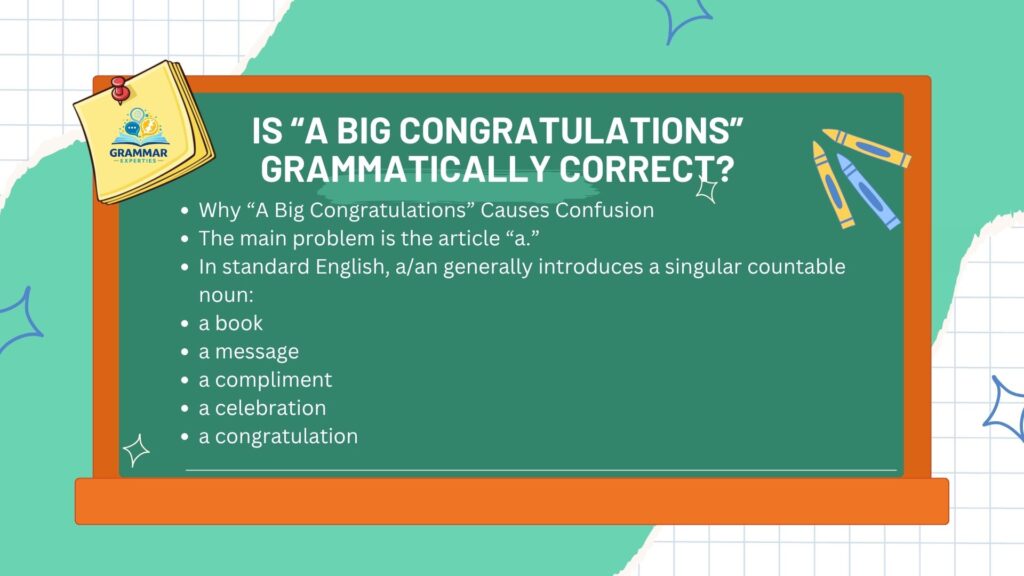
Why “A Big Congratulations” Causes Confusion
The main problem is the article “a.”
In standard English, a/an generally introduces a singular countable noun:
- a book
- a message
- a compliment
- a celebration
- a congratulation
But congratulations is normally used as a plural expression when someone is being praised or wished well.
For example:
Congratulations on your promotion!
Congratulations on your graduation!
Congratulations to the entire team!
This is why some grammar-focused readers question:
A big congratulations to you!
The phrase combines a singular article with the familiar plural form congratulations.
Why Is the Phrase Still Common?
Language is not always as neat as a grammar formula.
People sometimes treat “a big congratulations” as one complete congratulatory expression, similar to saying “a big thank-you” or “a warm welcome.”
That helps explain why the phrase appears naturally in informal speech, announcements, social media, and personal messages.
So it is useful to distinguish between grammatical possibility, conventional usage, and stylistic preference.
A phrase can be widely understood without being the best choice for every context.
What Is the Safest Alternative?
If you are unsure, simply remove “a.”
Instead of:
A big congratulations to John!
Use:
Big congratulations to John!
Or use the most universally familiar version:
Congratulations to John!
For formal writing, you could also write:
Many congratulations to John on his achievement.
These alternatives eliminate the article issue while keeping the intended meaning.
“Big Congratulations” vs “A Big Congratulations”
Which Expression Is More Natural?
For most informal situations, “big congratulations” is the cleaner choice.
| Expression | Meaning | Naturalness | Best Context |
|---|---|---|---|
| Congratulations | Standard praise and good wishes | Excellent | Almost any situation |
| Big congratulations | Strong, enthusiastic praise | Very natural | Casual and celebratory |
| A big congratulations | Emphatic congratulations | Understandable but debated | Informal messages |
| Many congratulations | Warm congratulations | Very natural | Formal and personal |
| Huge congratulations | Very enthusiastic praise | Natural | Casual and social |
| A big congratulation | Singular expression of praise | Uncommon | Rarely needed |
If your goal is clear, polished English, “big congratulations” is generally preferable to “a big congratulations.”
Examples of “Big Congratulations”
Here are natural examples:
Big congratulations to James on his promotion!
Big congratulations to everyone who passed the examination.
Big congratulations on your new business!
Big congratulations to the winning team.
Big congratulations on completing your master’s degree.
These examples work well in friendly conversations, social media captions, group announcements, and informal workplace communication.
Examples of “A Big Congratulations”
You may also encounter:
A big congratulations to everyone who participated.
A big congratulations to the bride and groom.
A big congratulations to our new manager.
A big congratulations on your fantastic achievement.
The meaning is clear in all four examples. However, if you are writing for a formal publication, academic audience, or professional organization, you may want to replace the construction with “congratulations,” “big congratulations,” or “many congratulations.”
How to Use “Congratulations” Correctly
Use “Congratulations on” for an Achievement
The preposition “on” commonly introduces the achievement, event, or reason for the congratulations.
Examples:
- Congratulations on your promotion.
- Congratulations on passing the exam.
- Congratulations on your graduation.
- Congratulations on your wedding.
- Congratulations on winning the competition.
- Congratulations on your new job.
A useful pattern is:
Congratulations on + achievement/event
For example:
Congratulations on getting your dream job!
Use “Congratulations to” for the Person
Use “to” when you want to identify the person or group receiving the congratulations.
Examples:
- Congratulations to Maria!
- Congratulations to the entire team.
- Congratulations to the winners.
- Congratulations to our new graduates.
A simple pattern is:
Congratulations to + person/group
Use Both “To” and “On”
You can combine the two patterns:
Congratulations to Maria on her promotion.
Here, “to Maria” identifies the recipient, while “on her promotion” identifies the achievement.
More examples:
Congratulations to David on his graduation.
Congratulations to the team on winning the championship.
Congratulations to Lisa on her new position.
This is one of the easiest structures to remember.
When Should You Use “A Big Congratulations”?
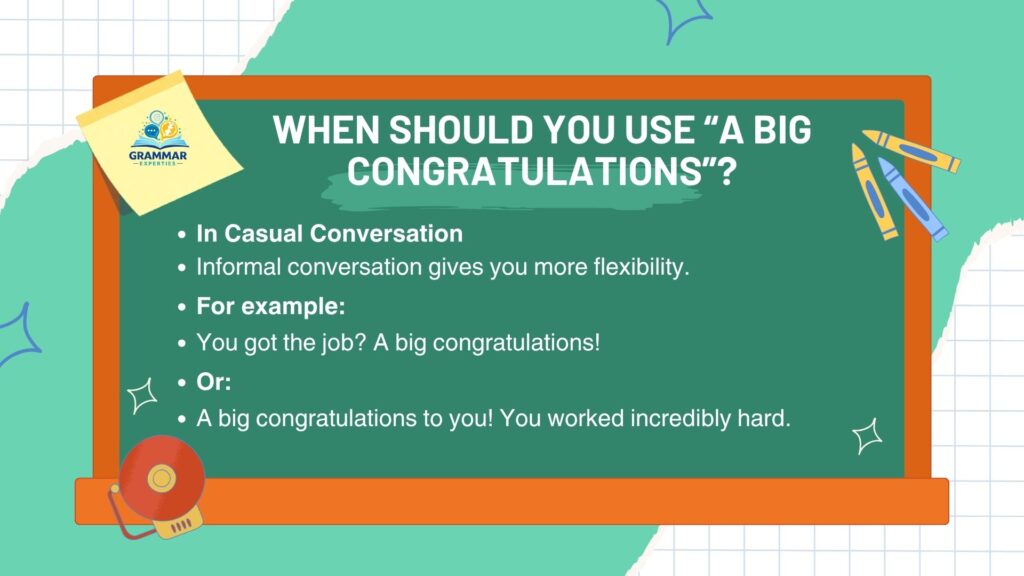
In Casual Conversation
Informal conversation gives you more flexibility.
For example:
You got the job? A big congratulations!
Or:
A big congratulations to you! You worked incredibly hard.
The phrase sounds friendly and enthusiastic in this context.
In Social Media Posts
Social media is another setting where expressive language is common.
For example:
A big congratulations to our amazing team for reaching 10,000 customers!
However, you could make the sentence shorter:
Big congratulations to our amazing team for reaching 10,000 customers!
Both are understandable, but the second avoids the article issue.
In Professional Emails
Professional writing benefits from clear and conventional expressions.
Instead of:
A big congratulations to Sarah on her promotion!
You could write:
Congratulations to Sarah on her well-deserved promotion.
Or:
Many congratulations to Sarah on her promotion.
These versions sound polished without losing warmth.
In Academic and Formal Writing
Formal writing generally favors conventional wording.
For example:
Congratulations to the research team on this significant achievement.
is more appropriate than:
A big congratulations to the research team!
The first sentence is professional and restrained. The second sounds more like a social-media announcement.
A Real-Life Example: Choosing the Right Congratulatory Phrase
Imagine that your colleague, Sarah, has just been promoted to department manager after five years of hard work.
You want to congratulate her in a company email.
Your first draft is:
A big congratulations to Sarah on her promotion!
The message is friendly and everyone will understand it. However, because you’re sending it to colleagues and managers, you decide to make it slightly more polished.
You change it to:
Congratulations to Sarah on her well-deserved promotion!
That version is concise, natural, and professional.
Suppose you want to sound warmer:
Many congratulations to Sarah on her well-deserved promotion. We’re delighted to see her take on this new role.
Now imagine you’re posting the same message on the company’s social-media page. A more energetic version could be:
Big congratulations to Sarah on her promotion! We’re excited to see her lead the team in this next chapter.
All three messages communicate essentially the same idea. The difference is tone and context.
This illustrates an important principle of practical grammar: the question isn’t always whether a phrase can be understood. You should also consider whether it sounds natural for your audience and situation.
A phrase that works perfectly well in a friendly Facebook post may not be the best choice for an academic letter or formal business announcement.
2025–2026 Usage and Evidence Snapshot
What Current Dictionary Evidence Shows
There isn’t a reliable public statistic that tells us exactly what percentage of English speakers use “a big congratulations” instead of “big congratulations.” It would be misleading to invent a percentage.
However, current dictionary evidence provides a strong grammatical baseline.
Cambridge Dictionary currently labels “congratulations” as a plural phrase and gives examples such as “Congratulations on your engagement!” and “Congratulations on your new job!”
Cambridge also distinguishes the noun “congratulation” from the plural expression “congratulations.” It notes that congratulation can refer to the act of congratulating someone, while the plural form is the normal expression used when congratulating someone.
Dictionary.com likewise describes congratulations as a plural noun expressing pleasure or joy and provides contemporary examples from 2026 usage.
What This Means for 2026 Writing
The practical conclusion is straightforward:
- “Congratulations” remains the standard expression.
- “Big congratulations” works naturally as an informal intensification.
- “A big congratulations” is understandable and appears in modern informal English.
- For highly polished writing, removing “a” is the safest approach.
In other words, current usage doesn’t justify claiming that “a big congratulations” is universally wrong, but standard dictionary treatment does support treating “congratulations” as the established plural expression.
Common Mistakes With “Congratulations”
Mistake 1: Writing “Congradulations”
The correct spelling is:
Congratulations
Not:
Congradulations
The pronunciation can make the spelling confusing, but the standard spelling is congratulations.
Mistake 2: Saying “Congratulation!” as the Normal Expression
The singular noun congratulation does exist, but it is not normally the form used when directly congratulating someone.
For example:
❌ Congratulation on your promotion!
Better:
✅ Congratulations on your promotion!
The plural expression is the conventional choice.
Mistake 3: Using “For” Instead of “On”
A common learner error is:
❌ Congratulations for your promotion.
The more natural standard construction is:
✅ Congratulations on your promotion.
Mistake 4: Using “On” Before the Person
Avoid:
❌ Congratulations on Sarah.
Use:
✅ Congratulations to Sarah.
If you mention the achievement too:
✅ Congratulations to Sarah on her promotion.
Mistake 5: Overusing Intensifiers
A formal message doesn’t always need words such as massive, huge, big, amazing, incredible, wonderful, fantastic, brilliant, and tremendous all at once.
Instead of:
A massive, huge, amazing congratulations on your incredible achievement!
Simply write:
Congratulations on your achievement!
Clear writing is often more effective than exaggerated wording.
Better Alternatives to “A Big Congratulations”
Casual Alternatives
For a friendly message, try:
- Big congratulations!
- Huge congratulations!
- Massive congratulations!
- Well done!
- Congratulations! You did it!
- Congratulations on this amazing achievement!
Example:
Huge congratulations on passing your driving test!
Professional Alternatives
For a workplace email or formal announcement:
- Congratulations on your achievement.
- Many congratulations on your promotion.
- Congratulations on this well-deserved success.
- Please accept my congratulations on your appointment.
- We extend our congratulations to the entire team.
Example:
Many congratulations on your promotion. I wish you continued success in your new role.
Warm Personal Alternatives
For friends and family:
- Heartfelt congratulations!
- Warmest congratulations!
- Congratulations and best wishes!
- Congratulations on this wonderful milestone!
- So happy for you congratulations!
These options let you express emotion without relying on the debated “a big congratulations” construction.
“Congratulations On” vs “Congratulations To”
One of the easiest ways to improve your congratulatory messages is to understand the difference between on and to.
| Structure | Purpose | Example |
|---|---|---|
| Congratulations to + person | Identifies recipient | Congratulations to Emma. |
| Congratulations on + achievement | Identifies achievement | Congratulations on your promotion. |
| Congratulations to + person + on + achievement | Gives both | Congratulations to Emma on her promotion. |
Remember:
Person = to
Achievement = on
For example:
Congratulations to John on his graduation.
This simple rule will help you avoid many common mistakes.
“Congratulation” vs “Congratulations”
Is “Congratulation” a Real Word?
Yes.
The singular noun congratulation exists. Cambridge defines it as the act of congratulating someone and also lists congratulations as the plural expression used to congratulate someone.
For example:
He sent her a note of congratulation.
This is grammatically possible, but it isn’t the usual everyday expression.
Why Do We Usually Say “Congratulations”?
When you directly praise someone for an achievement, English conventionally uses:
Congratulations!
rather than:
Congratulation!
Therefore, even though the singular noun exists, English learners should generally remember “congratulations” as the standard congratulatory expression.
Is “A Big Congratulations” Formal or Informal?
The safest classification is informal to conversational.
It can work in:
- text messages
- social media
- greeting cards
- friendly announcements
- casual conversations
- celebratory posts
For more formal settings, prefer:
- Congratulations
- Many congratulations
- Sincere congratulations
- Warm congratulations
- Congratulations on your achievement
The important point is not that “a big congratulations” is meaningless or incomprehensible. It clearly communicates its intended meaning. The issue is that the construction is less conventional than alternatives that avoid the singular article.
Quick Step-by-Step Guide to Choosing the Right Phrase
Step 1: Identify Your Audience
Ask yourself:
Am I writing to a friend, colleague, customer, student, teacher, or official audience?
A casual audience gives you more freedom.
Step 2: Decide How Enthusiastic You Want to Sound
Neutral:
Congratulations!
Friendly:
Big congratulations!
Very enthusiastic:
Huge congratulations!
Formal and warm:
Many congratulations!
Step 3: Add the Person if Necessary
Use to:
Congratulations to Ali.
Step 4: Add the Achievement
Use on:
Congratulations on your promotion.
Step 5: Combine Them
The complete structure is:
Congratulations to Ali on his promotion.
This is natural, clear, and suitable for almost any audience.
Quick Checklist
Before sending your congratulatory message, check these points:
- Did I spell congratulations correctly?
- Did I use on before the achievement?
- Did I use to before the person?
- Am I using “a big congratulations” in an informal enough setting?
- Would “big congratulations” sound cleaner?
- Would “many congratulations” suit a formal audience better?
- Am I keeping the message concise and sincere?
If you can answer these questions, your message will usually sound natural.
Mini Quiz: A Big Congratulations
1. Which expression is the safest standard way to congratulate someone?
A) A congratulations
B) Congratulations!
C) A congratulation
D) Congratulation!
Answer: B) Congratulations!
2. Which sentence is grammatically correct?
A) Congratulations for your promotion.
B) Congratulations on your promotion.
C) Congratulations at your promotion.
D) Congratulations with your promotion.
Answer: B) Congratulations on your promotion.
3. Which sentence correctly identifies the person receiving congratulations?
A) Congratulations on Maria.
B) Congratulations at Maria.
C) Congratulations to Maria.
D) Congratulations for Maria.
Answer: C) Congratulations to Maria.
4. Which phrase is generally cleaner than “a big congratulations”?
A) Big congratulations!
B) A congratulations!
C) One congratulations!
D) A congratulation!
Answer: A) Big congratulations!
5. What does “big” add to “big congratulations”?
A) Doubt
B) Anger
C) Emphasis and enthusiasm
D) Confusion
Answer: C) Emphasis and enthusiasm
6. Choose the correct sentence.
A) Congratulations to Emma on her promotion.
B) Congratulations on Emma to her promotion.
C) Congratulations at Emma for her promotion.
D) Congratulations with Emma on her promotion.
Answer: A) Congratulations to Emma on her promotion.
7. Which spelling is correct?
A) Congradulations
B) Congratulaitons
C) Congratulations
D) Congratulashions
Answer: C) Congratulations
8. Which phrase works well in a professional email?
A) Many congratulations on your promotion.
B) A congratulations for your promotion.
C) Big congratulation on your promotion.
D) One big congratulation!
Answer: A) Many congratulations on your promotion.
9. Which expression sounds natural for a casual social-media post?
A) Big congratulations to our team!
B) A congratulations to our team!
C) A big congratulation to our team!
D) One congratulations to our team!
Answer: A) Big congratulations to our team!
10. Fill in the blank: “Congratulations ___ your graduation!”
A) to
B) on
C) at
D) with
Answer: B) on
11. If you’re unsure which congratulatory phrase to use, which is the safest choice?
A) A big congratulations
B) A congratulation
C) Congratulations!
D) One congratulations
Answer: C) Congratulations!
12. Which sentence is correct?
A) Congratulations on your new job!
B) Congratulations at your new job!
C) Congratulations for your new job!
D) Congratulations with your new job!
Answer: A) Congratulations on your new job!
13. Which phrase sounds polished and professional?
A) Congratulations on this achievement.
B) A big congratulation for this achievement.
C) One congratulations on this achievement.
D) Congratulation at this achievement.
Answer: A) Congratulations on this achievement.
14. Which sentence correctly uses “to”?
A) Congratulations to the winners!
B) Congratulations on the winners!
C) Congratulations at the winners!
D) Congratulations with the winners!
Answer: A) Congratulations to the winners!
15. Which expression shows especially strong enthusiasm?
A) Tiny congratulations!
B) Huge congratulations!
C) Little congratulations!
D) Short congratulations!
Answer: B) Huge congratulations!
16. Which word is normally used when directly congratulating someone?
A) Congratulation
B) Congratulations
C) Congratulating
D) Congratulate
Answer: B) Congratulations
17. Choose the best workplace announcement.
A) Congratulations to Sarah on her promotion.
B) Congratulations on Sarah to her promotion.
C) A congratulations Sarah for promotion.
D) Congratulation to Sarah on her promotion.
Answer: A) Congratulations to Sarah on her promotion.
18. Which phrase is a traditional way to express warm congratulations?
A) Many congratulations!
B) Much congratulation!
C) A congratulations!
D) One congratulations!
Answer: A) Many congratulations!
19. In “Big congratulations to Ali on his success,” what does “to Ali” identify?
A) The achievement
B) The reason
C) The recipient
D) The location
Answer: C) The recipient
20. In “Big congratulations to Ali on his success,” what does “on his success” identify?
A) The recipient
B) The achievement or occasion
C) The speaker
D) The location
Answer: B) The achievement or occasion
21. Which sentence is most natural?
A) Congratulations on passing your exam!
B) Congratulations at passing your exam!
C) Congratulations to passing your exam!
D) Congratulations with passing your exam!
Answer: A) Congratulations on passing your exam!
22. Which phrase is best for a formal graduation card?
A) Many congratulations on your graduation.
B) A big congratulation for graduation.
C) One congratulations at graduation.
D) A congratulations on graduation.
Answer: A) Many congratulations on your graduation.
23. Which sentence uses “a big congratulations” in an informal way?
A) A big congratulations to everyone who participated!
B) A big congratulations on your exam!
C) A big congratulations at the winners!
D) A big congratulations for Maria on!
Answer: A) A big congratulations to everyone who participated!
24. Which option is generally preferred in careful formal writing?
A) A big congratulations!
B) Big congratulations!
C) A big congratulation!
D) One big congratulation!
Answer: B) Big congratulations!
25. What is the main lesson about “a big congratulations”?
A) It is always grammatically impossible.
B) “Congratulations” should always be singular.
C) It can be understood informally, but “big congratulations” or simply “congratulations” is usually cleaner.
D) “Congratulation” is always preferred.
Answer: C) It can be understood informally, but “big congratulations” or simply “congratulations” is usually cleaner.
FAQs About “A Big Congratulations”
Q1:Is “a big congratulations” grammatically correct?
“A big congratulations” is understandable and used in informal modern English, but it isn’t the safest construction for formal writing. The main concern is that “a” is singular while “congratulations” is conventionally used as a plural expression. “Big congratulations” or simply “congratulations” avoids that issue.
Q2:What does “a big congratulations” mean?
It means a warm, enthusiastic, or emphatic expression of praise and good wishes. The word “big” adds emotional emphasis.
For example:
A big congratulations to everyone who completed the project!
Q3:Is “big congratulations” correct?
Yes. “Big congratulations” is a natural informal expression.
For example:
Big congratulations to Maria on her promotion!
It is especially suitable for friendly messages, social posts, announcements, and celebrations.
Q4:Should I say “a big congratulations” or “big congratulations”?
If you want the safer and cleaner option, choose:
Big congratulations!
If you want the most universally accepted expression, simply say:
Congratulations!
Q5:Is “a big congratulation” correct?
The singular noun congratulation exists, so “a big congratulation” is grammatically possible. However, it sounds unusual in everyday English.
Most people would naturally write:
Big congratulations!
rather than:
A big congratulation!
Q6:Can I use “a big congratulations” in a formal email?
You can, and readers will understand it, but a more polished choice is:
Many congratulations on your promotion.
or:
Congratulations on your well-deserved promotion.
These alternatives are more conventional in professional communication.
Q7:Should I say “congratulations on” or “congratulations for”?
Use “congratulations on” when you identify the achievement or event.
Congratulations on your graduation.
Congratulations on your new job.
“Congratulations for” can occur in English, but “congratulations on” is the standard pattern for the achievement itself.
Q8:Can I say “congratulations to” someone?
Yes.
Use “congratulations to” when identifying the person receiving the congratulations.
Congratulations to Sarah!
You can combine it with “on”:
Congratulations to Sarah on her promotion.
Final Takeaway: Is “A Big Congratulations” Correct?
The phrase “a big congratulations” is easy to understand and appears in informal modern English, but it can sound grammatically awkward because “a” is singular while “congratulations” normally functions as a plural expression.
If you want the safest wording, choose:
Congratulations!
For a more enthusiastic informal tone:
Big congratulations!
For a warm, polished tone:
Many congratulations!
And when you mention the person and achievement, remember:
Congratulations to [person] on [achievement].
For example:
Congratulations to Emma on her promotion!
So, while “a big congratulations” isn’t likely to confuse your reader, “big congratulations” or simply “congratulations” is generally the better choice when you want clear, natural, and polished English.
Explore more easy grammar lessons and improve your English with Grammar Expertise
References
Cambridge Dictionary — Congratulations
Dictionary.com — Congratulations

Maimoona Mughal is an English grammar enthusiast dedicated to simplifying confusing words, grammar rules, and vocabulary through clear, accurate, and learner-friendly content that helps readers write and communicate with confidence.