Have you ever seen someone write “toxicated” and wondered whether it means drunk, poisoned, or simply toxic? If so, you’re not alone. The toxicated meaning can be confusing because the word resembles both toxic and intoxicated, but those words don’t work in exactly the same way.
The short answer is that “toxicated” is uncommon and context-dependent in modern English. Some informal sources use it as a shortened form of intoxicated, while toxicated can also occur as the past participle of the rare verb toxicate. For everyday English, however, intoxicated, poisoned, or affected by a toxin is usually clearer.
This guide explains the toxicated meaning, its origin, how it is used, whether it is standard English, and how it differs from related words.
What Does Toxicated Mean?
The meaning of toxicated depends heavily on context.
In informal online usage, people sometimes use toxicated as a shortened or altered form of intoxicated, meaning affected by alcohol or drugs. Other uses connect it with toxic exposure or poisoning.
That creates an important distinction: someone searching for toxicated meaning may actually be looking for the meaning of intoxicated.
Toxicated meaning in simple English
In simple terms, toxicated may be understood as:
Affected by a toxic substance or, informally, under the influence of alcohol or drugs.
However, this isn’t the best wording for most modern communication.
For example:
- Informal: “He was toxicated after the party.”
- Standard: “He was intoxicated after the party.”
The second sentence is much more natural and immediately understandable.
Is “toxicated” a real English word?
There isn’t one simple yes-or-no answer.
The form toxicated does exist as the past participle of the rare verb toxicate. Dictionary-style sources define toxicate in a specialized sense involving the metabolism of a drug or compound into a toxic metabolite.
At the same time, many people encounter toxicated online as an informal substitute for intoxicated. That use should not automatically be treated as standard English.
Therefore, if you’re writing an essay, professional email, article, academic assignment, or formal document, it’s safer to choose a more established word.
Is “toxicated” slang?
It can be used as slang, particularly when someone creates it by shortening intoxicated.
For example:
“We got toxicated last night.”
Here, the writer almost certainly means:
“We got intoxicated last night.”
This informal usage appears in slang and casual online writing, but it shouldn’t be confused with the specialized verb toxicate.
Toxicated vs. Intoxicated: What’s the Difference?
The most common confusion is between toxicated and intoxicated.
Intoxicated is the standard and widely recognized adjective. Cambridge defines intoxicated as being affected by alcohol or another drug to the point of losing some control over actions or behavior. It can also describe someone who is extremely excited or exhilarated.
Toxicated meaning vs. intoxicated meaning
| Word | Main meaning | Standard modern usage | Example |
|---|---|---|---|
| Toxicated | Affected by a toxin; sometimes informal “intoxicated” | Rare/context-dependent | The term appeared in a specialized discussion. |
| Intoxicated | Under the influence of alcohol or drugs | Yes | He was intoxicated after drinking. |
| Toxic | Poisonous or harmful | Yes | The chemical is toxic. |
| Poisoned | Harmed by a poisonous substance | Yes | The food was contaminated and several people were poisoned. |
The practical rule is simple:
Use “intoxicated” for alcohol or drug impairment. Use “toxic” for something harmful or poisonous. Use “poisoned” when someone has been affected by poison.
When should you use “intoxicated”?
Use intoxicated when you mean that someone is under the influence of alcohol or drugs.
Examples:
- The driver appeared to be intoxicated.
- She was intoxicated and couldn’t operate the vehicle safely.
- The police suspected that he was intoxicated.
Cambridge also recognizes a figurative meaning in which someone can be “intoxicated” by success, excitement, or another powerful feeling.
When should you use “toxic”?
Use toxic to describe something harmful, poisonous, or damaging.
Examples:
- The laboratory stores toxic chemicals.
- The factory released toxic fumes.
- Some household products can contain toxic substances.
Notice the difference:
The chemical is toxic.
But:
The person is intoxicated.
Changing one word changes the meaning.
The Origin of Toxicated and Related Words
Understanding the history of these words helps explain why they look so similar.
The deeper history leads back to the idea of poison. Etymological records show that intoxicate came into English through Medieval Latin intoxicatus, related to intoxicare, meaning “to poison.” The word’s meaning later developed to include making someone drunk.
Where does “intoxicated” come from?
The verb intoxicate dates to the Middle Ages in English. Its original sense was connected with poisoning, while the meaning associated with drunkenness developed later. Etymological records place the “drunk” sense in the 1570s.
This history explains why toxic, intoxicate, and intoxicated look related.
From poison to drunkenness
The semantic development is especially interesting.
Historically, something that intoxicated a person could be understood as something that poisoned or affected the body. Over time, intoxicate developed its familiar alcohol- and drug-related meaning.
The noun intoxication also originally referred to poisoning before developing the meaning of a state of inebriation. Etymological records place this latter sense in the 1640s.
Why “toxicated” causes confusion
Because toxic and intoxicated are historically related, it is easy to assume that simply removing in- from intoxicated creates another standard English word.
But English doesn’t always work that way.
A word can look grammatically possible without becoming a common standard term. That’s one reason toxicated can sound understandable yet unusual to many English speakers.
How to Use Toxicated Correctly
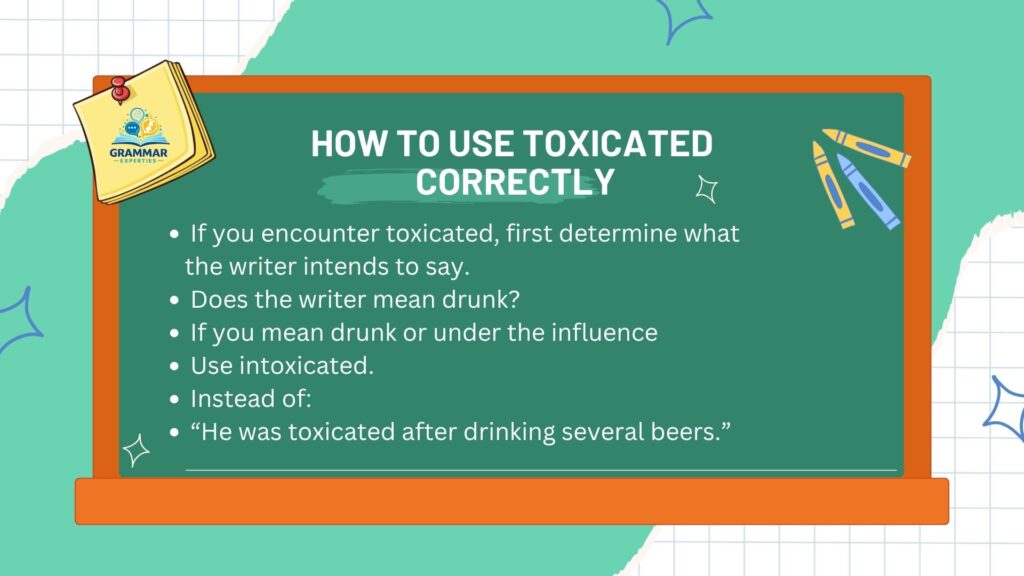
If you encounter toxicated, first determine what the writer intends to say.
Does the writer mean drunk? Does the writer mean poisoned? Or are they discussing the specialized verb toxicate?
If you mean drunk or under the influence
Use intoxicated.
Instead of:
“He was toxicated after drinking several beers.”
Write:
“He was intoxicated after drinking several beers.”
Instead of:
“She looked toxicated at the party.”
Write:
“She looked intoxicated at the party.”
This is especially important in formal or professional writing.
If you mean affected by poison
Use poisoned, exposed to a toxin, or another precise phrase.
For example:
“The workers were exposed to toxic fumes.”
or:
“The patient was poisoned by contaminated food.”
These expressions are clearer than relying on the uncommon word toxicated.
If you are discussing the word itself
You can certainly write about toxicated as a linguistic term.
For example:
“The writer used ‘toxicated’ as an informal shortening of ‘intoxicated.’”
Here, the word is being discussed rather than recommended for ordinary use.
Real-Life Example: Why Context Matters
Imagine a student writing an English assignment about a road accident.
The student writes:
“The driver was toxicated when the accident happened.”
A reader can probably guess the intended meaning. However, the sentence sounds unusual because toxicated isn’t the normal modern adjective for alcohol-related impairment.
A teacher would likely expect:
“The driver was intoxicated when the accident happened.”
Now imagine a completely different situation. A science writer is describing a chemical exposure and writes:
“The organisms were affected by a toxic compound.”
Here, words such as toxic, poisoned, exposed, or affected by a toxin communicate the scientific idea more clearly.
This example shows why simply asking whether toxicated is “a word” isn’t enough. Context determines the best vocabulary choice.
A word can appear in English and still be a poor choice for a particular audience. Good writing isn’t only about finding a technically possible word; it’s about choosing the word your readers will understand immediately.
For students, bloggers, journalists, and professional writers, that distinction matters. If the intended meaning is alcohol- or drug-related impairment, intoxicated is the safest choice. If the intended meaning involves poison or toxic exposure, poisoned, toxic, or exposed to a toxin will usually be more precise.
Toxicated Usage and Language Trends in 2025–2026
There is an important limitation when discussing statistics about toxicated: there is no reliable current public statistic showing a universally accepted monthly search volume or a definitive percentage of English speakers who use the word correctly.
That lack of dependable frequency data is itself useful information. It means writers shouldn’t present an invented usage percentage simply to make an article appear more authoritative.
What current evidence shows
Current reference material points toward a clear distinction:
- Intoxicated is established standard English.
- Toxic is established standard English.
- Poisoned is established standard English.
- Toxicated has much more limited and context-dependent usage.
Cambridge currently provides a standard dictionary entry for intoxicated, including its alcohol/drug and figurative meanings.
Etymological evidence also confirms that intoxicated has a long documented history, with the poisoning sense appearing in the 16th century and the drunkenness sense developing shortly afterward.
Google’s current Search guidance also emphasizes helpful, reliable, original, people-first content and warns against unsupported claims.
What this means for writers in 2026
The practical takeaway is more valuable than an unreliable search-volume statistic:
If your goal is clear modern English, choose the established word that precisely expresses your intended meaning.
For alcohol or drugs → intoxicated
For poisonous or harmful substances → toxic
For exposure to poison → poisoned
For the rare specialized term → toxicated, but define it clearly if your audience may not know it.
Common Mistakes With Toxicated
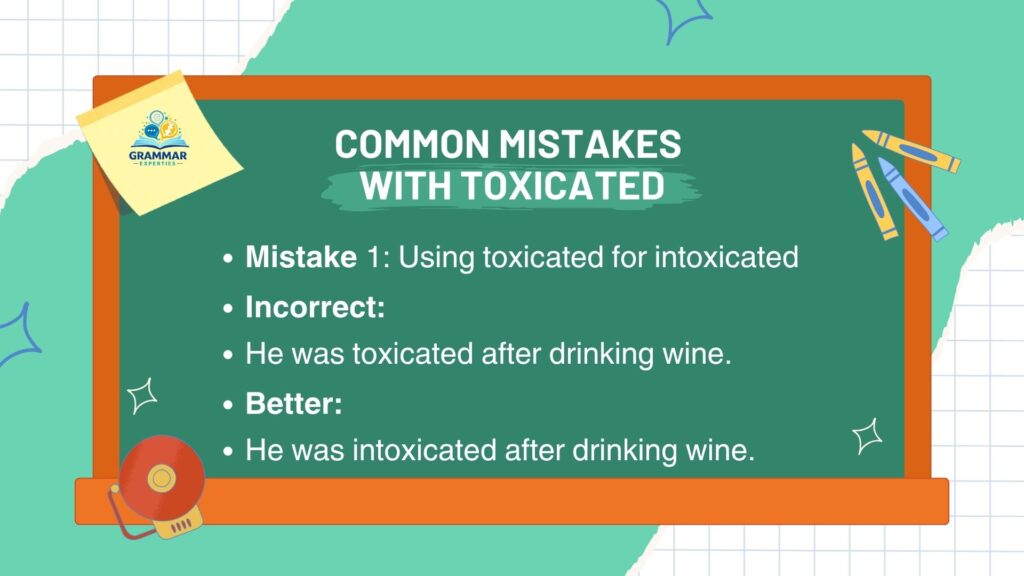
Mistake 1: Using toxicated for intoxicated
Incorrect:
He was toxicated after drinking wine.
Better:
He was intoxicated after drinking wine.
Mistake 2: Confusing toxic with intoxicated
Incorrect:
The man was toxic because he had been drinking.
Better:
The man was intoxicated because he had been drinking.
Toxic describes something harmful or poisonous; intoxicated describes a person’s altered state.
Mistake 3: Assuming every unusual word is a spelling error
It’s tempting to label toxicated simply as a misspelling.
That can be too simplistic.
The form appears in different contexts, including informal usage and as a form derived from the rare verb toxicate. Therefore, the better approach is to ask what meaning the writer intends.
Mistake 4: Using uncommon vocabulary when a clearer word exists
Good writing isn’t about choosing the strangest or most sophisticated word.
For example:
“The workers were toxicated by the fumes.”
is less immediately clear than:
“The workers were exposed to toxic fumes.”
Choose the second version when clarity is the priority.
Quick Guide: Which Word Should You Choose?
Use this checklist before publishing your sentence:
- Do you mean drunk or affected by drugs? → Use intoxicated.
- Do you mean poisonous or harmful? → Use toxic.
- Do you mean harmed by poison? → Use poisoned.
- Are you discussing the rare word itself? → Toxicated may be appropriate as a topic.
- Are you writing formally? → Avoid using toxicated unless you have a specific technical reason and have defined it.
- Are you writing casually online? → Readers may understand toxicated, but intoxicated is still clearer.
Mini Quiz: Toxicated Meaning
1. If you mean someone is under the influence of alcohol, which word is standard?
A) Toxic
B) Intoxicated
C) Toxicated
D) Poisoned
Answer: B) Intoxicated
2. Which sentence is correct?
A) The driver was intoxicated.
B) The driver was toxic.
C) The driver was toxicated.
D) The driver was toxical.
Answer: A) The driver was intoxicated.
3. What does “toxic” normally mean?
A) Drunk
B) Excited
C) Poisonous or harmful
D) Confused
Answer: C) Poisonous or harmful
4. Which word is best for formal writing when referring to alcohol-related impairment?
A) Toxicated
B) Toxic
C) Intoxicated
D) Toxical
Answer: C) Intoxicated
5. Which word best describes someone harmed by poison?
A) Poisoned
B) Toxic
C) Intoxicated
D) Toxicated
Answer: A) Poisoned
6. In casual slang, “toxicated” may sometimes be used to mean:
A) Educated
B) Intoxicated
C) Poisonous
D) Excited
Answer: B) Intoxicated
7. Which sentence is best for a professional article?
A) The employee appeared toxicated.
B) The employee appeared toxic.
C) The employee appeared intoxicated.
D) The employee appeared toxical.
Answer: C) The employee appeared intoxicated.
8. How is “toxicated” best described in modern English?
A) Very common
B) Uncommon and context-dependent
C) Always formal
D) A punctuation term
Answer: B) Uncommon and context-dependent
9. Choose the correct word: “The laboratory stores _____ chemicals.”
A) Intoxicated
B) Toxic
C) Toxicated
D) Poisoned
Answer: B) Toxic
10. What word should students generally use in an academic assignment about someone who is drunk?
A) Toxicated
B) Toxic
C) Intoxicated
D) Toxical
Answer: C) Intoxicated
11. Which pair is correctly matched?
A) Toxic = harmful; Intoxicated = under the influence
B) Toxic = drunk; Intoxicated = poisonous
C) Toxic = educated; Intoxicated = confused
D) Toxic = excited; Intoxicated = harmful
Answer: A) Toxic = harmful; Intoxicated = under the influence
12. Which word has a historical connection to poisoning and later developed an alcohol-related meaning?
A) Communicate
B) Celebrate
C) Intoxicate
D) Educate
Answer: C) Intoxicate
13. Which sentence correctly uses “toxic”?
A) The factory released toxic fumes.
B) The factory released intoxicated fumes.
C) The factory released toxicated fumes.
D) The factory released intoxicated workers.
Answer: A) The factory released toxic fumes.
14. When “toxicated” is used to mean drunk, it is generally considered:
A) Formal terminology
B) Informal usage
C) A spelling rule
D) A punctuation mark
Answer: B) Informal usage
15. Which phrase is clearest for chemical exposure?
A) Exposed to toxic fumes
B) Intoxicated fumes
C) Toxicated fumes
D) Toxical exposure
Answer: A) Exposed to toxic fumes
16. Replace “toxicated” with the standard word: “She was toxicated after drinking wine.”
A) Toxic
B) Poisoned
C) Intoxicated
D) Toxical
Answer: C) Intoxicated
17. Why can “toxicated” confuse English learners?
A) It resembles toxic and intoxicated.
B) It is a punctuation mark.
C) It has no connection to English vocabulary.
D) It always means poisoned.
Answer: A) It resembles toxic and intoxicated.
18. Which is best for a formal report about someone affected by drugs?
A) The person was toxic.
B) The person was toxicated.
C) The person was intoxicated.
D) The person was toxical.
Answer: C) The person was intoxicated.
19. Which statement about “intoxicated” is accurate?
A) It can describe alcohol- or drug-related impairment.
B) It only describes chemicals.
C) It means poisonous.
D) It means educated.
Answer: A) It can describe alcohol- or drug-related impairment.
20. Which sentence is most precise for contaminated food that harmed people?
A) Several people were toxic by the food.
B) Several people were poisoned by the food.
C) Several people were toxicated by the food.
D) Several people were intoxicated by the food.
Answer: B) Several people were poisoned by the food.
21. Which word is most appropriate for poisonous substances?
A) Intoxicated
B) Toxicated
C) Toxic
D) Intoxicate
Answer: C) Toxic
22. What is the best advice when using “toxicated” in formal writing?
A) Always use it.
B) Prefer a clearer established word.
C) Use it instead of toxic.
D) Use it instead of every form of intoxicated.
Answer: B) Prefer a clearer established word.
23. Which adjective belongs directly to the word family of “intoxication”?
A) Toxic
B) Intoxicated
C) Poisoned
D) Toxical
Answer: B) Intoxicated
24. Choose the best revision: “The driver was toxicated.” The intended meaning is under the influence of alcohol.
A) The driver was toxic.
B) The driver was poisoned.
C) The driver was intoxicated.
D) The driver was toxical.
Answer: C) The driver was intoxicated.
25. Which is the best practical rule?
A) Use “toxicated” for every situation involving chemicals.
B) Use “toxic” whenever someone drinks alcohol.
C) Use “intoxicated” for impairment, “toxic” for harmful substances, and “poisoned” for poisoning.
D) Use “poisoned” whenever someone drinks alcohol.
Answer: C) Use “intoxicated” for impairment, “toxic” for harmful substances, and “poisoned” for poisoning.
Frequently Asked Questions About Toxicated Meaning
Q1:Is “toxicated” a correct English word?
Toxicated exists in English in connection with the rare verb toxicate, but its status and meaning are much less straightforward than intoxicated. In ordinary modern writing, it isn’t the preferred word.
Q2:What does toxicated mean in slang?
In slang or casual online usage, toxicated may be used as a shortened form of intoxicated, meaning drunk or under the influence of alcohol or drugs.
Q3:Is toxicated the same as intoxicated?
Not necessarily. Some people use toxicated informally to mean intoxicated, but the established standard term for being under the influence of alcohol or drugs is intoxicated.
Q4:What is the difference between toxic and toxicated?
Toxic is a standard adjective meaning poisonous or harmful. Toxicated is much rarer and can refer to being affected by a toxic substance or be used informally as a form of intoxicated.
Q5:Can I use “toxicated” in formal writing?
Usually, no. If you mean alcohol- or drug-related impairment, use intoxicated. If you mean toxic exposure, use a clearer phrase such as poisoned, exposed to a toxin, or affected by a toxic substance.
Q6:Is “toxicated” a synonym for drunk?
In informal slang, it can be used that way. However, intoxicated, drunk, or under the influence are more natural choices in modern English.
Q7:What is the correct word: toxicated or intoxicated?
If you’re talking about someone affected by alcohol or drugs, the correct standard word is intoxicated.
Q8:Why does “toxicated” sound like a real word?
It follows a word-building pattern that looks natural in English and resembles both toxic and intoxicated. In addition, the form occurs in some specialized and informal contexts. That’s why readers can often understand it even when they would normally expect another word.
Final Verdict on Toxicated Meaning
The toxicated meaning depends on context, but you should be careful with the word.
If someone uses toxicated to mean drunk or under the influence, they’re generally using it as an informal shortening of intoxicated. If the context is toxic exposure, the term may relate to the rare verb toxicate. However, neither situation makes toxicated the best everyday choice.
For clear modern English, remember:
Intoxicated = under the influence of alcohol or drugs.
Toxic = poisonous or harmful.
Poisoned = affected by poison.
Toxicated = uncommon and context-dependent; use it cautiously.
When you’re writing an essay, professional email, academic paper, website article, or formal report, choosing the clearer established word will make your writing more precise and easier to understand.
Explore more easy grammar lessons and improve your English with Grammar Expertise
References
Google Search Central — Creating Helpful, Reliable, People-First Content
Cambridge Dictionary — Intoxicated

Maimoona Mughal is an English grammar enthusiast dedicated to simplifying confusing words, grammar rules, and vocabulary through clear, accurate, and learner-friendly content that helps readers write and communicate with confidence.