Have you ever typed “stoped” and wondered whether it should have one p or two? If so, you’re not alone. Stopped or stoped is a common spelling question, especially for English learners who are learning how verbs change in the past tense.
The correct spelling is stopped, with two p’s. Stoped is incorrect when you mean the past tense or past participle of stop.
The reason is a common English spelling rule: when stop takes the ending -ed, its final consonant is doubled. Therefore:
stop + ed = stopped
In this guide, you’ll learn why stopped has two p’s, how to use it correctly, the spelling rule behind it, common mistakes to avoid, and an easy way to remember the correct form.
Stopped or Stoped: Which Spelling Is Correct?
The correct spelling is stopped.
Stoped is a misspelling. If you are talking about something that ended, came to a halt, or was prevented in the past, use stopped.
Merriam-Webster lists stopped and stopping as the standard forms of stop. Cambridge Dictionary likewise identifies stopped as the past simple and past participle of stop.
Is “Stopped” the Correct Spelling?
Yes.
The basic verb is:
stop
Its past tense is:
stopped
Its present participle is:
stopping
Its past participle is:
stopped
For example:
- The car stopped at the traffic light.
- She stopped talking.
- The rain has stopped.
- The machine was stopped for maintenance.
Why Is “Stoped” Incorrect?
The mistake happens when writers simply add -ed to stop without changing the final consonant:
stop + ed = stoped ❌
However, English spelling requires the final p to be doubled:
stop + p + ed = stopped ✅
This same pattern appears in words such as planned, hopped, dropped, and clapped.
Quick Answer
If you only need the answer, remember:
Stopped = correct
Stoped = incorrect
The word needs two p’s.
Why Does Stop Become Stopped?
The spelling of stopped follows a common consonant-doubling pattern in English.
The Double-Consonant Rule
Many short verbs ending in a consonant-vowel-consonant pattern double their final consonant before a suffix such as -ed or -ing.
Consider:
- stop → stopped
- hop → hopped
- plan → planned
- drop → dropped
- rob → robbed
- clap → clapped
The doubling helps preserve the pronunciation of the original short vowel sound.
For stop, the final p is doubled before -ed:
stop → stopped
Cambridge’s grammar resources use stop → stopped/stopping as an example of final-consonant doubling.
The Pattern in “Stopped”
You can break the word down like this:
stop + ed
The final consonant is doubled:
stopp + ed
The result is:
stopped
This is why stoped does not follow the standard spelling pattern.
What About “Stopping”?
The same principle applies when adding -ing:
stop → stopping
Not:
stop → stoping ❌
So you can remember the pair together:
stopped
stopping
Both forms have two p’s.
How to Use “Stopped” Correctly
The word stopped can describe an action that ended, movement that came to a halt, or something that was prevented.
“Stopped” Means an Activity Ended
Use stopped when an activity is no longer happening.
Examples:
- The children stopped playing.
- She stopped laughing.
- The music stopped suddenly.
- He stopped working at five o’clock.
- The rain stopped before sunset.
In each sentence, an activity that was happening came to an end.
“Stopped” Means Movement Ended
You can also use stopped when a person, vehicle, or object is no longer moving.
Examples:
- The bus stopped outside the school.
- The car stopped near the entrance.
- The train stopped at the station.
- He stopped at the red light.
Merriam-Webster gives similar examples involving cars, buses, traffic lights, and people coming to a halt.
“Stopped” Means Prevented
The verb stop can also mean to prevent something from happening.
Examples:
- The police stopped the fight.
- The teacher stopped the students from leaving.
- A security guard stopped him at the entrance.
- The heavy rain stopped the match.
So stopped does not always mean that something simply ended by itself. It can also mean that someone or something caused it to end.
Stopped vs Stoped: Examples and Comparison
Seeing the two spellings side by side makes the difference easy to remember.
Correct and Incorrect Examples
| Incorrect | Correct |
|---|---|
| The car stoped suddenly. | The car stopped suddenly. |
| She stoped talking. | She stopped talking. |
| The rain stoped at noon. | The rain stopped at noon. |
| He stoped the machine. | He stopped the machine. |
| The bus stoped outside. | The bus stopped outside. |
| The music stoped suddenly. | The music stopped suddenly. |
The pattern is consistent: whenever the past tense or past participle of stop is required, use stopped.
A Simple Spelling Checklist
Before publishing or submitting your writing, ask:
- Is the base verb stop?
- Am I using its past tense or past participle?
- Did I double the final p?
- Does the word read stopped, not stoped?
If the answer to all four is yes, your spelling is correct.
Stopped or Stoped: A Real-Life Writing Example
Imagine a student writing an English assignment about a road trip. The student wants to explain what happened when the family reached a small town. They write:
“We were driving for several hours when our car stoped near a small village.”
The sentence is understandable, but stoped is still a spelling error. A teacher or editor would normally expect stopped:
“We were driving for several hours when our car stopped near a small village.”
Now consider the same mistake in professional writing. An employee might write:
“The production line stoped because of a technical problem.”
Again, the meaning is clear, but the spelling is incorrect. The polished version is:
“The production line stopped because of a technical problem.”
This small example shows why understanding spelling rules is more useful than simply memorizing individual words. Once you understand that the final consonant in stop is doubled before -ed, you can apply the same idea to other words such as planned, hopped, and dropped. It also makes proofreading easier because you can recognize a pattern instead of treating every spelling decision as a separate problem.
For students, bloggers, job applicants, and professionals, these small corrections can improve the overall appearance of written communication. A single spelling mistake may not change the meaning, but accurate spelling makes writing look more polished and carefully prepared.
The Difference Between “Stopped Doing” and “Stopped to Do”
One important grammar point is often confused with the spelling of stopped.
The structures stopped doing and stopped to do have different meanings.
Stopped Doing Something
Stopped + -ing means an activity ended.
For example:
She stopped talking.
This means she was talking, but then she no longer continued talking.
More examples:
- He stopped smoking.
- They stopped arguing.
- We stopped working.
- She stopped using the old computer.
Cambridge explains that the -ing form after stop indicates that an action or event is no longer continuing.
Stopped to Do Something
Stopped + to + verb means someone paused one activity in order to do another.
For example:
She stopped to talk to her friend.
This means she was doing something else, paused, and then talked to her friend.
Compare these two sentences:
He stopped smoking.
He no longer smokes.
He stopped to smoke.
He paused another activity so that he could smoke.
The spelling of stopped remains the same, but the grammar after it changes the meaning.
Common Words That Follow the Same Spelling Pattern
Learning related words can help you remember why stopped has two p’s.
Similar Double-Consonant Examples
| Base Verb | Past Tense |
|---|---|
| stop | stopped |
| hop | hopped |
| drop | dropped |
| plan | planned |
| clap | clapped |
| rob | robbed |
| grab | grabbed |
| slip | slipped |
For example:
The athlete hopped across the field.
She planned the event carefully.
The glass dropped onto the floor.
He slipped on the wet surface.
These examples show why it is useful to learn the spelling pattern rather than memorizing stopped alone.
A Note About Spelling Rules
English spelling rules can have exceptions and depend on pronunciation, syllable stress, and the suffix being added. Therefore, the safest approach is to learn the common pattern while checking a reliable dictionary when a word looks unfamiliar.
For stop, however, there is no uncertainty:
stopped is the standard form.
Why Correct Spelling Matters in Modern Writing
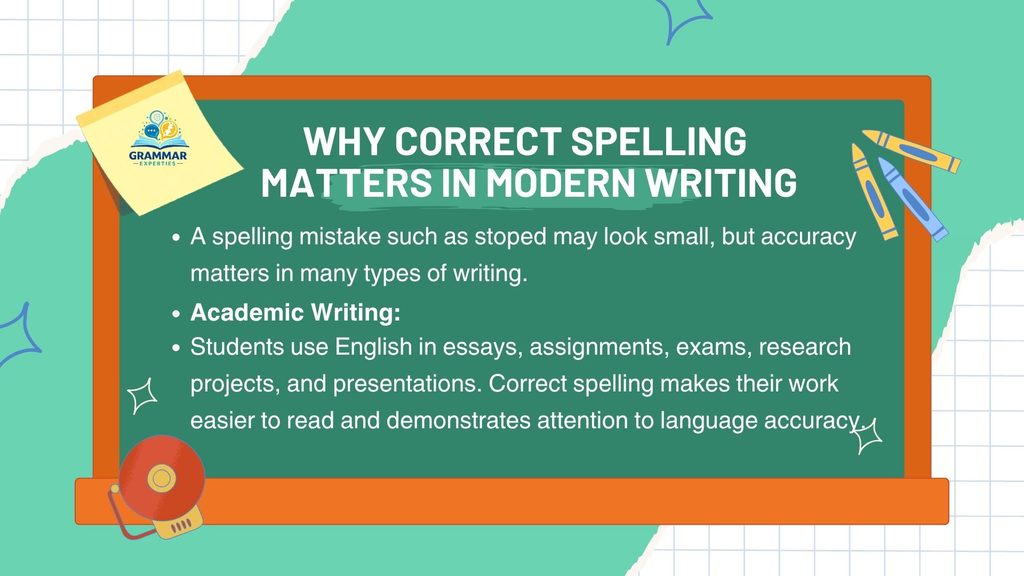
A spelling mistake such as stoped may look small, but accuracy matters in many types of writing.
Academic Writing
Students use English in essays, assignments, exams, research projects, and presentations. Correct spelling makes their work easier to read and demonstrates attention to language accuracy.
Professional Communication
Emails, reports, proposals, presentations, and documents often represent a person or organization. A carefully proofread document creates a more professional impression.
Online Content
Bloggers and website owners need clear, accurate writing because visitors quickly notice obvious spelling mistakes. Correct language also makes educational content easier to trust and understand.
What Recent Workplace Data Shows
Recent workplace research reinforces the importance of checking written documents. Adobe’s survey of 1,015 full-time U.S. employees found that 82% reported making at least one document mistake during the previous year, while 58% identified typos as a common type of error. The survey was published as current workplace research and includes a 95% confidence level with a 3% margin of error.
The statistic doesn’t specifically measure the spelling of stopped. However, it illustrates a broader point: small writing and document errors remain common in modern workplaces.
Therefore, knowing simple spelling patterns can help you catch mistakes before they reach a teacher, client, manager, reader, or customer.
How to Remember the Correct Spelling of Stopped
If you frequently forget whether stopped has one or two p’s, use a simple memory trick.
Think “STOP + P + ED”
Instead of thinking:
stop + ed
Think:
stop + p + ed
That gives you:
stopped
You can also connect it with:
stop → stopped → stopping
All three forms visibly contain the double p where appropriate.
Use a Mental Sentence
Try remembering:
The car stopped.
Whenever you need the past tense, picture the word with two p’s.
Compare It With “Stoping”
If you remember that stopping has two p’s, it becomes easier to remember that stopped does too.
Correct:
- stopped
- stopping
Incorrect:
- stoped
- stoping
Mini Quiz:Stopped or Stoped
1. Which spelling is correct?
A) Stoped
B) Stopped
C) Stoppd
D) Stopt
Answer: B) Stopped
2. Choose the correct sentence.
A) She stoped talking.
B) She stopped talking.
C) She stopt talking.
D) She stoppd talking.
Answer: B) She stopped talking.
3. What is the past tense of “stop”?
A) Stoped
B) Stopt
C) Stopped
D) Stopping
Answer: C) Stopped
4. Which sentence is grammatically correct?
A) The car stoped suddenly.
B) The car stopped suddenly.
C) The car stopp suddenly.
D) The car stopt suddenly.
Answer: B) The car stopped suddenly.
5. Why does “stop” become “stopped”?
A) The vowel changes.
B) The final consonant is doubled before adding -ed.
C) The word loses a letter.
D) An extra vowel is added.
Answer: B) The final consonant is doubled before adding -ed.
6. Fill in the blank:
“The rain finally ______.”
A) stoped
B) stopped
C) stopt
D) stop
Answer: B) stopped
7. Which spelling should you use in formal writing?
A) Stoped
B) Stopped
C) Stopp
D) Stopt
Answer: B) Stopped
8. Choose the correct sentence.
A) He stopped the machine.
B) He stoped the machine.
C) He stop the machine.
D) He stopp the machine.
Answer: A) He stopped the machine.
9. What is the correct spelling of the past participle of “stop”?
A) Stoped
B) Stopped
C) Stopt
D) Stoppt
Answer: B) Stopped
10. Which word contains the correct spelling?
A) Stoped
B) Stopped
C) Stoppped
D) Stoppd
Answer: B) Stopped
11. Fill in the blank:
“She ______ working at 6 p.m.”
A) stoped
B) stopped
C) stop
D) stopping
Answer: B) stopped
12. Which sentence is incorrect?
A) The bus stopped outside the school.
B) He stopped laughing.
C) The music stopped suddenly.
D) She stoped the conversation.
Answer: D) She stoped the conversation.
13. What is the correct form of “stop + ing”?
A) Stoping
B) Stopping
C) Stoppping
D) Stopingg
Answer: B) Stopping
14. Choose the correct pair.
A) Stop — Stoped
B) Stop — Stopped
C) Stop — Stopt
D) Stop — Stoppt
Answer: B) Stop — Stopped
15. Fill in the blank:
“The teacher ______ the class for a short break.”
A) stoped
B) stopped
C) stopping
D) stop
Answer: B) stopped
16. Which sentence uses “stopped” correctly?
A) I stopped to buy some water.
B) I stoped to buy some water.
C) I stopped buying some water yesterday.
D) I stop to bought some water.
Answer: A) I stopped to buy some water.
17. Which spelling is NOT correct?
A) Stopped
B) Stop
C) Stopping
D) Stoped
Answer: D) Stoped
18. Complete the sentence:
“The children ______ playing when it started raining.”
A) stoped
B) stopped
C) stop
D) stopping
Answer: B) stopped
19. Which word follows the same spelling pattern as “stopped”?
A) Hoped
B) Planned
C) Played
D) Opened
Answer: B) Planned
20. What should you remember about “stopped”?
A) It has one P.
B) It has two Ps.
C) It has three Ps.
D) It has no P.
Answer: B) It has two Ps.
21. Choose the correct sentence.
A) The train stoped at the station.
B) The train stopped at the station.
C) The train stop at the station yesterday.
D) The train stopping at the station yesterday.
Answer: B) The train stopped at the station.
22. Which sentence correctly uses “stopped doing”?
A) She stopped to smoke.
B) She stopped smoking.
C) She stoped smoking.
D) She stopped smoked.
Answer: B) She stopped smoking.
23. Which sentence correctly uses “stopped to do”?
A) He stopped to answer the phone.
B) He stopped answering the phone to.
C) He stoped to answer the phone.
D) He stopped answer the phone.
Answer: A) He stopped to answer the phone.
24. Pick the correct word:
“The traffic ______ moving.”
A) stoped
B) stopped
C) stoping
D) stopt
Answer: B) stopped
25. Final challenge: Which statement is true?
A) “Stoped” is the standard past tense of stop.
B) “Stopped” is the standard past tense and past participle of stop.
C) Both “stoped” and “stopped” are equally correct.
D) “Stopt” is the preferred spelling.
Answer: B) “Stopped” is the standard past tense and past participle of stop.
Frequently Asked Questions About Stopped or Stoped
Q1:Is “stoped” a correct English word?
No. Stoped is not the standard spelling of the past tense or past participle of stop. The correct form is stopped.
Q2:Is it stopped or stoped?
It is stopped, with two p’s.
Example:
The bus stopped at the station.
Q3:Why does stopped have two p’s?
The final consonant of stop is doubled before adding -ed. Therefore:
stop → stopped
The same pattern occurs in words such as hopped, planned, and dropped.
Q4:What is the past tense of stop?
The past tense is stopped.
Example:
The rain stopped after an hour.
Cambridge identifies stopped as the past simple and past participle of stop.
Q5:Is stopped the past participle of stop?
Yes. Stopped functions as both the past simple and past participle.
Examples:
- She stopped the car.
- The car has stopped.
Q6:Is “stoping” correct?
No. The correct spelling is stopping, with two p’s.
stop → stopping
Q7:What is the difference between stopped doing and stopped to do?
Stopped doing means an activity ended:
She stopped reading.
Stopped to do means someone paused another activity to perform a different action:
She stopped to read the sign.
Cambridge confirms this distinction between the -ing form and the to-infinitive after stop.
Q8:How can I easily remember stopped?
Remember this formula:
STOP + P + ED = STOPPED
The extra p is the key.
Conclusion: Stopped Is the Correct Spelling
When choosing between stopped or stoped, the correct answer is always stopped when you mean the past tense or past participle of stop.
The spelling rule is simple:
stop → stopped
The final p is doubled before -ed, just as it is in words such as hopped, planned, and dropped.
So the next time you write a sentence such as “The car stopped at the corner,” remember the two p’s.
Avoid stoped. Use stopped.
Explore more easy grammar lessons and improve your English with Grammar Expertise
References

Maimoona Mughal is an English grammar enthusiast dedicated to simplifying confusing words, grammar rules, and vocabulary through clear, accurate, and learner-friendly content that helps readers write and communicate with confidence.