Have you ever wondered whether the plural of belly is bellys or bellies? You’re not alone. English has many words that form their plurals by simply adding -s, but nouns ending in a consonant followed by y follow a different spelling pattern.
The correct spelling is bellies.
Belly → Bellies
The spelling bellys is not the standard plural form of belly. The change happens because belly ends in a consonant (l) followed by y. When forming the plural, the y changes to i, and -es is added.
In this guide, you’ll learn the meaning of belly, why bellies is correct, when to use it, common mistakes, American and British English usage, and an easy way to remember the rule.
Quick Answer: Is It Bellys or Bellies?
Bellies is the correct spelling.
Belly is the singular form, while bellies is the plural form.
| Singular | Plural | Correct? |
|---|---|---|
| belly | bellies | ✅ Correct |
| belly | bellys | ❌ Incorrect |
For example:
- One belly → two bellies
- The baby has a round belly.
- The babies have round bellies.
The reason is the standard plural rule for many nouns ending in consonant + y:
Consonant + y → change y to i + es
So:
- belly → bellies
- baby → babies
- city → cities
- family → families
- story → stories
What Does Belly Mean?
Belly Meaning
Belly is an informal noun referring to the front part of the body between the chest and legs. It can refer broadly to the stomach or abdominal area. Cambridge Dictionary also records belly for the rounded or curved part of an object.
For example:
- The baby has a soft belly.
- The dog rolled onto its belly.
- He ate until his belly was full.
- The belly of the aircraft was painted silver.
The word can therefore describe both people and animals, and it can sometimes describe a curved or lower section of an object.
What Is the Plural of Belly?
The plural of belly is bellies.
When you are talking about more than one belly, use bellies:
- one belly
- two bellies
- several bellies
- their bellies
- full bellies
Cambridge’s dictionary material explicitly gives bellies as the plural form.
Bellies Meaning
Bellies simply means more than one belly.
For example:
The puppies were lying on their bellies.
Here, bellies refers to the bellies of multiple puppies.
You may also see the word used in descriptions of objects or animals:
The fish had pale bellies.
The aircraft had large cargo compartments in their bellies.
Why Is Bellies Correct Instead of Bellys?
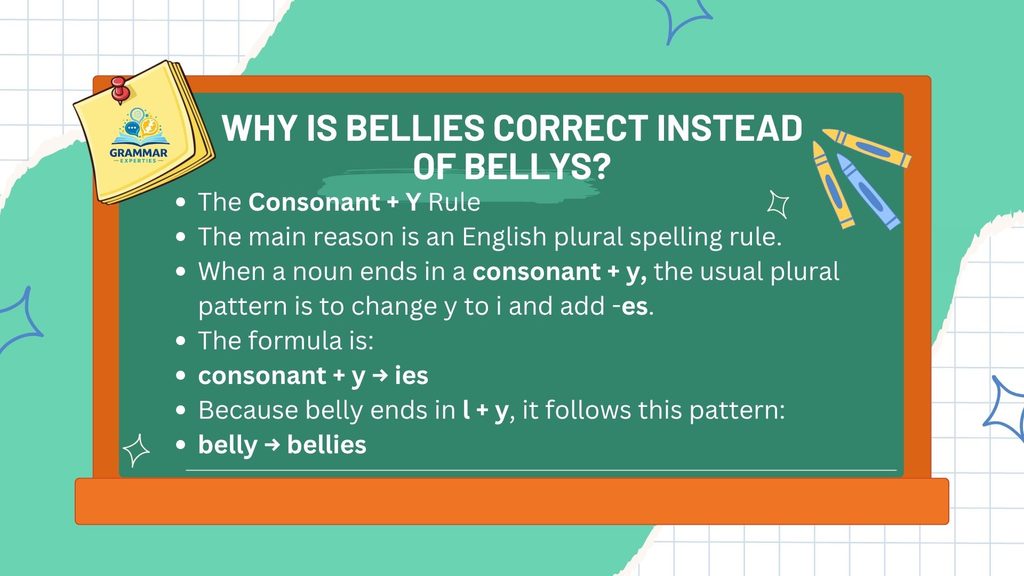
The Consonant + Y Rule
The main reason is an English plural spelling rule.
When a noun ends in a consonant + y, the usual plural pattern is to change y to i and add -es.
The formula is:
consonant + y → ies
Because belly ends in l + y, it follows this pattern:
belly → bellies
Other examples include:
| Singular | Plural |
|---|---|
| baby | babies |
| city | cities |
| country | countries |
| family | families |
| lady | ladies |
| party | parties |
| story | stories |
| belly | bellies |
Therefore, writing bellys ignores the spelling change required by this plural pattern.
Why Isn’t It Bellys?
It can be tempting to simply add -s:
belly + s = bellys ❌
However, English does not form the plural of belly that way.
The correct process is:
belly → remove y → belli → add es → bellies
So the correct spelling contains -ies at the end.
Don’t Confuse Consonant + Y With Vowel + Y
There is an important distinction.
Words ending in a vowel + y normally keep the y and simply take -s.
For example:
- boy → boys
- toy → toys
- key → keys
- day → days
- journey → journeys
Compare them with words ending in a consonant + y:
- baby → babies
- city → cities
- lady → ladies
- belly → bellies
This distinction makes the rule much easier to remember.
Bellys or Bellies: Grammar and Usage Guide
Use Bellies When You Mean More Than One Belly
Whenever belly is plural, use bellies.
Correct:
The children rubbed their bellies after dinner.
Correct:
The puppies rolled onto their bellies.
Correct:
The birds have white bellies.
Incorrect:
The children rubbed their bellys after dinner.
Incorrect:
The puppies rolled onto their bellys.
Bellies in Formal and Informal Writing
Bellies is the standard plural spelling, so it can be used in both informal and formal writing when the word belly is appropriate.
You might see it in:
- everyday conversations
- emails
- blog posts
- children’s books
- journalism
- descriptive writing
- educational content
- general nonfiction
For highly technical medical writing, abdomens may be more precise depending on the context. However, that is a vocabulary choice, not a spelling issue.
For example:
The children had full bellies after lunch.
This is natural general English.
In a technical medical context, a writer might instead say:
The patients’ abdomens were examined.
Both can be appropriate depending on the intended meaning and level of formality.
Bellies in Common Expressions
You may encounter bellies in several natural phrases.
Examples include:
- full bellies
- round bellies
- hungry bellies
- baby bellies
- pregnant bellies
- puppy bellies
- fish bellies
- lying on their bellies
Example:
After the family dinner, everyone went home with full bellies.
Bellys vs Bellies: Comparison Table
| Feature | Bellies | Bellys |
|---|---|---|
| Standard spelling | ✅ Yes | ❌ No |
| Plural of belly | ✅ Yes | ❌ No |
| Used in standard English | ✅ Yes | ❌ No |
| Correct in formal writing | ✅ Yes | ❌ No |
| Correct in informal writing | ✅ Yes | ❌ No |
| Follows consonant + y rule | ✅ Yes | ❌ No |
| American English | ✅ Yes | ❌ No |
| British English | ✅ Yes | ❌ No |
The key difference is simple: bellies follows the standard plural spelling rule, while bellys does not.
Bellies in American and British English
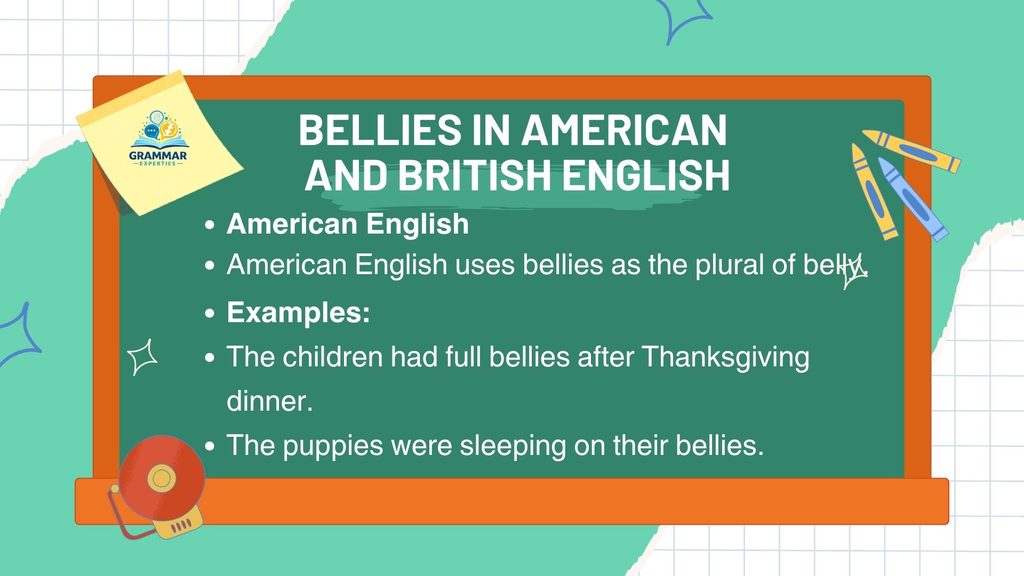
American English
American English uses bellies as the plural of belly.
Examples:
The children had full bellies after Thanksgiving dinner.
The puppies were sleeping on their bellies.
There is no standard American English plural bellys.
British English
British English also uses bellies.
Examples:
The children rubbed their bellies after lunch.
The animals were resting on their bellies.
Therefore, you do not need to change the spelling depending on whether your audience is American or British.
Is the Rule Different in Other English Varieties?
The plural spelling bellies is the standard form across major varieties of English.
This is a spelling rule rather than a regional preference. Therefore, writers in the United States, United Kingdom, Canada, Australia, and other English-speaking environments can use bellies.
Real-Life Example: How the Mistake Happens
A Common Writing Situation
Imagine that a teacher asks students to write a sentence using the plural form of belly.
One student writes:
The puppies were sleeping on their bellys.
At first glance, the mistake may seem understandable. The student knows that English plurals often take -s, so they simply add s to belly.
However, the word ends in consonant + y. The student needs to apply the plural spelling rule:
belly → bellies
The corrected sentence is:
The puppies were sleeping on their bellies.
This example shows why spelling rules matter. The problem isn’t the meaning. Readers can usually understand what bellys is intended to mean. The problem is that the spelling does not follow standard English.
The same issue can occur when someone types quickly on a phone, writes from memory, or learns English as a second language. Because bellys and bellies may sound similar when spoken, listening alone does not reveal the spelling difference. The writer has to remember the written pattern.
A useful strategy is to connect belly with similar words such as baby, city, and story. If you remember baby → babies, you can transfer the same pattern to belly → bellies.
For students, writers, bloggers, and editors, this small rule can prevent a surprisingly common spelling error.
2025–2026 Data and Reference Check
What Current Reference Sources Show
A reliable spelling guide should distinguish between actual dictionary evidence and unsupported search-volume claims.
Current Cambridge Dictionary material defines belly and records bellies as its plural form.
The grammar principle is also consistent with Cambridge’s explanation of plural nouns: regular plural formation depends on the spelling and pronunciation of the noun, and many nouns require spelling changes rather than simply receiving -s.
For historical corpus research, Google’s Ngram Viewer provides book-based usage data. Google states that its newer dataset was released in July 2024 and that its corpus can change as books are added and language/OCR processing improves. The currently available Ngram interface covers book data through 2022 rather than providing a direct 2025–2026 usage count.
What This Means for 2025–2026 Writers
There is an important distinction between current dictionary evidence and live search-volume statistics.
For this spelling question, authoritative dictionary evidence establishes the answer:
Belly → bellies
It would be misleading to invent a precise 2025 or 2026 percentage for bellies versus bellys without a verifiable dataset that reports those exact terms.
The practical data points are therefore:
| Reference point | Finding |
|---|---|
| Standard singular | belly |
| Standard plural | bellies |
| Standard plural ending | -ies |
| “Bellys” as standard plural | No |
| American English plural | bellies |
| British English plural | bellies |
| Current dictionary evidence | Supports bellies |
| Google Ngram latest corpus coverage | Through 2022 in the available interface |
This is stronger than relying on an unsupported claim about search volume because the spelling itself can be verified directly through established dictionary references.
Common Mistakes With Bellys and Bellies
Mistake 1: Simply Adding S
The most common error is:
belly → bellys ❌
Remember:
belly → bellies ✅
Mistake 2: Forgetting the Consonant + Y Rule
Some writers remember that y words change in the plural but forget when the rule applies.
Compare:
- baby → babies
- city → cities
- belly → bellies
But:
- boy → boys
- toy → toys
- key → keys
The letter immediately before y matters.
Mistake 3: Using Bellys in Professional Writing
You may occasionally encounter bellys online, especially in user-generated content, fast typing, or unedited text. Its appearance online does not make it a standard English plural.
For professional writing, use:
bellies
Mistake 4: Assuming Pronunciation Determines Spelling
English spelling and pronunciation don’t always correspond perfectly.
Someone might pronounce the intended word correctly but still type the wrong spelling.
If you’re unsure, don’t rely only on how the word sounds. Check the spelling rule:
belly → bellies
A Simple Trick to Remember Bellies
Use the “Baby and Belly” Trick
Remember this pair:
baby → babies
belly → bellies
Both words end in consonant + y, so both change y → i and take -es.
You can also remember:
If consonant + Y ends the word, think IES.
Examples:
- baby → babies
- puppy → puppies
- city → cities
- family → families
- belly → bellies
But remember that vowel + y behaves differently:
- boy → boys
- toy → toys
- key → keys
This simple comparison makes the spelling rule much easier to recall.
Mini Quiz: Bellys or Bellies
- What is the correct plural of belly?
A) Bellys
B) Bellies
C) Bellyes
D) Belly’s
Answer: B) Bellies - Which sentence is correct?
A) The babies have round bellys.
B) The babies have round bellies.
Answer: B) The babies have round bellies. - What is the singular form of bellies?
A) Belly
B) Bellys
C) Bellye
D) Bellie
Answer: A) Belly - Why does belly become bellies?
A) It ends in consonant + y
B) It ends in vowel + y
C) It is an irregular noun
D) It needs an apostrophe
Answer: A) It ends in consonant + y - Which is the correct spelling?
A) Bellys
B) Bellyes
C) Bellies
D) Belly’s
Answer: C) Bellies - Which word follows the same plural pattern as belly?
A) Boy → Boys
B) Toy → Toys
C) Baby → Babies
D) Key → Keys
Answer: C) Baby → Babies - True or False: “Bellys” is the standard plural of belly.
Answer: False - Complete the sentence: “The puppies have soft ______.”
A) bellys
B) bellies
C) bellyes
D) belly’s
Answer: B) Bellies - Which spelling is incorrect?
A) Belly
B) Bellies
C) Belly’s
D) Bellys
Answer: D) Bellys - What happens to the y in belly when forming the plural?
A) It stays y
B) It changes to i
C) It is removed
D) It changes to e
Answer: B) It changes to i - Which sentence is grammatically correct?
A) Their bellys were full.
B) Their bellies were full.
C) Their bellyes were full.
D) Their belly’s were full.
Answer: B) Their bellies were full. - What is the plural of baby?
A) Babys
B) Babyes
C) Babies
D) Baby’s
Answer: C) Babies - Which word does not follow the same spelling pattern as belly → bellies?
A) City → Cities
B) Party → Parties
C) Toy → Toys
D) Family → Families
Answer: C) Toy → Toys - True or False: Bellies is correct in both American and British English.
Answer: True - Which sentence uses belly’s correctly?
A) The children have belly’s.
B) The belly’s shape was unusual.
C) The puppies have belly’s.
D) Several belly’s were visible.
Answer: B) The belly’s shape was unusual. - Which form means more than one belly?
A) Belly
B) Belly’s
C) Bellies
D) Bellyes
Answer: C) Bellies - Which is the correct plural?
A) Lady → Ladys
B) Lady → Ladies
C) Lady → Ladyes
D) Lady → Lady’s
Answer: B) Lady → Ladies - Complete the sentence: “The birds have colorful ______.”
A) bellys
B) bellyes
C) bellies
D) belly’s
Answer: C) Bellies - Which spelling should you avoid in standard English?
A) Belly
B) Bellies
C) Bellys
D) Belly’s
Answer: C) Bellys - What is the correct plural rule for a common noun ending in consonant + y?
A) Add only -s
B) Change y to i and add -es
C) Add an apostrophe
D) Remove the y
Answer: B) Change y to i and add -es - Which sentence is correct?
A) We laughed until our bellys hurt.
B) We laughed until our bellies hurt.
C) We laughed until our bellyes hurt.
D) We laughed until our belly’s hurt.
Answer: B) We laughed until our bellies hurt. - Which pair is correctly matched?
A) Belly → Bellys
B) Belly → Bellyes
C) Belly → Bellies
D) Belly → Belly’s
Answer: C) Belly → Bellies - True or False: An apostrophe is normally used to make “belly” plural.
Answer: False - Which sentence contains the correct plural spelling?
A) The children rubbed their bellies after eating.
B) The children rubbed their bellys after eating.
C) The children rubbed their bellyes after eating.
D) The children rubbed their belly’s after eating.
Answer: A) The children rubbed their bellies after eating. - What is the easiest rule to remember for belly → bellies?
A) Vowel + y → ies
B) Consonant + y → ies
C) Every y → s
D) Every plural needs an apostrophe
Answer: B) Consonant + y → ies
FAQs About Bellys or Bellies
Q1:Is “bellys” a correct word?
Bellys is not the standard plural spelling of belly. The correct plural is bellies.
Q2:What is the plural of belly?
The plural of belly is bellies.
The pattern is:
one belly → two bellies
Q3:Why is it “bellies” and not “bellys”?
Because belly ends in a consonant followed by y. In the plural, the y changes to i, followed by -es:
belly → bellies
Q4:Is “bellies” grammatically correct?
Yes. Bellies is the standard plural form of belly and is used when referring to more than one belly.
Q5:Is “bellys” ever acceptable in English?
It is not the standard plural form of belly. In ordinary English writing, use bellies.
A particular brand, username, character name, or other proper name could theoretically use Bellys as a name, but that would not make it the standard grammatical plural of belly.
Q6:Is the plural “bellies” in American English?
Yes. American English uses bellies.
The children had full bellies.
Q7:Is the plural “bellies” in British English?
Yes. British English also uses bellies.
There is no standard British spelling bellys.
Q8:What is the difference between belly and bellies?
Belly is singular, meaning one belly.
Bellies is plural, meaning more than one belly.
For example:
- The baby has a belly.
- The babies have bellies.
Final Checklist: Belly or Bellies?
Before publishing your sentence, use this quick checklist:
- One = belly
- More than one = bellies
- Consonant + y changes to -ies
- Bellies is the standard plural
- Bellys should be avoided in standard English
- American English uses bellies
- British English uses bellies
Quick Memory Formula
Belly + plural = Bellies
Not:
Belly + s = Bellys ❌
Conclusion
So, bellys or bellies—which spelling is correct?
The answer is bellies.
Belly is the singular noun, and bellies is its standard plural form. Because belly ends in a consonant followed by y, the y changes to i and -es is added.
Remember:
Belly → Bellies
The same pattern appears in words such as baby → babies, city → cities, and family → families.
Whether you’re writing a school assignment, business email, blog post, article, or social media caption, use bellies when referring to more than one belly.
If you often confuse English spellings like this, save this rule and use it whenever you encounter a noun ending in consonant + y. A small grammar rule can make your writing much more accurate and polished.
Explore more easy grammar lessons and improve your English with Grammar Expertise
References

Maimoona Mughal is an English grammar enthusiast dedicated to simplifying confusing words, grammar rules, and vocabulary through clear, accurate, and learner-friendly content that helps readers write and communicate with confidence.