Introduction
Have you ever written an email and stopped to wonder whether enquiries or inquiries is the correct spelling? You are not alone. These two forms look almost identical, sound similar, and both appear in dictionaries.
The good news is that both “enquiries” and “inquiries” are correct English spellings. The main difference is regional. Enquiries is strongly associated with British English, while inquiries is the standard spelling in American English. British English can also use inquiries, especially when referring to formal investigations.
For example:
- UK: Please direct all enquiries to the customer service team.
- US: Please direct all inquiries to the customer service team.
So, which one should you use? It depends mainly on which variety of English you are writing and, in British English, sometimes what you mean.
This guide explains the difference between enquiries and inquiries, their meanings, UK and US usage, singular and plural forms, common examples, and the easiest way to choose the right spelling.
Enquiries or Inquiries: What Is the Difference?
At the most basic level, enquiries and inquiries are plural forms referring to questions, requests for information, or investigations.
The spelling difference is primarily connected to regional English.
Enquiries in British English
Enquiries is commonly used in British English, particularly for ordinary questions or requests for information.
Examples include:
- We received several enquiries about the course.
- Please send your enquiries to the admissions office.
- The hotel has received many enquiries about room availability.
- I made a few enquiries before booking the trip.
In British usage, enquiry can therefore refer to something as simple as asking for information.
Inquiries in American English
In American English, inquiries is the normal spelling for both general questions and official investigations.
Examples include:
- We received several inquiries about the new product.
- Please direct all customer inquiries to this department.
- The company is responding to customer inquiries.
- The government launched an official inquiry into the incident.
American English generally does not require writers to switch between enquiry and inquiry based on the type of question.
Are Both Spellings Correct?
Yes.
Neither spelling is inherently a spelling mistake. The important consideration is regional consistency.
If you are writing in British English, enquiries is a natural choice for ordinary requests for information. If you are writing in American English, inquiries is the expected spelling.
Oxford Learner’s Dictionaries notes that British English sometimes distinguishes between enquiry for a general request for information and inquiry for an official investigation. It also notes that either spelling can be used in either meaning. American English generally uses inquiry for both.
Enquiries vs Inquiries in UK and US English
The easiest way to remember the difference is to think about your audience first.
UK English: Enquiries Is Common
In British English, enquiries is especially common when someone simply wants information.
Consider these examples:
I have a few enquiries about the application process.
Please contact our office with any further enquiries.
We received hundreds of enquiries from prospective students.
Here, the word refers to ordinary requests for information.
British English may also use inquiry, particularly for a formal investigation.
For example:
The government announced an official inquiry into the incident.
However, this distinction is not an absolute rule. Modern British English allows overlap between the two forms.
US English: Inquiries Is Standard
American English generally uses inquiries in both ordinary and formal contexts.
For example:
We received several inquiries about the job.
The customer service department handles all inquiries.
The committee conducted an inquiry into the matter.
Notice that American English does not normally need enquiries for the first two examples.
Quick UK vs US Comparison
| Context | British English | American English |
|---|---|---|
| General question | enquiry | inquiry |
| General requests | enquiries | inquiries |
| Customer questions | enquiries | inquiries |
| Business questions | enquiries | inquiries |
| Formal investigation | inquiry / enquiry | inquiry |
| Plural | enquiries / inquiries | inquiries |
| Verb | enquire / inquire | inquire |
The table is a useful guide, but remember that real-world British usage is more flexible than a strict UK-versus-US rule suggests.
Enquiries or Inquiries: Meaning and Examples
Although the spellings differ, the basic meaning is closely related.
What Does Enquiry Mean?
Enquiry means a question or request for information. It can also refer to an investigation or process of finding information.
Examples:
- I sent an enquiry about the course fees.
- Your enquiry has been forwarded to the relevant department.
- The receptionist answered my enquiry.
- We received an enquiry from a potential customer.
The plural is:
enquiry → enquiries
For example:
We received several enquiries this morning.
What Does Inquiry Mean?
Inquiry can mean a request for information, a question, or an official investigation.
Examples:
- I made an inquiry about the delivery date.
- The company received several customer inquiries.
- The committee launched an inquiry into the incident.
- She made an inquiry about university admissions.
The plural is:
inquiry → inquiries
For example:
The office received more than 100 inquiries this week.
Enquiry and Inquiry Are Not Different Words in Origin
The two spellings are closely related rather than completely separate words.
Both belong to the same word family associated with asking, investigating, and seeking information. Modern English developed regional and contextual preferences around the spellings.
That is why you can find both forms in dictionaries.
Cambridge Dictionary lists enquiry as a UK form and directs readers to inquiry, while its entry for inquiry explicitly identifies enquiry as a UK form.
When Should You Use Enquiries?
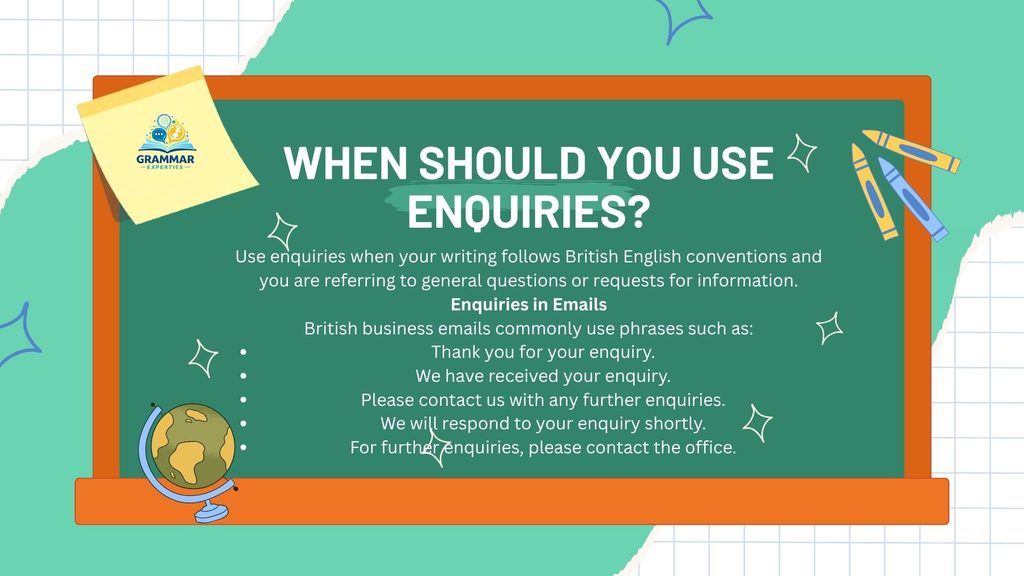
Use enquiries when your writing follows British English conventions and you are referring to general questions or requests for information.
Enquiries in Emails
British business emails commonly use phrases such as:
- Thank you for your enquiry.
- We have received your enquiry.
- Please contact us with any further enquiries.
- We will respond to your enquiry shortly.
- For further enquiries, please contact the office.
These expressions are natural in British English.
Enquiries in Customer Service
British companies may write:
For all customer enquiries, please contact our support team.
Or:
Our team is available to answer your enquiries.
If the website is specifically written in British English, maintaining enquiries throughout the site can help preserve consistency.
Enquiries in Education
British educational institutions may use expressions such as:
- course enquiries
- student enquiries
- admissions enquiries
- international enquiries
- general enquiries
For example:
For admissions enquiries, please contact the university directly.
If the institution follows American English, admissions inquiries would be expected instead.
When Should You Use Inquiries?
Use inquiries when writing in American English. It is also used in British English, particularly for formal investigations or where an organisation’s established style uses the spelling.
Inquiries in American Business Writing
American companies commonly use phrases such as:
- customer inquiries
- media inquiries
- sales inquiries
- product inquiries
- general inquiries
- information inquiries
Examples:
Please send all media inquiries to the communications department.
Our customer service team handles hundreds of inquiries every week.
Inquiries for Official Investigations
The word inquiry is particularly common when discussing a formal investigation.
Examples:
- The committee launched an inquiry.
- An official inquiry was ordered.
- The government announced an inquiry into the matter.
- The inquiry examined the available evidence.
This use occurs in both British and American English.
Inquiry in Academic Writing
Inquiry is also common in academic contexts.
For example:
Scientific inquiry depends on careful observation and evidence.
Here, inquiry describes the process of investigating or seeking knowledge.
Therefore, even British writers may naturally encounter inquiry in academic, legal, governmental, and investigative contexts.
Enquiries vs Inquiries: A Real-Life Usage Example
Imagine a British university has an international admissions department.
A prospective student sends an email asking:
Could you tell me whether international students need to submit an English-language test?
The university might reply:
Thank you for your enquiry. Our admissions team will review your question and respond shortly.
Now imagine an American university receiving the same type of message.
Its response might say:
Thank you for your inquiry. Our admissions team will respond shortly.
The meaning has not changed. The difference is the spelling convention.
Now consider a more formal investigation.
A British newspaper might report:
The government announced an inquiry into the circumstances surrounding the incident.
An American newspaper might write:
The government announced an inquiry into the circumstances surrounding the incident.
In this situation, both varieties naturally use inquiry.
This illustrates why the simple rule “enquiry is British and inquiry is American” is useful but incomplete. British English uses both spellings, while American English overwhelmingly relies on inquiry.
For writers, the practical lesson is straightforward: identify your target variety first, then follow the convention consistently.
2025–2026 Usage and Dictionary Evidence
There is an important point about current usage: dictionaries do not treat enquiry as a misspelling of inquiry.
Current dictionary entries continue to document both forms. Oxford Learner’s Dictionaries labels enquiry as especially British English and identifies inquiry as a North American English form as well as a British form. Its usage note explains that British writers sometimes use enquiry for general requests and inquiry for official investigations, but the distinction is not absolute.
Cambridge Dictionary similarly identifies enquiry as a UK form and inquiry as the standard headword, with enquiry listed as a UK alternative.
A current 2026 usage snapshot therefore gives us three useful facts:
- Two established spellings are documented: enquiry and inquiry.
- British English uses both, with enquiry especially associated with general requests.
- American English generally uses inquiry for both general questions and investigations.
It is better to use these dictionary-based facts than to claim a precise percentage split between the spellings without a clearly defined corpus. Search-volume figures can also vary by country, search engine, date range, and user intent, so they should not be presented as universal language statistics.
Microsoft’s updated writing guidance, published in 2023 and updated in April 2025, likewise explains the regional distinction and notes that inquiry is the more common form in American English.
What the Current Evidence Tells Writers
The evidence does not support calling enquiries incorrect.
Instead, it supports a regional usage rule:
- British English: enquiries is common and natural.
- American English: inquiries is the standard choice.
- Formal investigations: inquiry is widely used in both varieties.
- International writing: choose a consistent English variety and follow it throughout the document.
Common Mistakes With Enquiries and Inquiries
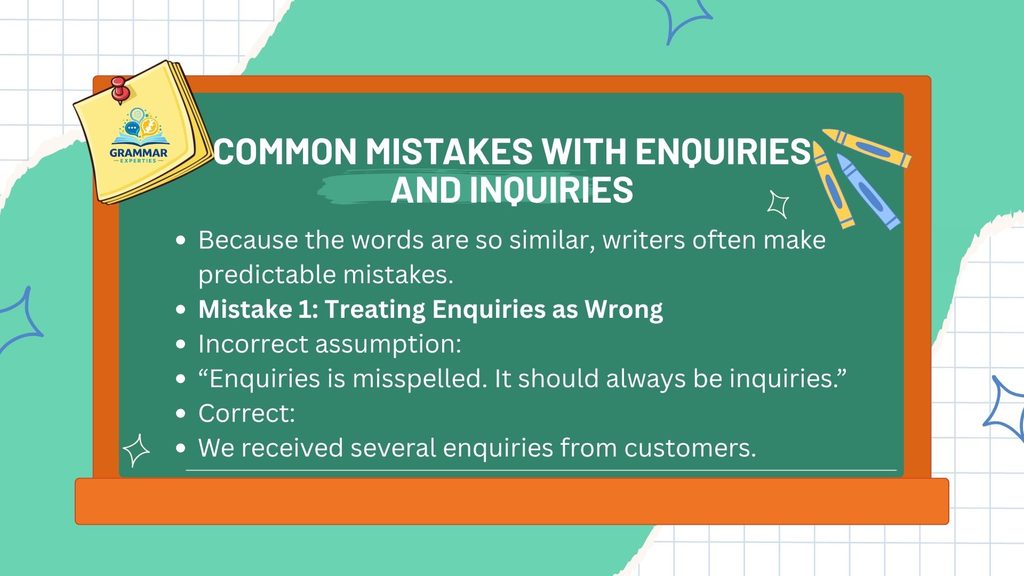
Because the words are so similar, writers often make predictable mistakes.
Mistake 1: Treating Enquiries as Wrong
Incorrect assumption:
“Enquiries is misspelled. It should always be inquiries.”
That is not accurate.
Enquiries is an established British English spelling.
Correct:
We received several enquiries from customers.
Mistake 2: Using Both Forms Randomly
A document might contain:
Please send all enquiries to our office.
Later, the same document says:
We will respond to all customer inquiries within 24 hours.
This may not make the text grammatically incorrect, but it creates unnecessary inconsistency if the document is intended to follow one variety of English.
Choose one convention and stick with it.
Mistake 3: Assuming British English Only Uses Enquiry
British English can use inquiry, especially for formal investigations.
For example:
An official inquiry was launched.
Therefore, saying that inquiry is always American is too simplistic.
Mistake 4: Confusing the Plural Forms
Remember:
- enquiry → enquiries
- inquiry → inquiries
The spelling changes in the plural.
For example:
one enquiry → several enquiries
and:
one inquiry → several inquiries
Enquiry vs Inquiry vs Enquire vs Inquire
The noun forms are part of a larger word family.
| Word | Common British Usage | Common American Usage |
|---|---|---|
| enquire | ask for information | inquire is preferred |
| inquiry | formal investigation / also general use | general or formal use |
| enquiry | general request for information | uncommon |
| inquiries | possible, especially formal contexts | standard plural |
| enquiries | common for general requests | uncommon |
Enquire in British English
British English often uses enquire when someone asks for information.
Example:
I called the hotel to enquire about room availability.
Inquire in American English
American English generally uses inquire:
I called the hotel to inquire about room availability.
Again, British English can also use inquire, particularly in formal contexts.
How to Choose the Correct Spelling
You can make the decision in three simple steps.
Step 1: Identify Your Audience
Ask yourself who will read the document.
If your audience primarily uses British English, enquiries may be the natural choice for ordinary requests.
If your audience primarily uses American English, choose inquiries.
Step 2: Check the Context
If you are describing an official investigation, inquiry is widely accepted in both varieties.
For a simple request for information in British English, enquiry is a common choice.
Step 3: Stay Consistent
Once you select a spelling convention, use it consistently.
For example, a British-English website could use:
customer enquiries
sales enquiries
product enquiries
An American-English website could use:
customer inquiries
sales inquiries
product inquiries
Consistency is often more useful than trying to create an artificial rule where English usage is flexible.
Quick Comparison Checklist
Before publishing your writing, use this checklist:
- Is my audience British or American?
- Am I writing about a general request or an official investigation?
- Am I using British or American spelling consistently?
- Have I checked the singular and plural forms?
- Does the organisation have its own style guide?
- Have I avoided switching between enquiries and inquiries without a reason?
This simple check can prevent most errors.
Mini Quiz:Enquiries or Inquiries
1. Which spelling is especially common in British English for a general request for information?
A) Enquiry
B) Inquery
C) Enquerry
D) Inquerry
Answer: A) Enquiry
2. Which spelling is standard in American English for a request for information?
A) Enquiries
B) Inquiries
C) Enquirys
D) Inquaries
Answer: B) Inquiries
3. “Enquiries” is a correct English spelling used especially in British English.
A) True
B) False
Answer: True
4. What is the correct plural of “inquiry”?
A) Inquirys
B) Inquiryes
C) Inquiries
D) Inquirries
Answer: C) Inquiries
5. Which sentence follows common British English usage?
A) We received several customer enquiries.
B) We received several customer inquirys.
C) We received several customer enquerries.
D) We received several customer inquerys.
Answer: A) We received several customer enquiries.
6. Which sentence is appropriate in standard American English?
A) Please send all customer enquiries to us.
B) Please send all customer inquiries to us.
C) Please send all customer enquires to us.
D) Please send all customer inquieries to us.
Answer: B) Please send all customer inquiries to us.
7. Which of these are standard English words? Select all that apply.
A) Enquiry
B) Inquiry
C) Enquiries
D) Inquirry
Answers: A, B, C
8. In British English, which spelling is commonly used for an official investigation?
A) Inquiry
B) Inquery
C) Enquerry
D) Inquary
Answer: A) Inquiry
9. American English normally uses “inquiries” for both general requests and formal investigations.
A) True
B) False
Answer: True
10. Which pair correctly shows the singular and plural British forms?
A) Enquiry → Enquiries
B) Enquiry → Enquiryes
C) Enquary → Enquaries
D) Enquirry → Enquirries
Answer: A) Enquiry → Enquiries
11. Which sentence best fits American English?
A) Thank you for your enquiry about the course.
B) Thank you for your inquiry about the course.
C) Thank you for your enquary about the course.
D) Thank you for your inquerry about the course.
Answer: B) Thank you for your inquiry about the course.
12. What does “enquiry” generally mean in British English?
A) A request for information
B) A type of punctuation
C) A spelling rule
D) A business contract
Answer: A) A request for information
13. Which word is the American English equivalent commonly used where British English may use “enquire”?
A) Inquire
B) Inquiry
C) Enquiry
D) Inquiringly
Answer: A) Inquire
14. Which sentence uses the plural noun correctly?
A) We answered five enquiries today.
B) We answered five enquiry today.
C) We answered five enquires today.
D) We answered five inquieries today.
Answer: A) We answered five enquiries today.
15. Which statement best describes the UK-versus-US spelling difference?
A) UK often uses enquiry; US uses inquiry.
B) UK always uses inquiry; US always uses enquiry.
C) Only enquiry is correct English.
D) Only inquiry is correct English.
Answer: A) UK often uses enquiry; US uses inquiry.
16. Which phrases are natural? Select all that apply.
A) Customer enquiries
B) Media inquiries
C) Sales enquiries
D) Media inquirys
Answers: A, B, C
17. A British university wants a heading for ordinary questions from prospective students. Which is natural?
A) Student Enquiries
B) Student Inquirys
C) Student Enquaries
D) Student Inquieries
Answer: A) Student Enquiries
18. Choose the correct American English word:
“The company received hundreds of customer ______ this month.”
A) Enquiries
B) Inquiries
C) Enquarys
D) Inquirys
Answer: B) Inquiries
19. Which spelling is appropriate for the noun meaning an official investigation in both UK and US English?
A) Inquiry
B) Inquery
C) Enquary
D) Inquerry
Answer: A) Inquiry
20. What is the best general rule when choosing between “enquiries” and “inquiries”?
A) Choose according to your English variety and stay consistent.
B) Always use enquiries everywhere.
C) Always use inquiries everywhere.
D) Switch spellings randomly.
Answer: A) Choose according to your English variety and stay consistent.
21. Which sentence is natural in British English?
A) Please contact us with any further enquiries.
B) Please contact us with any further inquirys.
C) Please contact us with any further enquarys.
D) Please contact us with any further inquieries.
Answer: A) Please contact us with any further enquiries.
22. Which sentence is natural in American English?
A) We will respond to your enquiry shortly.
B) We will respond to your inquiry shortly.
C) We will respond to your inquery shortly.
D) We will respond to your enquary shortly.
Answer: B) We will respond to your inquiry shortly.
23. Which spelling is most commonly associated with British English?
A) Enquiry
B) Inquiry
C) Inquery
D) Enquary
Answer: A) Enquiry
24. Which spelling is most commonly preferred in American English?
A) Enquiry
B) Enquire
C) Inquiry
D) Enquary
Answer: C) Inquiry
25. Which statement is correct?
A) “Enquiries” is always incorrect.
B) “Inquiries” is always incorrect in British English.
C) Both “enquiries” and “inquiries” are established English forms.
D) Neither spelling is correct.
Answer: C) Both “enquiries” and “inquiries” are established English forms.
Frequently Asked Questions
Q1:Is “enquiries” correct English?
Yes. Enquiries is a correct plural form of enquiry and is especially common in British English. It is frequently used for general questions or requests for information.
Q2:Is “inquiries” correct English?
Yes. Inquiries is the standard plural form of inquiry. It is the normal spelling in American English and is also used in British English.
Q3:Is enquiries British or American?
Enquiries is strongly associated with British English. American English normally uses inquiries instead.
Q4:Is inquiry American or British?
Inquiry is standard in American English and is also used in British English. In British English, it can be particularly common when referring to a formal investigation.
Q5:What is the plural of enquiry?
The plural is enquiries.
Example:
We received several enquiries from customers.
Q6:What is the plural of inquiry?
The plural is inquiries.
Example:
The company received hundreds of inquiries about the product.
Q7:Can I use “inquiry” in British English?
Yes. Inquiry is used in British English, especially in contexts involving formal investigations. British English also permits overlap between enquiry and inquiry.
Q8:Which spelling should I use in an American English article?
Use inquiry and inquiries when writing for an American audience. These are the standard American forms.
Conclusion
So, enquiries or inquiries — which spelling is correct? The answer is that both are correct, but the appropriate choice depends on regional English and, in British English, sometimes the context.
Use enquiries when following British English and referring to general requests for information. Use inquiries when writing in American English. For formal investigations, inquiry is widely used in both British and American English.
The most important rule is not to treat one spelling as universally right and the other as universally wrong. Instead, identify your audience, choose the appropriate English variety, and remain consistent.
If you are writing a British-English website, email, letter, or article, enquiries will often be the natural choice for everyday requests. If you are writing for an American audience, inquiries is the standard option.
Keep this simple rule in mind:
UK English: enquiries is common for general requests; inquiry is also used, especially for investigations.
US English: inquiries is the standard spelling for both general requests and investigations.
Explore more easy grammar lessons and improve your English with Grammar Expertise
References
Oxford Learner’s Dictionaries — Enquiry
Oxford Learner’s Dictionaries — Inquiry

Maimoona Mughal is an English grammar enthusiast dedicated to simplifying confusing words, grammar rules, and vocabulary through clear, accurate, and learner-friendly content that helps readers write and communicate with confidence.