If you are wondering whether “frie” or “fry” is the correct spelling in English, the answer is simple: fry is correct. “Frie” is not the standard spelling of the English word used for cooking food in oil or fat.
The confusion is understandable because fry is pronounced /fraɪ/, and English has several words whose spellings do not perfectly match their pronunciation. However, when you want to say that you are cooking something in hot oil or fat, the correct word is fry.
In this guide, you will learn why fry is correct, what “frie” means, how to use fry in a sentence, and how to remember the spelling easily.
Frie or Fry: Which Spelling Is Correct?
The correct spelling is fry.
Frie is generally a misspelling when someone intends to use the verb “fry.” Major English dictionaries list fry as the standard word. Merriam-Webster defines fry as cooking food in a pan or on a griddle, especially with fat, while Cambridge Dictionary defines it as cooking food in hot oil or fat.
Fry is the correct spelling
Use fry when you mean to cook food in hot oil, fat, or a hot cooking surface.
Examples:
- I will fry the eggs for breakfast.
- Please fry the onions until they turn golden.
- She likes to fry chicken in a deep pan.
- We need to fry the potatoes before serving them.
Frie is not the standard spelling
When “frie” is used to mean “fry,” it is a spelling mistake.
For example:
- ❌ I will frie the eggs.
- ✅ I will fry the eggs.
The same rule applies in formal writing, schoolwork, articles, emails, recipes, and other standard English contexts.
What Does Fry Mean?
The word fry has more than one meaning, although its cooking meaning is probably the one most people encounter.
Fry as a cooking verb
As a verb, fry means to cook food using hot oil or fat. Cambridge Dictionary lists this as a B1-level English meaning.
For example:
Fry the onions in a little butter.
Other examples include:
- Fry the chicken until it is fully cooked.
- He fried an egg for breakfast.
- We are frying vegetables for dinner.
The word can also describe food that is being cooked:
The onions are frying in the pan.
Fry as a noun
Fry can also be a noun. Merriam-Webster lists several noun meanings, including something fried and the young of fish or other animals.
For example:
- We ordered fish and fries.
- The pond was full of young fry.
- The phrase small fry can refer to someone or something considered unimportant.
This second meaning can sometimes surprise English learners because fry is not only connected with cooking.
Fry can have informal meanings
In informal English, fry can also describe something being badly damaged by heat or excessive electrical power.
For example:
- The excessive heat could fry the computer.
- The electrical surge fried the circuit.
This is a different meaning from cooking, but the spelling remains fry.
Why Is Fry Spelled With Y?
The spelling fry has a long history in English.
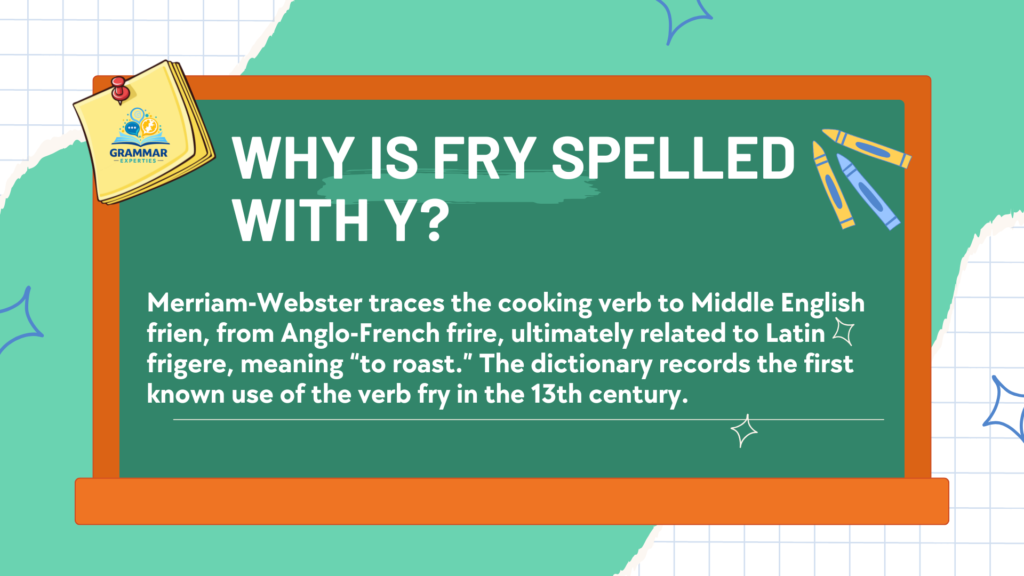
Merriam-Webster traces the cooking verb to Middle English frien, from Anglo-French frire, ultimately related to Latin frigere, meaning “to roast.” The dictionary records the first known use of the verb fry in the 13th century.
The spelling is not “frie”
It can be tempting to write frie because the pronunciation ends with the long “i” sound.
However, English spelling does not always follow pronunciation in a predictable way.
Compare:
- fry
- try
- cry
- dry
- fly
- sky
These common words all use y at the end.
Therefore, when you want to write the cooking verb, remember:
Fry = correct
Frie = incorrect
Fry, fried, frying, and fries
One useful way to avoid the spelling mistake is to learn the common forms together:
| Form | Example |
|---|---|
| fry | I will fry the eggs. |
| fried | She fried the chicken. |
| frying | He is frying onions. |
| fries | We ordered French fries. |
Notice that the base word is fry, but its spelling changes when certain endings are added.
For example, fry → fried and fry → frying.
Frie vs Fry: Examples You Can Remember
The easiest way to understand the difference is to see the two spellings side by side.
Correct and incorrect examples
| Incorrect | Correct |
|---|---|
| I will frie the egg. ❌ | I will fry the egg. ✅ |
| She wants to frie potatoes. ❌ | She wants to fry potatoes. ✅ |
| Please frie the chicken. ❌ | Please fry the chicken. ✅ |
| He is going to frie onions. ❌ | He is going to fry onions. ✅ |
| We frie the vegetables in oil. ❌ | We fry the vegetables in oil. ✅ |
There is an important point here: “frie” should not be used as the ordinary spelling of the cooking verb.
A simple memory trick
Think of these words:
try → cry → dry → fry
They all end in Y.
So if you are unsure whether to write frie or fry, remember:
Fry rhymes with try.
That small association can make the correct spelling much easier to remember.
Fry in British and American English
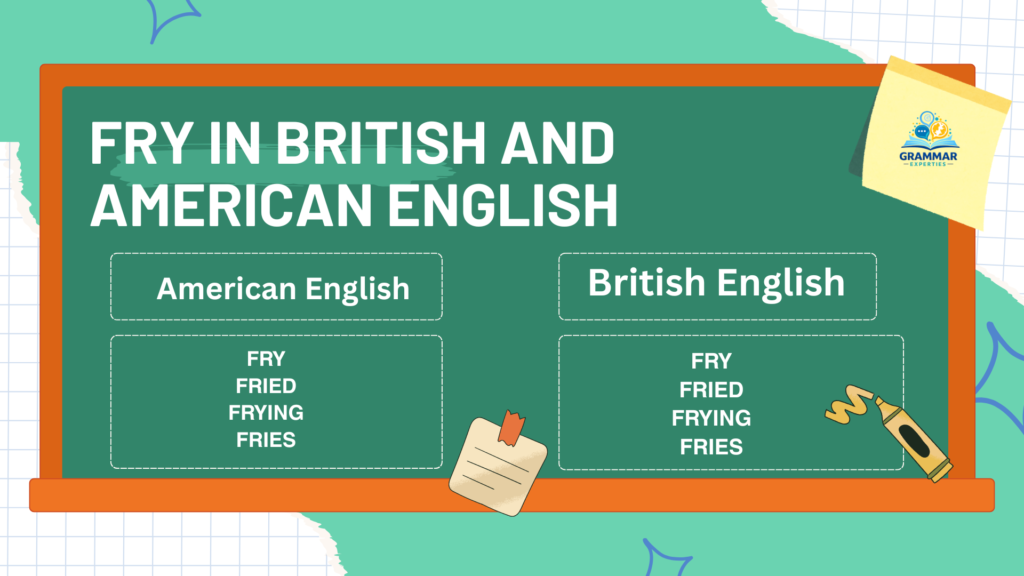
Another common question is whether British and American English use different spellings.
The answer is no for the verb.
American English
American English uses:
- fry
- fried
- frying
- fries
Example:
I need to fry some potatoes.
British English
British English also uses:
- fry
- fried
- frying
- fries
Example:
I need to fry some potatoes.
The spelling of the verb fry does not change between these varieties of English.
There can, however, be differences in food vocabulary. For example, French fries are commonly called chips in British English. That is a vocabulary difference, not a change from fry to frie.
Real-Life Example: How This Spelling Mistake Happens
Consider a student learning English as a second language.
The student wants to write a recipe for breakfast and types:
“First, frie two eggs in a pan.”
At first glance, the spelling may look reasonable. The pronunciation of fry is /fraɪ/, so someone who is learning English might naturally think that the final sound should be represented by ie.
The student checks a dictionary and finds fry instead. The corrected sentence becomes:
“First, fry two eggs in a pan.”
This small correction matters because spelling errors can change how professional or reliable writing appears. In a school assignment, recipe, blog post, product description, or business document, using the standard spelling helps readers understand the writer’s meaning immediately.
The same issue can happen when someone writes quickly on a phone. Autocorrect, pronunciation, and unfamiliar spelling patterns can all contribute to mistakes. Once the learner connects fry with words such as try, cry, dry, and fly, the spelling becomes easier to remember.
This is also a useful example of why checking a trusted dictionary is better than relying only on pronunciation. English contains many spelling patterns that cannot always be predicted simply by listening to a word.
2025–2026 Dictionary Evidence About Fry
Current dictionary evidence strongly supports fry as the standard spelling.
What current sources show
As of 2026:
- Merriam-Webster lists fry as a verb meaning to cook food, with its first known use recorded in the 13th century. Its entry was updated in March 2026.
- Cambridge Dictionary lists fry as an English verb pronounced /fraɪ/ and defines it as cooking food in hot oil or fat.
- Merriam-Webster also documents related forms and meanings, including fried, frying, fries, and the noun fry.
This provides a useful 2025–2026 reference point: major contemporary dictionaries continue to recognize fry as the standard English spelling.
It is worth noting that there is no reliable universal statistic showing exactly how many English speakers type “frie” instead of “fry.” Search suggestions and isolated online examples should not be treated as authoritative language statistics. For spelling questions, established dictionaries provide stronger evidence than unsupported usage claims.
How to Remember the Correct Spelling
You do not need a complicated grammar rule to remember fry.
Use the rhyme trick
Remember:
Try → Cry → Dry → Fry
All four end with Y.
So:
“I will fry the egg.”
not:
“I will frie the egg.”
Learn the word family
Memorizing related forms can also help:
- fry
- fried
- frying
- fries
Seeing these forms repeatedly makes the spelling more familiar.
Check the meaning before choosing the spelling
If you mean cook something in hot oil or fat, use fry.
For example:
We need to fry the fish.
If you are talking about the food itself:
We ordered fries with our burgers.
This distinction can prevent both spelling and word-form mistakes.
Mini Quiz: Frie or Fry
- Which spelling is correct?
A) Frie
B) Fry
C) Frey
D) Fri
Answer: B) Fry - Which sentence is correct?
A) I will frie the eggs.
B) I will fry the eggs.
C) I will frey the eggs.
D) I will fri the eggs.
Answer: B) I will fry the eggs. - What does “fry” usually mean?
A) To freeze food
B) To cook food in hot oil or fat
C) To wash food
D) To cut food
Answer: B) To cook food in hot oil or fat - Which word rhymes with “fry”?
A) Free
B) Try
C) Frie
D) Tree
Answer: B) Try - Complete the sentence: “Please ___ the chicken.”
A) frie
B) fry
C) frey
D) fri
Answer: B) fry - What is the past tense of “fry”?
A) Fryed
B) Frie
C) Fried
D) Fride
Answer: C) Fried - Which spelling is correct?
A) Frying
B) Frieing
C) Freying
D) Friing
Answer: A) Frying - Choose the correct sentence:
A) She fried two eggs.
B) She fryed two eggs.
C) She frie two eggs.
D) She fride two eggs.
Answer: A) She fried two eggs. - Which word is the base form?
A) Fried
B) Frying
C) Fries
D) Fry
Answer: D) Fry - Which spelling should you use in a recipe?
A) Frie
B) Fry
C) Frey
D) Fri
Answer: B) Fry - Complete the sentence: “He is ___ vegetables.”
A) frieing
B) frying
C) fryed
D) freying
Answer: B) frying - Which one is NOT the standard spelling of the cooking verb?
A) Fry
B) Fried
C) Frying
D) Frie
Answer: D) Frie - What is the correct word for cooked food such as potatoes served with a burger?
A) Fries
B) Friez
C) Friezes
D) Frise
Answer: A) Fries - Which sentence sounds correct?
A) We need to fry the onions.
B) We need to frie the onions.
C) We need to fryed the onions.
D) We need to frieing the onions.
Answer: A) We need to fry the onions. - Which word belongs to the same spelling pattern as “fry”?
A) Try
B) Tree
C) Free
D) See
Answer: A) Try - What is the correct form? “She ___ vegetables every evening.”
A) fry
B) fries
C) fried
D) frying
Answer: B) fries - Which sentence uses “fried” correctly?
A) I fried an egg yesterday.
B) I fryed an egg yesterday.
C) I frie an egg yesterday.
D) I frying an egg yesterday.
Answer: A) I fried an egg yesterday. - True or False: “Frie” is the standard spelling of the verb “fry.”
A) True
B) False
Answer: B) False - Which spelling is correct in both British and American English?
A) Frie
B) Fry
C) Frey
D) Fri
Answer: B) Fry - Complete the memory pattern: “Try → Cry → Dry → ___”
A) Frie
B) Free
C) Fry
D) Fri
Answer: C) Fry - Which sentence is grammatically and correctly spelled?
A) Mom is frying potatoes.
B) Mom is frieing potatoes.
C) Mom is fryeing potatoes.
D) Mom is fryed potatoes.
Answer: A) Mom is frying potatoes. - What should you write instead of “I will frie the fish”?
A) I will fry the fish.
B) I will fried the fish.
C) I will frying the fish.
D) I will frieing the fish.
Answer: A) I will fry the fish. - Which word is spelled correctly?
A) Frie
B) Fry
C) Frye
D) Frey
Answer: B) Fry - Quick Challenge: Spot the mistake — “She wants to frie an egg.” What should change?
A) She → He
B) Wants → Want
C) Frie → Fry
D) Egg → Eggs
Answer: C) Frie → Fry - Final Challenge: Which sentence has NO spelling mistake?
A) I will frie the chicken.
B) She fryed the eggs.
C) He is frying potatoes.
D) We are frieing vegetables.
Answer: C) He is frying potatoes.
Frequently Asked Questions
Q1: Is “frie” a correct English word?
Frie is not the standard spelling of the cooking verb fry. If you mean “cook something in hot oil or fat,” use fry.
Q2: Is it “fry” or “frie” an egg?
The correct phrase is “fry an egg.”
Example:
I am going to fry an egg.
Q3: Why do people spell fry as frie?
The mistake can happen because fry is pronounced /fraɪ/, and English learners may expect the final sound to be written with ie. However, the standard spelling is fry.
Q4: What is the past tense of fry?
The past tense is fried.
Example:
She fried the eggs this morning.
Q5: Is “fried” spelled with an e?
Yes. The correct past-tense form is fried:
fry → fried
For example:
He fried the chicken.
Q6: Is “fries” correct?
Yes. Fries is correct when referring to multiple items of food or, depending on context, the third-person singular form of the verb.
Examples:
We ordered fries.
She fries vegetables every evening.
Q7: Is fry spelled differently in British English?
No. The verb is spelled fry in both British and American English. Some related food terms differ between varieties, but fry itself does not change.
Q8: What is the easiest way to remember fry?
Think of the rhyme:
try, cry, dry, fry
If you remember those four words together, you are less likely to write frie by mistake.
Conclusion: Frie or Fry?
So, frie or fry which spelling is correct?
The answer is fry.
Use fry when you mean to cook food in hot oil, fat, or a hot cooking surface. Frie is not the standard spelling for this meaning. Current English dictionaries, including Merriam-Webster and Cambridge Dictionary, support fry as the correct form.
Remember the simple pattern:
Try → Cry → Dry → Fry
Once you connect fry with these familiar words, the spelling becomes much easier to remember.
If you often confuse similar English spellings, keep a trusted dictionary nearby and check unfamiliar words before publishing or submitting your writing. A few seconds of checking can make your English clearer, more accurate, and more professional.
Explore more easy grammar lessons and improve your English with Grammar Expertise
References

Maimoona Mughal is an English grammar enthusiast dedicated to simplifying confusing words, grammar rules, and vocabulary through clear, accurate, and learner-friendly content that helps readers write and communicate with confidence.