Have you ever written emphasize and wondered whether emphasise is actually the correct spelling? Or perhaps you’ve seen both forms in British and American articles and aren’t sure which one to use.
The good news is that both “emphasize” and “emphasise” are correct spellings. They have the same meaning and pronunciation. The main difference is the English variety and style convention being followed.
In general, American English uses “emphasize,” while British English commonly uses “emphasise.” However, British English also accepts -ize spellings in many words, particularly in styles associated with Oxford. Cambridge identifies emphasise as the usual UK spelling, while Oxford lists emphasize as the main form and notes emphasise as a British English alternative.
So, which spelling should you choose? Let’s examine the difference, meaning, examples, grammar, regional usage, and practical rules.
Emphasize or Emphasise: Which Spelling Is Correct?
The short answer is simple:
- Emphasize is the standard spelling in American English.
- Emphasise is a common and standard spelling in British English.
- Both forms mean to give special importance or attention to something.
- The pronunciation is essentially the same.
- British English can also use emphasize, depending on the style guide.
Cambridge Dictionary defines emphasize as showing that something is especially important or deserves attention and specifically marks emphasise as the usual UK spelling.
What Does Emphasize Mean?
Emphasize is a verb meaning to give extra importance, attention, or force to something.
For example:
The teacher wanted to emphasize the importance of regular practice.
Here, emphasize means to make the importance of regular practice particularly clear.
You can also emphasize a physical or visual feature:
The lighting emphasizes the painting’s bright colors.
The word can therefore describe both verbal emphasis and something that makes a feature more noticeable.
What Does Emphasise Mean?
Emphasise has exactly the same meaning.
For example:
The teacher wanted to emphasise the importance of regular practice.
The sentence means exactly the same thing. Only the spelling changes.
British English commonly uses -ise in words such as:
- emphasise
- organise
- realise
- recognise
- apologise
- criticise
American English generally uses:
- emphasize
- organize
- realize
- recognize
- apologize
- criticize
The difference is primarily a spelling convention rather than a difference in meaning.
Quick Answer: Emphasize vs Emphasise
| Feature | Emphasize | Emphasise |
|---|---|---|
| American English | Common | Not the usual US form |
| British English | Accepted in some styles | Common/usually preferred |
| Meaning | Give importance or attention | Give importance or attention |
| Pronunciation | Same | Same |
| Part of speech | Verb | Verb |
| Past tense | emphasized | emphasised |
| -ing form | emphasizing | emphasising |
Therefore, neither spelling is simply a “misspelling.” Your choice should match your audience and the style guide you are following.
Emphasize vs Emphasise in UK and USA English
The biggest practical difference appears when you compare American and British spelling conventions.
Emphasize in American English
If you are writing for an American audience, emphasize is the normal choice.
Examples:
- The report emphasizes the need for better planning.
- I want to emphasize one important point.
- The teacher emphasized the value of clear writing.
- The article emphasizes practical solutions.
- We should emphasize the importance of safety.
American English generally uses -ize for this group of verbs. A US-focused style guide therefore normally expects emphasize, not emphasise.
Emphasise in British English
If you are writing in a British English style that uses -ise, choose emphasise.
Examples:
- The report emphasises the need for better planning.
- I want to emphasise one important point.
- The teacher emphasised the value of clear writing.
- The article emphasises practical solutions.
- We should emphasise the importance of safety.
The OECD’s 2025 Style Guide, for example, explicitly requires British English and says its content should use -ise rather than -ize in relevant words such as organise and realise.
Is “Emphasize” Wrong in British English?
No.
This is an important point because British spelling is sometimes presented as though every verb must use -ise. That isn’t accurate.
Collins notes that both -ize and -ise are acceptable in Britain for many verbs. It also explains that -ize is preferred by some British styles.
Oxford’s dictionary likewise lists emphasize as its main headword and states that emphasise is also used in British English.
So a British writer may encounter either:
The report emphasises the problem.
or:
The report emphasizes the problem.
The important thing is to follow the required style consistently.
Why Do Emphasize and Emphasise Have Different Spellings?
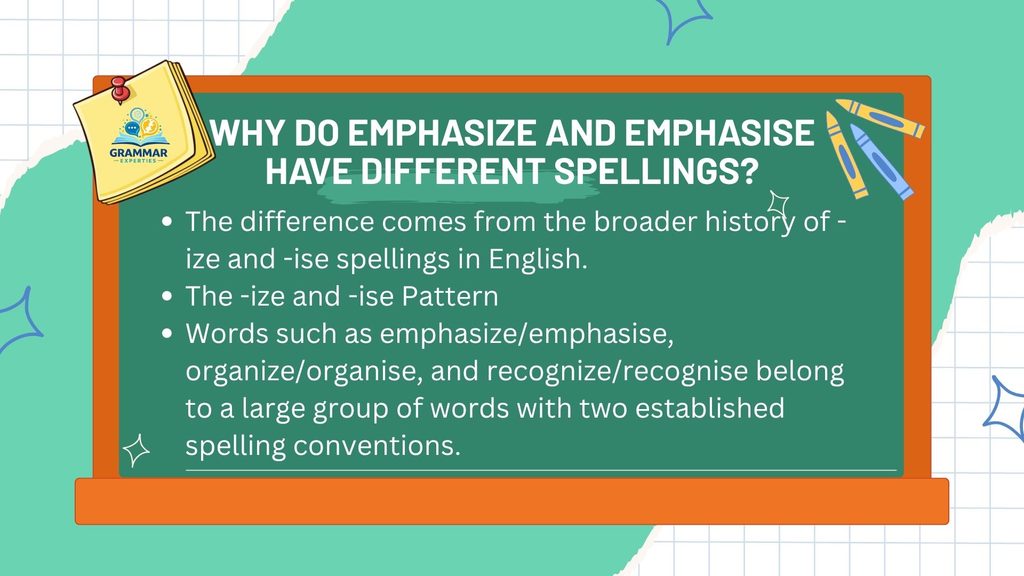
The difference comes from the broader history of -ize and -ise spellings in English.
The -ize and -ise Pattern
Words such as emphasize/emphasise, organize/organise, and recognize/recognise belong to a large group of words with two established spelling conventions.
American English generally favors -ize:
- organize
- recognize
- realize
- emphasize
- specialize
British English commonly uses -ise:
- organise
- recognise
- realise
- emphasise
- specialise
However, British English does not universally reject -ize. Collins specifically explains that -ize is preferred in Britain and the US for many verbs, while -ise is also acceptable in British English.
Oxford Style and -ize
One reason the situation can seem confusing is that some British publishers and institutions use -ize.
Oxford’s dictionary uses emphasize as its main entry while identifying emphasise as a British English form.
This means you should not automatically assume:
-ize = American only
A more accurate rule is:
-ize is standard in American English and is also accepted by some British styles; -ise is especially common in British English.
Other Examples of the Same Pattern
The same distinction appears in many familiar words:
| Common UK Form | US Form |
|---|---|
| emphasise | emphasize |
| organise | organize |
| realise | realize |
| recognise | recognize |
| apologise | apologize |
| criticise | criticize |
| specialise | specialize |
| centralise | centralize |
There are exceptions, so you shouldn’t mechanically change every word ending in -ise to -ize. Words such as advertise, advise, revise, and exercise do not follow the same pattern because their -ise ending is not functioning in the same way.
How to Use Emphasize and Emphasise Correctly
Knowing the spelling is only part of the answer. You also need to use the verb correctly in a sentence.
Emphasize Something
The most straightforward construction is:
emphasize + noun
Examples:
- The teacher emphasized the importance of reading.
- The report emphasises the need for reform.
- The manager emphasized the deadline.
- The article emphasises the main problem.
Notice that the verb can be followed directly by the thing receiving emphasis.
Emphasize That Something Is Important
You can also use emphasize that before a clause.
Examples:
The doctor emphasized that regular exercise is important.
The teacher emphasised that every student should participate.
The report emphasizes that further research is needed.
This construction is particularly common in formal and academic writing.
Emphasize a Point
Another common expression is:
emphasize a point
Examples:
- I want to emphasize one point.
- The speaker emphasised an important point.
- She repeatedly emphasized the same point.
You can also use alternatives such as stress, highlight, underline, or draw attention to, depending on the context.
One useful grammar point is that “emphasize on” is generally not the standard construction when emphasize is used as a transitive verb.
Instead of:
❌ The report emphasizes on the importance of education.
Write:
✅ The report emphasizes the importance of education.
Or:
✅ The report places emphasis on the importance of education.
This distinction can make formal writing much more natural.
Emphasize or Emphasise: Examples in Real Writing
Seeing the two forms side by side makes the difference easier to remember.
American English Examples
The study emphasizes the importance of early education.
The manager emphasized the need to meet the deadline.
I want to emphasize that this information is confidential.
The design emphasizes simplicity and accessibility.
British English Examples
The study emphasises the importance of early education.
The manager emphasised the need to meet the deadline.
I want to emphasise that this information is confidential.
The design emphasises simplicity and accessibility.
The meaning does not change.
Formal Writing
American:
The researchers emphasize the importance of accurate data collection.
British:
The researchers emphasise the importance of accurate data collection.
Academic Writing
American:
The findings emphasize the relationship between language and communication.
British:
The findings emphasise the relationship between language and communication.
Workplace Writing
American:
I would like to emphasize the importance of submitting the report on time.
British:
I would like to emphasise the importance of submitting the report on time.
Everyday Writing
American:
I just want to emphasize one thing.
British:
I just want to emphasise one thing.
In every example, the spelling changes, but the meaning remains the same.
2025–2026 Evidence Snapshot: What Current References Show
There isn’t a single authoritative 2025–2026 global statistic that measures the percentage of English speakers who use emphasize versus emphasise. Search-volume figures published on individual websites should therefore not be treated as official language-use statistics.
However, current dictionary and style-guide evidence provides a clear picture.
| Current evidence | What it shows |
|---|---|
| Cambridge Dictionary, current entry | Lists emphasize and identifies emphasise as the usual UK spelling |
| Oxford Learner’s Dictionaries, current entry | Uses emphasize as the headword and notes emphasise as British English |
| OECD Style Guide, 2025 | Uses British English and explicitly requires -ise endings |
| Collins Dictionary | States that both -ize and -ise are acceptable in Britain for many verbs |
| Current 2026 dictionary examples | Both spellings continue to appear in contemporary English |
Cambridge’s current dictionary entry identifies emphasise as the usual UK spelling. Oxford’s current entry gives emphasize as the headword while explicitly recognizing emphasise in British English.
The 2025 OECD Style Guide provides a concrete institutional example of a modern organization choosing British -ise spelling consistently.
Therefore, the current evidence supports a style-based explanation rather than a claim that one spelling has replaced the other.
A Real-Life Editing Example: Choosing the Right Form
Imagine a writer in the United States is preparing an academic article for an American university. The writer has used the following sentence:
The researchers emphasise the importance of accurate data.
The sentence is understandable, and the meaning is correct. However, if the publication requires American English, the editor would normally change it to:
The researchers emphasize the importance of accurate data.
Now consider a British organization preparing a formal report under a house style that uses -ise spellings. The same sentence could appear as:
The researchers emphasise the importance of accurate data.
Both sentences communicate exactly the same idea.
The important lesson is not simply to memorize one spelling. Instead, look at the language system used by the document.
Suppose the rest of an American document contains color, organize, recognize, and realize. Using emphasise suddenly introduces a different spelling convention. It may not make the sentence grammatically wrong, but it can make the document’s style inconsistent.
Now imagine a British document using colour, organise, recognise, and realise. In that environment, emphasise fits naturally.
There is another possibility: a British publisher may deliberately use Oxford-style -ize spellings. In that case, emphasize may be exactly what the publisher expects.
This is why professional editing doesn’t rely on the simplistic rule that “British equals -ise and American equals -ize.” Audience matters, but house style matters too.
Oxford’s current dictionary treatment demonstrates this nuance particularly well: emphasize is the headword, while emphasise is identified as the British English form.
A Simple Guide to Choosing Emphasize or Emphasise
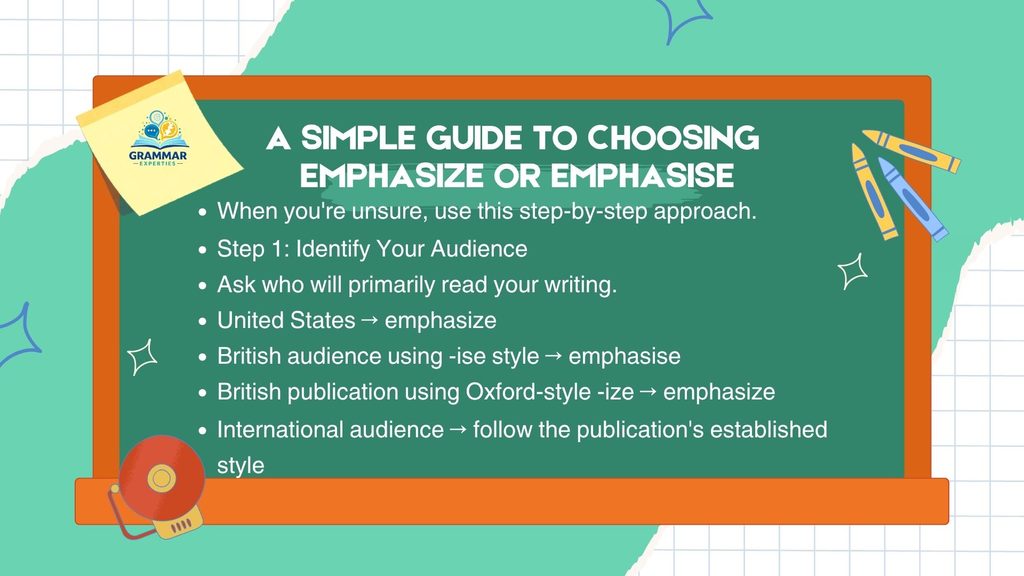
When you’re unsure, use this step-by-step approach.
Step 1: Identify Your Audience
Ask who will primarily read your writing.
- United States → emphasize
- British audience using -ise style → emphasise
- British publication using Oxford-style -ize → emphasize
- International audience → follow the publication’s established style
Step 2: Check the Existing Spelling Pattern
Look at similar words in your document.
If you already use:
organize, recognize, realize
then emphasize will usually fit.
If you use:
organise, recognise, realise
then emphasise will usually fit.
Step 3: Follow the Style Guide
If your employer, university, publisher, journal, or client provides a style guide, follow it.
A style guide can override a general regional preference.
For example, the 2025 OECD Style Guide specifically instructs writers to use British -ise endings.
Step 4: Stay Consistent
Consistency is more important than switching between forms simply because both are recognized.
Avoid writing:
The report emphasises the issue and emphasizes the solution.
unless there is a specific reason for quoting or reproducing different source styles.
For your own writing, select the appropriate convention and maintain it throughout the document.
Emphasize vs Emphasise: Common Mistakes
Mistake 1: Treating Emphasise as a Typo
❌ “Emphasise is wrong because American English uses emphasize.”
This is incorrect.
Emphasise is a standard British spelling. Cambridge explicitly identifies it as the usual UK form.
Mistake 2: Assuming Emphasize Is Never British
This is also too simplistic.
British English permits -ize spellings in many cases, and Oxford uses emphasize as its main dictionary headword.
Mistake 3: Mixing Spelling Systems
For example:
The organization emphasises the importance of color.
This combines British-style emphasises with American color.
That combination isn’t necessarily impossible in international English, but it may be inappropriate if your document is supposed to follow one consistent house style.
Mistake 4: Using “Emphasize On”
Avoid:
❌ The teacher emphasized on the importance of grammar.
Use:
✅ The teacher emphasized the importance of grammar.
Or:
✅ The teacher placed emphasis on the importance of grammar.
Mistake 5: Confusing the Verb With the Noun
Emphasize/emphasise is a verb.
Emphasis is a noun.
Examples:
The teacher emphasized the main idea.
The teacher placed emphasis on the main idea.
Don’t replace emphasis with emphasise or vice versa.
Mini Quiz :Emphasize or Emphasise
1. Which spelling is standard in American English?
A. Emphasise
B. Emphasize
C. Emphasyze
D. Emphazise
Answer: B. Emphasize
2. Which spelling is commonly used in British English?
A. Emphasize
B. Emphasise
C. Emphesize
D. Emphasyse
Answer: B. Emphasise
3. Do “emphasize” and “emphasise” have the same meaning?
A. Yes
B. No
C. Only in British English
D. Only in American English
Answer: A. Yes
4. What does “emphasize” mean?
A. To remove importance
B. To give special importance or attention
C. To shorten a sentence
D. To change pronunciation
Answer: B. To give special importance or attention
5. Choose the correct American English sentence.
A. The teacher emphasises the main point.
B. The teacher emphasizes the main point.
C. The teacher emphazises the main point.
D. The teacher emphisizes the main point.
Answer: B. The teacher emphasizes the main point.
6. Choose the common British English spelling.
A. The report emphasizes the issue.
B. The report emphasises the issue.
C. The report emphazises the issue.
D. The report emphesises the issue.
Answer: B. The report emphasises the issue.
7. Is “emphasise” a spelling mistake?
A. Yes, always
B. No, it is a standard British spelling
C. Yes, in British English
D. Only in formal writing
Answer: B. No, it is a standard British spelling
8. Which spelling is generally preferred in American English?
A. Emphasise
B. Emphasize
C. Emphasyse
D. Emphazise
Answer: B. Emphasize
9. Complete the sentence: “I want to ___ one important point.”
A. emphasise
B. emphasize
C. emphesize
D. emphasyze
Answer: B. emphasize (American English)
10. Complete the sentence using common British spelling: “I want to ___ one important point.”
A. emphasize
B. emphasise
C. emphesize
D. emphasize
Answer: B. emphasise
11. What is the American English past tense of “emphasize”?
A. Emphasised
B. Emphasized
C. Emphasizeed
D. Emphasizedd
Answer: B. Emphasized
12. What is the common British English past tense of “emphasise”?
A. Emphasized
B. Emphasised
C. Emphasiseded
D. Emphasiseed
Answer: B. Emphasised
13. What is the American English -ing form?
A. Emphasising
B. Emphasizing
C. Emphasizeing
D. Emphasizingg
Answer: B. Emphasizing
14. What is the common British English -ing form?
A. Emphasizing
B. Emphasising
C. Emphasiseing
D. Emphasing
Answer: B. Emphasising
15. Which sentence is grammatically correct?
A. The teacher emphasized the importance of grammar.
B. The teacher emphasized on the importance of grammar.
C. The teacher emphasized to the importance of grammar.
D. The teacher emphasized at the importance of grammar.
Answer: A. The teacher emphasized the importance of grammar.
16. Which word is the noun?
A. Emphasize
B. Emphasise
C. Emphasis
D. Emphasizing
Answer: C. Emphasis
17. Choose the correct sentence.
A. The speaker placed emphasis on the main issue.
B. The speaker placed emphasise on the main issue.
C. The speaker placed emphasize on the main issue.
D. The speaker placed emphasizing on the main issue.
Answer: A. The speaker placed emphasis on the main issue.
18. Which spelling follows the common British “-ise” convention?
A. Emphasize
B. Emphasise
C. Emphesize
D. Emphazise
Answer: B. Emphasise
19. Which spelling follows the standard American “-ize” convention?
A. Emphasise
B. Emphasize
C. Emphasyse
D. Emphazise
Answer: B. Emphasize
20. True or False: “Emphasize” and “emphasise” have different meanings.
Answer: False
21. True or False: “Emphasise” is commonly used in British English.
Answer: True
22. True or False: “Emphasize” is the standard American English spelling.
Answer: True
23. Which sentence is correct?
A. The study emphasizes the need for further research.
B. The study emphasizes on the need for further research.
C. The study emphasize on the need for further research.
D. The study emphasises on the need for further research.
Answer: A. The study emphasizes the need for further research.
24. Which sentence correctly uses the common British spelling?
A. The article emphasises the main problem.
B. The article emphasises on the main problem.
C. The article emphasise the main problem.
D. The article emphazises the main problem.
Answer: A. The article emphasises the main problem.
25. What is the easiest rule to remember?
A. US English → emphasize; common UK English → emphasise
B. US English → emphasise; UK English → emphasize only
C. Both spellings are wrong
D. Only “emphasise” is correct worldwide
Answer: A. US English → emphasize; common UK English → emphasise
Frequently Asked Questions
Q1:Is emphasize or emphasise correct?
Both emphasize and emphasise are correct spellings. Emphasize is standard in American English, while emphasise is commonly used in British English. British English also accepts emphasize in styles that use the -ize convention.
Q2:Is emphasize American or British English?
Emphasize is the standard American English spelling. It is also used in some British English styles, including Oxford-style writing.
Q3:Is emphasise British English?
Yes. Emphasise is a standard British English spelling and is identified by Cambridge as the usual UK form.
Q4:Do emphasize and emphasise mean the same thing?
Yes. They have the same meaning: to give special importance, attention, or force to something.
For example:
She emphasized the main point.
and
She emphasised the main point.
Both sentences mean the same thing.
Q5:Which spelling should I use in American English?
Use emphasize.
For example:
The report emphasizes the importance of clear communication.
This follows the standard American -ize spelling pattern.
Q6:Which spelling should I use in British English?
If you’re following the common British -ise convention, use emphasise.
For example:
The report emphasises the importance of clear communication.
However, some British styles use -ize, so check your publication or organization’s style guide when one exists.
Q7:Is “emphasize on” grammatically correct?
In standard usage, emphasize normally takes a direct object, so write:
The report emphasizes the problem.
Instead of:
The report emphasizes on the problem.
If you want to use on, use a construction such as:
The report places emphasis on the problem.
Q8:What is the past tense of emphasize and emphasise?
The past tense forms are:
- American: emphasized
- British: emphasised
Examples:
The speaker emphasized the main issue.
The speaker emphasised the main issue.
The difference follows the same -ize/-ise spelling pattern.
Q9:What is the -ing form?
The forms are:
- emphasizing — American English
- emphasising — British English
Examples:
The article is emphasizing the importance of accuracy.
The article is emphasising the importance of accuracy.
Again, the meaning is unchanged.
Final Answer: Emphasize or Emphasise?
Emphasize and emphasise are both correct.
Use emphasize when writing standard American English. Use emphasise when following the common British -ise spelling convention. However, remember that British English also permits -ize spellings in many words, particularly in styles associated with Oxford.
The easiest way to remember the distinction is:
US English → emphasize
Common UK English → emphasise
Most importantly, be consistent. If your article, essay, website, or professional document follows American English, keep using American spellings. If it follows a British -ise style, use the British forms consistently.
So the next time you wonder whether to write emphasize or emphasise, don’t ask which word is universally correct. Ask which English spelling system and style guide your writing follows.
Explore more easy grammar lessons and improve your English with Grammar Expertise
Reference

Maimoona Mughal is an English grammar enthusiast dedicated to simplifying confusing words, grammar rules, and vocabulary through clear, accurate, and learner-friendly content that helps readers write and communicate with confidence.