Introduction
Have you ever written “volumn” and then wondered whether it should actually be “volume”? This is a surprisingly common spelling confusion because the word’s pronunciation can make the final letters difficult to hear clearly.
The correct spelling is volume.
Volumn is a misspelling, not an alternative standard spelling of the word. Major English dictionaries, including Cambridge and Oxford, list volume as the standard form. The word can refer to the amount of space something occupies, the amount or quantity of something, the loudness of sound, or a book in a series.
In this guide, you’ll learn why volume is correct, what it means, how to pronounce it, why volumn is commonly written by mistake, and how to remember the correct spelling.
Volumn or Volume: Which Spelling Is Correct?
Volume Is the Correct Spelling
Volume is the correct spelling in standard English.
The word appears in major dictionaries and has several established meanings. Cambridge Dictionary lists volume as a noun referring to the amount of space something contains, the amount of something, sound level, and a book in a series.
Examples:
- The volume of the tank is 500 liters.
- Please turn down the volume.
- The company produces a high volume of products.
- I bought the second volume of the encyclopedia.
Notice that all four examples use volume, not volumn.
Volumn Is a Misspelling
Volumn is not the standard spelling of this word.
If you’re writing an essay, email, report, article, assignment, or professional document, use volume.
For example:
❌ Please lower the volumn of the television.
✅ Please lower the volume of the television.
The mistake often happens because the final sound in volume is not pronounced like a clearly articulated spelling ending. When people write the word from memory or based on sound, they may incorrectly insert n before the final consonant.
Quick Answer
| Spelling | Correct? | Use it? |
|---|---|---|
| Volume | Yes | Yes |
| Volumn | No | No |
Easy rule: Remember volu + me = volume, not volu + mn.
What Does Volume Mean?
Volume Means Amount of Space
One of the most common meanings of volume relates to three-dimensional space.
In mathematics and science, volume is the amount of space occupied by an object or contained within a container. Oxford defines it as the amount of space an object or substance fills or the amount of space a container has.
For example:
- The volume of the box is 2 cubic meters.
- Scientists measured the volume of the liquid.
- This bottle has a larger volume than that one.
Volume is normally expressed in cubic units, such as:
- cubic centimeters (cm³)
- cubic meters (m³)
- cubic inches (in³)
- cubic feet (ft³)
For a rectangular box, a common formula is:
Volume = length × width × height
For example, if a box is 5 meters long, 2 meters wide, and 3 meters high:
5 × 2 × 3 = 30 cubic meters
Therefore, the volume is 30 m³.
Volume Can Mean Quantity
Volume can also mean the amount or quantity of something.
Oxford and Cambridge both give this meaning. For example, volume of traffic, volume of work, and volume of sales all refer to an amount rather than physical space.
Examples:
- The website receives a high volume of traffic.
- We have a large volume of work this week.
- The company increased its sales volume.
- The airport handles a huge volume of passengers.
Here, volume essentially means quantity, amount, or scale.
Volume Can Mean Sound Level
Another very common meaning relates to sound.
If someone says:
“Turn down the volume.”
they mean to reduce the level of sound coming from a television, phone, computer, speaker, or other device.
Cambridge defines this sense of volume as the level of sound produced by a television, radio, or similar device, or the control used to adjust it.
Examples:
- Please turn the volume down.
- The music is at full volume.
- I increased the volume on my phone.
- The television’s volume is too loud.
How to Spell Volume Correctly
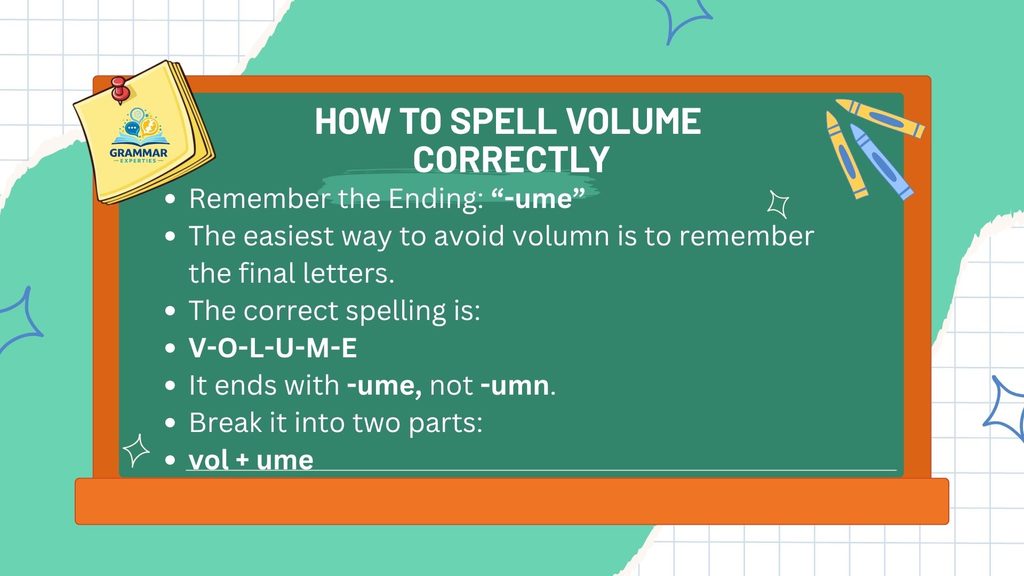
Remember the Ending: “-ume”
The easiest way to avoid volumn is to remember the final letters.
The correct spelling is:
V-O-L-U-M-E
It ends with -ume, not -umn.
Break it into two parts:
vol + ume
Or simply remember:
volume = vol + ume
The final e is important.
Volume Pronunciation
Spelling and pronunciation don’t always match perfectly in English, which is one reason spelling mistakes happen.
Cambridge gives the pronunciation as approximately:
- UK: /ˈvɒl.juːm/
- US: /ˈvɑːl.juːm/
It can sound roughly like:
VOL-yoom
The pronunciation may make the spelling feel less obvious, especially for English learners.
However, pronunciation should not be used as the only guide for spelling. When you’re unsure, remember the written form:
volume
A Simple Memory Trick
Try this sentence:
The volume has an “e” at the end.
You can also connect the word with familiar phrases:
- volume control
- volume button
- volume of water
- volume of traffic
- volume of a book
Seeing the correct spelling repeatedly makes it easier to remember.
Why Do People Spell Volume as “Volumn”?
The Pronunciation Can Cause Confusion
One reason people write volumn is that English spelling isn’t always predictable from pronunciation.
When someone says volume, the ending can be heard quickly. A writer who is spelling the word from sound may accidentally produce an incorrect form.
This is especially possible for:
- English learners
- young writers
- students
- people writing quickly
- people unfamiliar with the word in written form
The problem becomes more noticeable when someone has heard the word many times but hasn’t seen it written frequently.
Visual Similarity May Also Play a Role
Another possible source of confusion is the appearance of other words containing -mn or similar consonant combinations.
English has many spelling patterns that don’t follow a single simple rule. For example, learners encounter words such as:
- column
- autumn
- solemn
- condemn
- hymn
That doesn’t mean volume follows the same pattern.
The correct spelling is simply:
volume
Not:
volumn
Similar Spelling Mistakes
The volumn mistake belongs to a broader group of errors where writers add, remove, or rearrange letters.
Compare:
| Incorrect | Correct |
|---|---|
| volumn | volume |
| goverment | government |
| enviroment | environment |
| recieve | receive |
| seperate | separate |
| definately | definitely |
The solution is similar in every case: learn the standard written form and use it consistently.
Volume in Real-Life English
Common Phrases With Volume
You will encounter volume in many everyday expressions.
Volume of Water
The tank can hold a large volume of water.
Here, volume refers to the amount of space occupied by the water.
Volume of Traffic
The volume of traffic increased during the morning rush.
Here, volume refers to the amount or number of traffic.
Turn the Volume Down
Could you turn the volume down?
Here, volume refers to sound level.
Volume of a Book
The final volume of the series was published last year.
Here, volume means one book in a series.
Trading Volume
In finance, trading volume refers to the amount of shares or other financial instruments traded during a particular period. Cambridge’s Business English Dictionary also uses volume for the total number of shares bought or sold over a period.
Volume in Academic Writing
The word is also common in academic and professional writing.
Examples include:
- a high volume of research
- a large volume of data
- the volume of evidence
- the volume of production
- the volume of exports
- the volume of work
This makes correct spelling especially important for students and professionals.
A spelling error such as volumn can distract readers and make otherwise clear writing appear less polished.
Volume vs. Volumn: A Practical Comparison
| Feature | Volume | Volumn |
|---|---|---|
| Standard English spelling | Yes | No |
| Found in major dictionaries | Yes | No as the standard form |
| Used in formal writing | Yes | No |
| Can mean amount of space | Yes | No |
| Can mean sound level | Yes | No |
| Can mean quantity | Yes | No |
| Can mean a book in a series | Yes | No |
| Recommended spelling | Volume | Avoid |
A Step-by-Step Way to Check the Spelling
If you aren’t sure whether to write volumn or volume, follow these steps:
- Look at the ending.
Does it end in -ume? - Check the word in a reliable dictionary.
Cambridge and Oxford both list volume. - Check the meaning.
If you’re talking about space, quantity, sound, or a book in a series, you’re probably looking for volume. - Replace the questionable spelling.
Change volumn to volume. - Proofread the complete sentence.
Make sure the word fits the intended meaning.
A Real-Life Writing Example: Catching the “Volumn” Mistake
Imagine a student preparing a science report about measuring liquids. The student writes:
“The volumn of water in the container was measured before the experiment.”
At first glance, the sentence looks perfectly understandable. The meaning is clear, and the reader can easily guess what the student intended.
However, the spelling still needs correction.
The revised sentence is:
“The volume of water in the container was measured before the experiment.”
This small correction matters because scientific writing depends on precise terminology. The student isn’t simply describing an everyday object; they’re using a technical term that has a specific meaning.
The same issue can occur outside the classroom. Imagine an employee writing a report that says, “The company experienced a higher volumn of customer inquiries this month.” A manager will probably understand the sentence immediately, but the spelling error can make the report look less carefully edited.
This example illustrates an important point about spelling mistakes: understanding is not the same as correctness. A misspelled word may still communicate the intended meaning, but standard spelling makes communication clearer and more professional.
When you see the word frequently in written contexts, the correct form becomes easier to remember. Phrases such as volume of water, volume of traffic, volume of sales, and turn the volume down reinforce the spelling through repetition.
So, if you regularly make the volumn mistake, don’t rely on pronunciation alone. Train yourself to recognize the written pattern vol-u-me.
Data and Usage: What Can We Reliably Say in 2025–2026?
Why Exact “Volumn” Search Numbers Are Difficult to Verify
It’s tempting to claim that volumn receives a particular number of searches every month. However, publicly available tools don’t always provide reliable exact figures for rare misspellings.
Google specifically notes that Google Trends is not a perfect mirror of search activity and that very low-volume search terms can appear as 0. It also explains that Trends filters certain types of searches and that its figures represent search interest rather than a direct count of every search.
Google also distinguishes between a search term, which measures the exact words entered, and a topic, which can represent a broader concept and related searches.
Therefore, an exact 2025–2026 search-volume figure for volumn should not be invented or presented as verified data without a suitable keyword-data source.
What Current Dictionary Evidence Shows
Current dictionary references provide stronger evidence for the spelling itself.
Oxford lists volume with meanings covering space, quantity, sound, books, and periodicals.
Cambridge likewise lists volume with meanings involving space, quantity, sound, books, and business usage.
This gives us a reliable conclusion:
The standard spelling in current English reference dictionaries is “volume.”
What This Means for Writers
For 2025–2026 writing, the practical recommendation is straightforward:
- Use volume in essays.
- Use volume in business writing.
- Use volume in scientific writing.
- Use volume in website content.
- Use volume in academic work.
- Avoid volumn unless you’re specifically discussing the misspelling itself.
Google’s current Search guidance also emphasizes helpful, reliable, people-first content and recommends avoiding factual or spelling errors.
Common Sentences With Volume
Correct Examples
Here are natural examples showing different meanings of volume:
- What is the volume of this container?
- Please turn down the volume.
- The volume of traffic was unusually high.
- We received a large volume of emails.
- The second volume of the series is now available.
- The machine can process a high volume of data.
- The volume of water increased after the rainfall.
- Sales volume increased during the holiday season.
- The laboratory measured the volume of gas.
- She turned the volume up on her headphones.
Incorrect Examples
These sentences contain the common misspelling:
- ❌ What is the volumn of the container?
- ❌ Turn down the volumn, please.
- ❌ The volumn of traffic increased.
- ❌ We processed a high volumn of orders.
- ❌ I bought the third volumn of the series.
Correct all of them to:
volume
Volume: Origin and Word History

Where Does “Volume” Come From?
The word volume has a long history.
Oxford traces it to Late Middle English, ultimately from Old French volume and Latin volumen, meaning a roll. The Latin word is connected with volvere, meaning “to roll.”
This history makes sense because early written works could exist as rolls or scrolls. Over time, the meaning developed and expanded.
Today, volume can refer to a book, the amount of space something occupies, an amount or quantity, or the level of sound.
Why the History Helps
Understanding the history isn’t necessary to spell the word correctly, but it can make the word more memorable.
Think of:
volume → book → amount/size → sound level
These different meanings developed over time, but the spelling remains:
volume
Mini Quiz :Volumn or Volume
- Which spelling is correct?
- A) Volumn
- B) Volume
- C) Volum
- D) Volumne
- Is “volumn” a standard English spelling?
- A) Yes
- B) No
- C) Only in British English
- D) Only in American English
- Complete the sentence: “Please turn down the _____.”
- A) volumn
- B) volum
- C) volume
- D) voluem
- Which word refers to the amount of space an object occupies?
- A) Volume
- B) Volumn
- C) Volumne
- D) Volum
- Choose the correctly spelled phrase:
- A) volume of water
- B) volumn of water
- C) volum of water
- D) voluem of water
- Which spelling should you use in formal writing?
- A) Volumn
- B) Volume
- C) Volum
- D) Volumne
- What does “volume” mean when talking about a television?
- A) Its size
- B) Its weight
- C) Its sound level
- D) Its screen width
- Complete the sentence: “The _____ of the box is 30 cubic meters.”
- A) volumn
- B) volume
- C) volum
- D) voluem
- Which word is correctly spelled?
- A) Volumn
- B) Volume
- C) Volumne
- D) Volumee
- What is the correct spelling of the word meaning “amount or quantity”?
- A) Volumn
- B) Volume
- C) Volum
- D) Volumne
- Which sentence is correct?
- A) The volumn of traffic increased.
- B) The volume of traffic increased.
- C) The volum of traffic increased.
- D) The voluem of traffic increased.
- What letters does “volume” end with?
- A) -umn
- B) -um
- C) -ume
- D) -omne
- Which sentence uses “volume” correctly?
- A) Please increase the volume.
- B) Please increase the volumn.
- C) Please increase the volum.
- D) Please increase the voluem.
- In mathematics, volume usually measures:
- A) Temperature
- B) Three-dimensional space
- C) Speed
- D) Weight
- Which spelling is incorrect?
- A) Volume
- B) Volumn
- C) Both are correct
- D) Neither is correct
- Complete the phrase: “a high _____ of traffic.”
- A) volumn
- B) volume
- C) volumne
- D) voluem
- Which word can refer to one book in a series?
- A) Volume
- B) Volumn
- C) Volum
- D) Volumne
- Which sentence contains the correct spelling?
- A) I bought the second volumn.
- B) I bought the second volume.
- C) I bought the second volum.
- D) I bought the second voluem.
- How is “volume” approximately pronounced?
- A) VOL-yoom
- B) VOL-man
- C) VO-lum
- D) VOM-len
- Which spelling should English learners remember?
- A) V-O-L-U-M-N
- B) V-O-L-U-M-E
- C) V-O-L-M-U-E
- D) V-O-M-U-L-E
- Which sentence is grammatically and orthographically correct?
- A) The volume of water was measured.
- B) The volumn of water was measured.
- C) The volum of water was measured.
- D) The voluem of water was measured.
- What is “volumn” best described as?
- A) A British spelling
- B) An American spelling
- C) A standard alternative spelling
- D) A misspelling of “volume”
- Which phrase is correct?
- A) Volume control
- B) Volumn control
- C) Volum control
- D) Voluem control
- Complete the sentence: “The company handles a large _____ of orders.”
- A) volumn
- B) volume
- C) voluem
- D) volumne
- What is the easiest spelling rule to remember?
- A) Volume ends in “-umn.”
- B) Volume ends in “-um.”
- C) Volume ends in “-ume.”
- D) Volume ends in “-omne.”
Frequently Asked Questions About Volumn or Volume
Q1:Is “volumn” a correct spelling?
No. Volumn is a misspelling. The standard English spelling is volume.
Q2:Is it “volumn” or “volume”?
It is volume. Use volume when referring to the amount of space, quantity, sound level, or a book in a series.
Q3:Why do people spell volume as “volumn”?
The error may occur because the pronunciation doesn’t make every letter obvious. People sometimes spell words according to how they sound rather than according to their established written forms.
Q4:How do you spell volume correctly?
The correct spelling is:
V-O-L-U-M-E
A useful memory trick is to remember that the word ends in -ume, not -umn.
Q5:What does volume mean?
Volume has several meanings. It can mean the amount of space an object or substance occupies, an amount or quantity of something, the level of sound, or a book that belongs to a series.
Q6:How do you pronounce volume?
Cambridge gives the UK pronunciation as approximately /ˈvɒl.juːm/ and the US pronunciation as /ˈvɑːl.juːm/.
It sounds roughly like VOL-yoom.
Q7:Can “volume” be used for sound?
Yes. Volume commonly refers to the level of sound produced by a television, radio, phone, speaker, or similar device.
For example:
Please turn down the volume.
Q8:Is “volume” the same in British and American English?
Yes, volume is the standard spelling in both British and American English. Pronunciation can differ slightly between the two varieties, but the spelling remains
Explore more easy grammar lessons and improve your English with Grammar Expertise
Reference

Maimoona Mughal is an English grammar enthusiast dedicated to simplifying confusing words, grammar rules, and vocabulary through clear, accurate, and learner-friendly content that helps readers write and communicate with confidence.