Have you ever stopped while writing and wondered whether the correct spelling is many or meny? The answer is simple: many is the correct standard English spelling. Meny is generally a misspelling when you intend the common English word many.
The confusion is understandable because English spelling doesn’t always match pronunciation perfectly. A word may sound one way but be written differently.
In this guide, you’ll learn the meaning of many, why meny is incorrect in ordinary English usage, how to use many naturally, and how to avoid this common spelling mistake.
Many or Meny: What Is the Correct Spelling?
The correct spelling is many.
Many is commonly used to refer to a large or considerable number of people or things. It normally appears with plural countable nouns.
Correct: Many students attended the workshop.
Incorrect: Meny students attended the workshop.
Correct: How many books did you buy?
Incorrect: How meny books did you buy?
If you’re choosing between many or meny in ordinary English writing, choose many.
Is “Many” a Word?
Yes. Many is a standard English word. Depending on the sentence, dictionaries classify it in grammatical roles such as a determiner or pronoun.
Examples:
- Many people enjoy reading.
- Many were invited to the event.
- How many questions are left?
- She doesn’t have many options.
The central idea is a large number or asking about a number.
Is “Meny” a Word?
When you mean the familiar English quantity word, meny is not the correct spelling. It should be written many.
Therefore:
Correct: There are many reasons to practice English.
Incorrect: There are meny reasons to practice English.
You might encounter Meny as a name, historical form, or specialized term in another context. That does not make it an alternative spelling of the modern English word many.
What Does Many Mean?
Many refers to a large number of people, objects, occasions, ideas, or other things that can normally be counted.
For example:
Many cars were parked outside.
Here, cars are countable, and many tells us that there was a large number of them.
Simple Meaning of Many
A simple definition is:
Many means a large number of something that can be counted.
Consider these examples:
- Many children enjoy cartoons.
- We visited many places during our trip.
- Many employees attended the meeting.
- She has read many books.
- There are many ways to solve the problem.
In each example, many relates to things or people that can be counted individually.
Many as a Determiner
Many frequently comes before a plural countable noun:
- many houses
- many questions
- many opportunities
- many mistakes
- many students
For example:
Many students find English spelling difficult at first.
Here, many modifies the plural countable noun students.
Many as a Pronoun
Many can also stand without a noun when the noun or group being discussed is already understood.
For example:
Many applied, but only ten were selected.
The context tells us that many refers to many people or applicants.
Why Do People Confuse Many and Meny?
The many or meny spelling mistake often happens because writers rely on how the word sounds instead of remembering its established spelling.
English contains numerous words whose pronunciation doesn’t provide a perfect letter-by-letter guide to their spelling. As a result, learners may write a word according to the sounds they think they hear.
Pronunciation Can Cause Confusion
In common modern English pronunciation, many begins with a sound resembling the vowel in men. That can tempt learners to write meny.
However, pronunciation and spelling don’t always match exactly.
Think about familiar words such as:
- said
- says
- friend
- enough
Their spellings aren’t always predictable from sound alone.
Therefore, hearing a short “e”-like vowel in many doesn’t mean the word should contain the letter e.
English Spelling Preserves History
English spelling reflects centuries of linguistic change. Pronunciation can evolve while familiar written forms remain relatively stable.
That is one reason phonetic guessing isn’t always reliable. Learning the standard written form is more useful than attempting to spell every word exactly as it sounds.
For many, remember the fixed spelling:
M + A + N + Y = MANY
A Simple Memory Trick
Connect many with any:
many = m + any
If you already know how to spell any, simply place m in front of it.
any → many
This quick pattern can make the correct spelling much easier to remember.
How to Use Many Correctly in English
Knowing the spelling is only part of the lesson. You also need to know when many fits naturally into a sentence.
The most important rule is that many generally goes with plural countable nouns.
Use Many With Countable Nouns
Countable nouns are things you can count individually.
For example:
- one apple, two apples
- one chair, four chairs
- one student, twenty students
- one question, several questions
Therefore, these sentences are correct:
- Many apples were left in the basket.
- Many chairs were empty.
- Many students passed the test.
- Many questions remained unanswered.
Many in Questions
Many is extremely common in questions, especially with how many.
Examples:
- How many people are coming?
- How many days are left?
- How many languages do you speak?
- How many emails did you receive?
- How many chapters have you finished?
The phrase how many asks about the number of countable people or things.
Many in Negative Sentences
Many also sounds natural in negative constructions.
Examples:
- I don’t have many books.
- She didn’t make many mistakes.
- We haven’t received many complaints.
- There aren’t many seats available.
In everyday affirmative speech, speakers sometimes prefer phrases such as a lot of.
For example:
Natural conversational style: We have a lot of customers.
Grammatically possible: We have many customers.
The second sentence is correct, although context and dialect can affect which expression sounds more natural.
Many vs Much
A useful grammar rule is:
| Word | Usually Used With | Example |
|---|---|---|
| Many | Plural countable nouns | many books |
| Much | Uncountable nouns | much water |
| Many | people | many people |
| Much | information | much information |
| Many | questions | many questions |
| Much | time | much time |
You can count books, so use many books.
You don’t normally count water as individual waters when referring to the substance generally, so much water is appropriate.
Similarly:
Correct: How many mistakes did I make?
Correct: How much information do you need?
Many or Meny: Examples and Common Mistakes
Seeing correct and incorrect examples side by side can help reinforce the spelling.
| Incorrect | Correct |
|---|---|
| Meny people attended. | Many people attended. |
| How meny books are there? | How many books are there? |
| She has meny friends. | She has many friends. |
| We visited meny cities. | We visited many cities. |
| There aren’t meny options. | There aren’t many options. |
| Meny students participated. | Many students participated. |
The pattern is straightforward: when you’re expressing a large number using this common English word, spell it many.
Correct Examples With Many
Here are more natural examples:
- Many people work from home.
- There are many reasons to learn another language.
- How many guests did you invite?
- We don’t have many choices.
- Many businesses use online marketing.
- She has visited many countries.
- Many students submitted their assignments early.
- I have asked that question many times.
Common Incorrect Examples With Meny
Avoid sentences such as:
- Meny people agree.
- I have meny ideas.
- How meny students are here?
- We saw meny animals.
- There were meny mistakes.
Replace meny with many in each sentence.
Many, Too Many, and So Many
You can combine many with other words to create slightly different meanings.
Too many indicates an excessive number:
There are too many cars on this road.
So many emphasizes a surprisingly or notably large number:
Why are there so many people outside?
As many as can emphasize a particular number:
As many as 100 people attended the event.
These expressions all retain the spelling many.
Real-Life Case Study: Fixing the Many vs Meny Mistake
Consider a fictional but realistic example of an English learner named Sara who regularly wrote meny instead of many. She had learned much of her conversational English through listening, so she often relied on pronunciation when spelling unfamiliar words.
In an early writing exercise, she wrote sentences such as, “There are meny students in my class” and “How meny questions are on the test?” Her meaning was perfectly understandable, but the spelling was incorrect.
Instead of memorizing the word in isolation, Sara connected it with the familiar word any. She used the pattern m + any = many. She then practiced the word in several common phrases: many people, many times, many questions, and how many.
Afterward, she began checking her work for the letter sequence -any whenever she used the word. This simple proofreading habit helped her recognize the incorrect meny form immediately.
The example highlights a useful spelling strategy: combine pattern recognition, meaningful examples, and proofreading. Rather than repeatedly memorizing a correction without context, learners can connect the correct spelling with a familiar word and use it in complete sentences.
Spelling and Search Data in 2025–2026: What Should Writers Know?
Reliable 2025–2026 statistics specifically measuring how often English learners confuse many and meny are limited. Therefore, it would be misleading to invent a percentage or claim that a certain number of writers make this particular mistake.
What can be established more reliably is the standard spelling itself. Major contemporary dictionaries list many as the familiar English quantity word.
For publishers in 2026, accuracy also matters beyond individual spelling rules. Google’s current guidance emphasizes creating helpful, reliable, people-first content rather than content designed primarily to manipulate search rankings. That means grammar articles should answer the reader’s question clearly, demonstrate the rule with useful examples, and avoid unsupported claims or fabricated statistics.
For this topic, the most trustworthy approach is therefore simple: use dictionary evidence to establish the spelling and grammar, provide practical examples, and clearly disclose when narrowly focused statistical data isn’t available.
Quick 2026 Accuracy Checklist
Before publishing content containing many, check that:
- You spell the word many, not meny.
- You generally use many with plural countable nouns.
- You use much when an uncountable noun requires it.
- You write how many when asking about a number of countable things.
- You proofread examples before publishing.
- You avoid inventing statistics to make an article appear more authoritative.
- You use reputable dictionaries or grammar references when verification is needed.
Many or Meny in Different Types of Writing
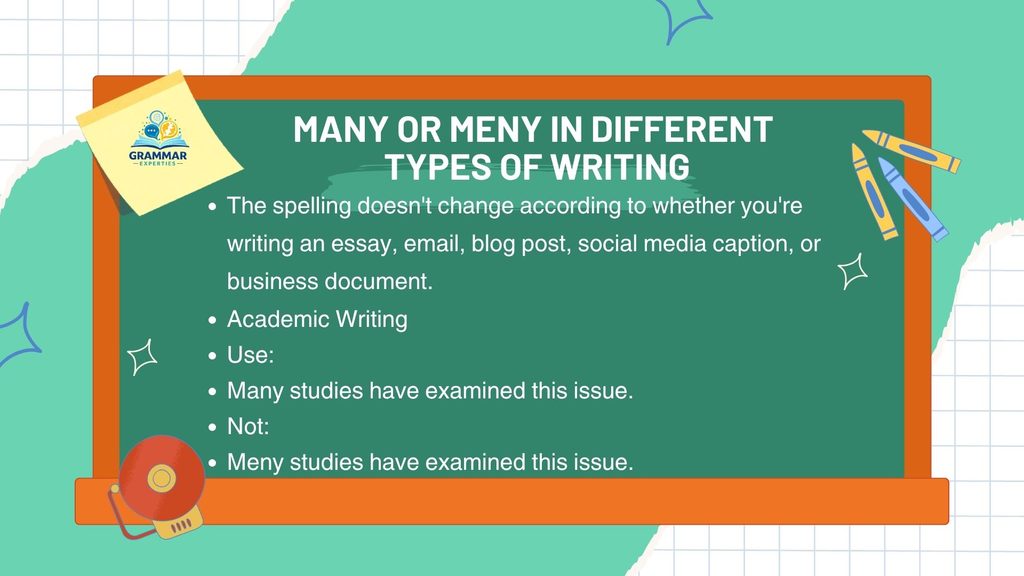
The spelling doesn’t change according to whether you’re writing an essay, email, blog post, social media caption, or business document.
Academic Writing
Use:
Many studies have examined this issue.
Not:
Meny studies have examined this issue.
In academic writing, you may sometimes choose a more precise quantity when the actual number is known.
For example:
Twenty-three studies examined the issue.
This is more informative than many studies when reliable numerical information is available.
Professional and Business Writing
Correct spelling contributes to clear, polished communication.
For example:
Many customers requested the new feature.
A simple spelling error such as meny can distract readers, especially in polished business communication.
Everyday English
The same rule applies to casual messages:
How many people are coming tonight?
Whether you’re writing formally or informally, many remains the correct spelling.
Mini Quiz:Many or Meny
1. Which spelling is correct?
A) Meny
B) Many
C) Menny
D) Mane
Answer: B) Many
2. Which sentence is correct?
A) Meny people came to the party.
B) Many people came to the party.
C) Menny people came to the party.
D) Mane people came to the party.
Answer: B) Many people came to the party.
3. Is “meny” the standard spelling of “many”?
A) Yes
B) No
Answer: B) No
4. What does “many” generally mean?
A) A large number
B) A small amount
C) One person
D) Nothing
Answer: A) A large number
5. Complete the sentence: “How ___ books do you have?”
A) much
B) meny
C) many
D) more
Answer: C) many
6. Which word is normally used with plural countable nouns?
A) Much
B) Many
C) Meny
D) Little
Answer: B) Many
7. Which phrase is spelled correctly?
A) meny students
B) many students
C) menny students
D) maney students
Answer: B) many students
8. Which sentence contains a spelling mistake?
A) Many students passed.
B) I have many questions.
C) Meny people attended.
D) How many books are there?
Answer: C) Meny people attended.
9. Which is correct?
A) many cars
B) meny cars
C) manny cars
D) meney cars
Answer: A) many cars
10. What is a useful spelling trick for “many”?
A) m + any = many
B) men + y = many
C) ma + nny = many
D) me + any = many
Answer: A) m + any = many
11. Complete the sentence: “There are ___ reasons to learn English.”
A) meny
B) much
C) many
D) maney
Answer: C) many
12. Which question is grammatically correct?
A) How much students are here?
B) How meny students are here?
C) How many students are here?
D) How maney students are here?
Answer: C) How many students are here?
13. “Many” is commonly used with which type of noun?
A) Plural countable nouns
B) Only proper nouns
C) Only singular nouns
D) Only uncountable nouns
Answer: A) Plural countable nouns
14. Which phrase is correct?
A) many information
B) many water
C) many books
D) many milk
Answer: C) many books
15. Which word is usually appropriate with the uncountable noun “water”?
A) Many
B) Meny
C) Much
D) Menny
Answer: C) Much
16. Complete the sentence: “She has visited ___ countries.”
A) meny
B) many
C) much
D) manny
Answer: B) many
17. Which sentence uses “many” correctly?
A) How many chairs do we need?
B) How many water do we need?
C) I drank many milk.
D) We need many sugar.
Answer: A) How many chairs do we need?
18. What is wrong with “meny people”?
A) “People” is misspelled.
B) “Meny” should be “many.”
C) Both words are incorrect.
D) Nothing is wrong.
Answer: B) “Meny” should be “many.”
19. Which sentence is correctly spelled?
A) I don’t have meny options.
B) I don’t have maney options.
C) I don’t have many options.
D) I don’t have menny options.
Answer: C) I don’t have many options.
20. Complete the sentence: “___ employees attended the meeting.”
A) Meny
B) Much
C) Many
D) Maney
Answer: C) Many
21. Which expression means an excessive number?
A) too much many
B) too many
C) meny too
D) much many
Answer: B) too many
22. Which expression emphasizes a large number?
A) so many
B) so meny
C) much many
D) many much
Answer: A) so many
23. Complete the sentence: “I have asked you ___ times.”
A) meny
B) much
C) many
D) maney
Answer: C) many
24. Which sentence is correct for asking about a number of guests?
A) How much guests are coming?
B) How meny guests are coming?
C) How many guests are coming?
D) How maney guests are coming?
Answer: C) How many guests are coming?
25. What should you remember when choosing between “many” and “meny”?
A) Both spellings are interchangeable.
B) “Meny” is preferred in formal English.
C) “Many” is the correct standard spelling.
D) “Meny” is the American spelling.
Answer: C) “Many” is the correct standard spelling.
Frequently Asked Questions
Q1:Is It Many or Meny?
Many is the correct spelling when referring to a large number of people or things. Meny is not the standard spelling of this common English word.
Q2:Is Meny a Correct Alternative Spelling of Many?
No. Meny isn’t a standard alternative spelling of many in modern English when the intended meaning is “a large number.”
Q3:How Do You Spell Many?
Spell it:
M-A-N-Y
A simple trick is to remember:
m + any = many
Q4:Why Does Many Sound Like It Has an E?
Modern pronunciation can make the vowel sound closer to the vowel heard in words such as men. English spelling and pronunciation don’t always correspond exactly, so the standard written form remains many.
Q5:When Should I Use Many?
Use many primarily with plural countable nouns.
Examples include:
- many books
- many students
- many questions
- many houses
- many ideas
Q6:What Is the Difference Between Many and Much?
Many generally modifies plural countable nouns, while much generally modifies uncountable nouns.
Many books — correct.
Much water — correct.
Q7:Is “How Many” Grammatically Correct?
Yes. How many is used to ask about the number of countable people or things.
For example:
How many students are in your class?
Q8:Can Many Be Used Without a Noun?
Yes. Many can function without an immediately following noun when its reference is understood from context.
For example:
Many were invited, but only a few attended.
Conclusion
When deciding between many or meny, remember one straightforward rule: many is the correct spelling for the common English word meaning a large number. Meny is a spelling error when that is the intended word.
Use many with plural countable nouns in phrases such as many people, many books, and many questions. If you struggle to remember the spelling, use the simple pattern m + any = many.
Explore more easy grammar lessons and improve your English with Grammar Expertise
References
Cambridge Dictionary – Opening

Maimoona Mughal is an English grammar enthusiast dedicated to simplifying confusing words, grammar rules, and vocabulary through clear, accurate, and learner-friendly content that helps readers write and communicate with confidence.