Have you ever stopped while typing and wondered whether you should write opening or openning? The two forms may look similar, but only one is standard English.
The correct spelling is opening, with one n. Openning is a misspelling and should be avoided in standard writing. Major English dictionaries list opening as the established form.
The confusion usually comes from English spelling rules for adding -ing to verbs. Sometimes a final consonant doubles, as in run → running. However, that rule doesn’t apply to open.
This guide explains the opening or openning spelling difference, the rule behind it, its meanings, common examples, and an easy way to remember the correct form.
Opening or Openning: Which Is Correct?
Opening is the correct spelling. Openning is incorrect.
The word opening comes from the verb open plus the suffix -ing:
open + ing = opening
You don’t add another n.
Cambridge Dictionary recognizes opening as both a noun and an adjective. Depending on context, it can refer to a beginning, a hole or space, a ceremony, or an available opportunity or job.
Quick Answer
| Word | Correct? | Meaning/Status | Example |
|---|---|---|---|
| Opening | Yes | Beginning, space, ceremony, opportunity, or the -ing form of open | The opening ceremony starts at noon. |
| Openning | No | Common misspelling | Avoid this spelling. |
So, whenever you’re choosing between opening vs openning, use opening.
Opening in a Sentence
Here are some natural examples:
- The opening ceremony begins at 9 a.m.
- We found an opening in the fence.
- The company has an opening for a designer.
- She is opening the window.
- His opening remarks were brief.
- The restaurant’s grand opening attracted hundreds of visitors.
These examples also show that opening can perform different grammatical functions depending on the sentence.
Why Is Opening Spelled With Only One N?
This is where the spelling becomes easier once you understand the underlying rule.
English sometimes doubles a consonant before adding -ing. For example:
- run → running
- sit → sitting
- begin → beginning
So, someone might assume:
open → openning
However, that analogy is incorrect.
The Consonant-Doubling Rule
A final consonant is commonly doubled when a word ends in a suitable consonant-vowel-consonant pattern and the final syllable is stressed.
Consider:
begin → beginning
The stress falls on the final syllable: be-GIN. Therefore, the final n doubles.
Now compare:
open → opening
The stress falls on the first syllable: O-pen. Because the final syllable isn’t stressed, the n normally remains single.
Therefore:
open + ing = opening
not:
open + ing = openning
Compare Similar Words
| Base Word | -ing Form | Final Consonant Doubled? |
|---|---|---|
| run | running | Yes |
| sit | sitting | Yes |
| begin | beginning | Yes |
| admit | admitting | Yes |
| open | opening | No |
| listen | listening | No |
| happen | happening | No |
| visit | visiting | No |
Looking at related examples makes the opening or openning rule much easier to remember.
What Does Opening Mean?
The word opening has several meanings in English. Its exact meaning depends on context.
Cambridge lists meanings involving a hole or space, the beginning of something, a ceremony, and an available position or opportunity.
Opening Meaning “Beginning”
Opening can refer to the first part or beginning of something.
Examples:
- The opening of the movie was exciting.
- I enjoyed the opening chapter of the novel.
- Her opening statement caught everyone’s attention.
- The team’s opening game is on Friday.
Here, opening relates to the start of an event, activity, speech, story, or other sequence.
Opening Meaning “Hole or Space”
An opening can also mean a gap, hole, or space through which something can pass.
Examples:
- Light entered through an opening in the wall.
- The rabbit disappeared through a small opening.
- They discovered an opening in the fence.
Cambridge specifically records this sense as a hole or space through which a person or thing can pass.
Opening Meaning “Opportunity or Vacancy”
In workplace English, opening can mean an available job or opportunity.
Examples:
- There’s a job opening in the marketing department.
- The company announced several new openings.
- I applied for an opening in customer support.
This usage is especially common in phrases such as job opening and position opening. Cambridge’s Business English entry also uses opening for an available job.
Opening Meaning “Ceremony”
Opening can refer to a ceremony or occasion marking the beginning of an event, building, business, or activity.
Examples:
- We attended the grand opening of the restaurant.
- The official opening takes place tomorrow.
- Hundreds of people attended the store’s opening.
The expressions grand opening and official opening are standard English usages.
Opening vs Openning: Common Mistakes and Examples
The spelling openning may seem logical because learners encounter many English words with doubled consonants. However, applying one spelling pattern to every verb causes mistakes.
Incorrect and Correct Examples
Incorrect: The opening ceremony starts tomorrow.
Correct: The opening ceremony starts tomorrow.
Incorrect: She is openning the front door.
Correct: She is opening the front door.
Incorrect: There’s a new job openning at the company.
Correct: There’s a new job opening at the company.
Incorrect: We attended the openning of the exhibition.
Correct: We attended the opening of the exhibition.
In every case, opening is the standard spelling.
Don’t Confuse Opening With Beginning
An interesting comparison is opening versus beginning.
Both can refer to a start, but their spellings behave differently:
open → opening
begin → beginning
The reason isn’t simply that both words end in n. Stress and syllable structure matter.
Begin has final-syllable stress, whereas open has initial-syllable stress. That distinction helps explain why beginning has a doubled n while opening doesn’t.
Easy Memory Trick
Remember this simple pattern:
OPEN stays OPEN when -ING walks in.
Write:
OPEN + ING = OPENING
If you can still see the complete word open inside opening, you’re on the right track.
Real-Life Case Study: How One Spelling Rule Prevents Repeated Errors
Consider an ESL student preparing a professional email about a new store launch. The student writes, “We are excited to announce the openning of our new branch.”
A spelling checker flags openning. The student changes it to opening, but simply correcting the word doesn’t necessarily prevent the same mistake next time. The more useful approach is understanding why the second n isn’t required.
The student compares three words:
run → running
begin → beginning
open → opening
At first, all three seem as though they should follow the same pattern. However, closer attention reveals an important difference. Open has two syllables, and its primary stress falls on the first syllable. The final consonant therefore isn’t doubled when -ing is added.
Once the learner connects pronunciation, stress, and spelling, the correction becomes easier to remember. The student can then recognize related patterns in words such as listening, visiting, and happening.
This example highlights an effective approach to spelling improvement: instead of memorizing isolated corrections, learn the pattern behind them. Doing so makes it easier to apply the rule when writing emails, essays, reports, social posts, and other everyday content.
2025–2026 Language Reference Check
For a spelling question, current dictionary evidence is more useful than inventing search-volume statistics. As checked in 2026, Cambridge Dictionary continues to list opening as the standard form and provides multiple established meanings, including beginning, ceremony, hole or space, and opportunity. Its pronunciation guide gives the UK pronunciation /ˈəʊ.pən.ɪŋ/ and the US pronunciation /ˈoʊp.nɪŋ/.
This current reference evidence supports a straightforward conclusion:
| 2026 Reference Check | Result |
|---|---|
| Standard spelling | opening |
| Number of n’s in the middle | One |
| Openning standard spelling? | No |
| Base verb | open |
| -ing form | opening |
| Common noun use | beginning, ceremony, gap, opportunity |
| Common adjective use | opening remarks, opening night |
Rather than relying on an unsupported percentage or fabricated spelling-error statistic, authoritative dictionary evidence provides a verifiable basis for choosing the correct form.
How to Remember Opening or Openning
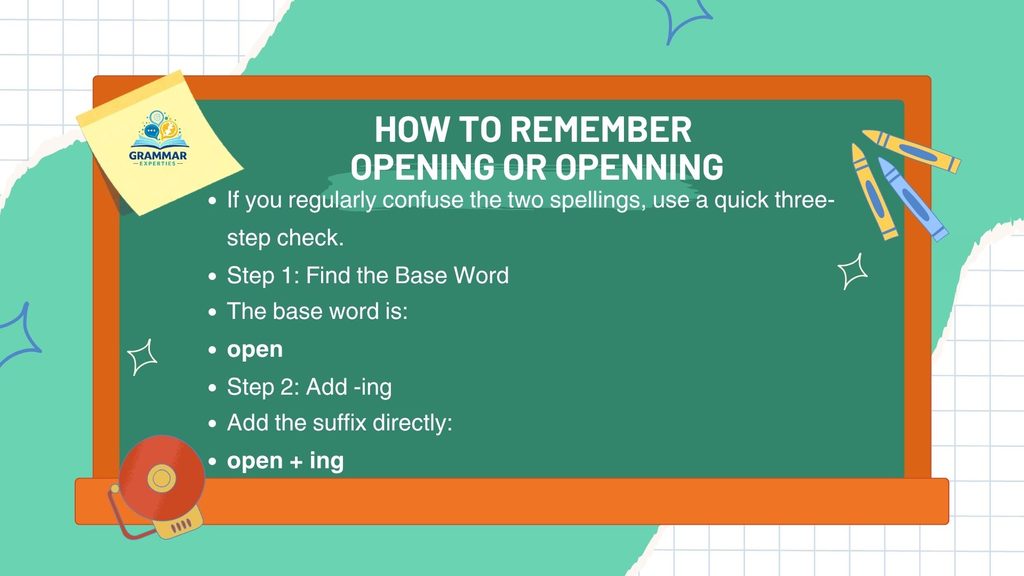
If you regularly confuse the two spellings, use a quick three-step check.
Step 1: Find the Base Word
The base word is:
open
Step 2: Add -ing
Add the suffix directly:
open + ing
Step 3: Keep One N
The result is:
opening
Therefore, you can remember the pattern as:
OPEN → OPENING
not:
OPEN → OPENNING
A second useful reminder is to compare it with other unstressed-final-syllable verbs:
- happen → happening
- listen → listening
- visit → visiting
- open → opening
The more often you see the pattern, the more natural the correct spelling becomes.
Mini Quiz:Opening or Openning
1. Which spelling is correct?
A) Openning
B) Opening
C) Opennig
D) Openin
Answer: B) Opening
2. Which spelling is incorrect?
A) Opening
B) Openning
Answer: B) Openning
3. What is the base word of “opening”?
A) Open
B) Ope
C) Opens
D) Opened
Answer: A) Open
4. Which word correctly completes the sentence: “She is ___ the door”?
A) openning
B) opening
C) opennig
D) openin
Answer: B) opening
5. What is the correct word formation?
A) Open + ing = Opening
B) Open + ning = Openning
C) Ope + nning = Openning
D) Open + in = Openin
Answer: A) Open + ing = Opening
6. Which phrase is correct?
A) Grand openning
B) Grand opening
C) Grand opennig
D) Grand openin
Answer: B) Grand opening
7. Why is “openning” incorrect?
A) It has an unnecessary extra “n”
B) It needs another “o”
C) It needs another “g”
D) It should end in “ed”
Answer: A) It has an unnecessary extra “n”
8. Which sentence is spelled correctly?
A) The store is openning tomorrow.
B) The store is opening tomorrow.
C) The store is opennig tomorrow.
D) The store is openin tomorrow.
Answer: B) The store is opening tomorrow.
9. In “There is an opening in the wall,” what does “opening” mean?
A) A gap or hole
B) A celebration
C) A job
D) A closing
Answer: A) A gap or hole
10. What does “job opening” mean?
A) A new building
B) An available position
C) A doorway
D) A business ceremony
Answer: B) An available position
11. Which word follows a similar spelling pattern?
A) Running
B) Beginning
C) Listening
D) Sitting
Answer: C) Listening
12. Which is correct?
A) Opening ceremony
B) Openning ceremony
Answer: A) Opening ceremony
13. What is the correct plural of “opening”?
A) Openninges
B) Opennings
C) Openings
D) Opening’s
Answer: C) Openings
14. Which sentence uses “opening” as an action?
A) She is opening her gift.
B) There is a job opening.
C) The opening was narrow.
D) The opening chapter was interesting.
Answer: A) She is opening her gift.
15. Which phrase refers to comments made at the beginning of a speech?
A) Opening remarks
B) Openning remarks
C) Closing opening
D) Opennig remarks
Answer: A) Opening remarks
16. Complete the sentence: “He is ___ the window.”
A) openning
B) opening
C) opennig
D) openningg
Answer: B) opening
17. What does “opening chapter” usually mean?
A) Final chapter
B) First chapter
C) Longest chapter
D) Missing chapter
Answer: B) First chapter
18. Which sentence is correct?
A) Several job opennings are available.
B) Several job openings are available.
C) Several job openinges are available.
D) Several job openninges are available.
Answer: B) Several job openings are available.
19. Which spelling should you use in formal writing?
A) Openning
B) Opening
C) Opennig
D) Openin
Answer: B) Opening
20. True or False: “Openning” is the standard spelling.
Answer: False
21. True or False: “Opening” contains only one “n.”
Answer: True
22. Which sentence contains a spelling mistake?
A) We attended the grand opening.
B) She is opening the box.
C) The shop is openning today.
D) There is an opening in the fence.
Answer: C) The shop is openning today.
23. Complete the sentence: “The restaurant’s grand ___ attracted many customers.”
A) openning
B) opening
C) opennig
D) openin
Answer: B) opening
24. Which transformation is correct?
A) Open → Opening
B) Open → Openning
C) Open → Opennig
D) Open → Openin
Answer: A) Open → Opening
25. What is the easiest rule to remember?
A) Always double the “n” in open
B) Remove the “n” before adding -ing
C) Add -ing to open without doubling the “n”
D) Change “open” to “oppen” first
Answer: C) Add -ing to open without doubling the “n”
Frequently Asked Questions
Q1:Is It Opening or Openning?
Opening is correct. Openning is a spelling error. Write opening with one n.
Q2:Why Isn’t Opening Spelled Openning?
The final n in open isn’t normally doubled before -ing because the final syllable of open isn’t stressed. The correct formation is open + ing = opening.
Q3:Is Openning a Real Word?
Openning isn’t the standard spelling of opening. In normal edited English, use opening.
Q4:How Do You Spell Opening a Door?
Write opening:
She is opening the door.
The same spelling applies whether you’re talking about opening a door, opening a business, or another use of the verb open.
Q5:Is It Grand Opening or Grand Openning?
The correct phrase is grand opening.
For example:
The grand opening of the café is Saturday.
Cambridge Dictionary also records grand opening in its examples of standard usage.
Q5:Is Opening a Noun or a Verb?
It can function in several ways. Opening can be a noun, as in a job opening, or an adjective, as in opening remarks. It is also the -ing form of the verb open, as in She is opening the package. Cambridge documents noun and adjective uses of the word.
Q7:What’s the Plural of Opening?
The plural is openings.
Example: The company currently has three job openings.
Q8:What Is the Difference Between Opening and Beginning?
Both words can refer to the start of something, but they aren’t interchangeable in every context. For example, the opening of a movie and the beginning of a movie can express similar ideas, while job opening normally means an available position rather than a “job beginning.”
Conclusion
When deciding between opening or openning, remember one simple rule: opening is the correct spelling, while openning is incorrect.
The word comes from open + ing, and the final n isn’t doubled. You can use opening for the beginning of something, a ceremony, a gap or entrance, an available position, or an action involving the verb open.
Keep this formula in mind:
OPEN + ING = OPENING
Explore more easy grammar lessons and improve your English with Grammar Expertise
References

Maimoona Mughal is an English grammar enthusiast dedicated to simplifying confusing words, grammar rules, and vocabulary through clear, accurate, and learner-friendly content that helps readers write and communicate with confidence.