Have you ever written vicious when you actually meant viscous? These two words look and sound surprisingly similar, but their meanings are completely different. Understanding vicious vs viscous can help you avoid embarrassing spelling and vocabulary mistakes in school, professional writing, and everyday English.
Vicious usually describes something cruel, violent, aggressive, or harmful. Viscous, on the other hand, describes a thick, sticky substance that does not flow easily. Merriam-Webster defines vicious with meanings including dangerously aggressive, malicious, and defective, while viscous refers to something thick or sticky or, technically, resistant to flow.
In this guide, you’ll learn the difference between vicious and viscous, how to pronounce them, when to use each word, common mistakes, memorable examples, and a simple trick that makes the distinction easy to remember.
Vicious vs Viscous: The Quick Difference
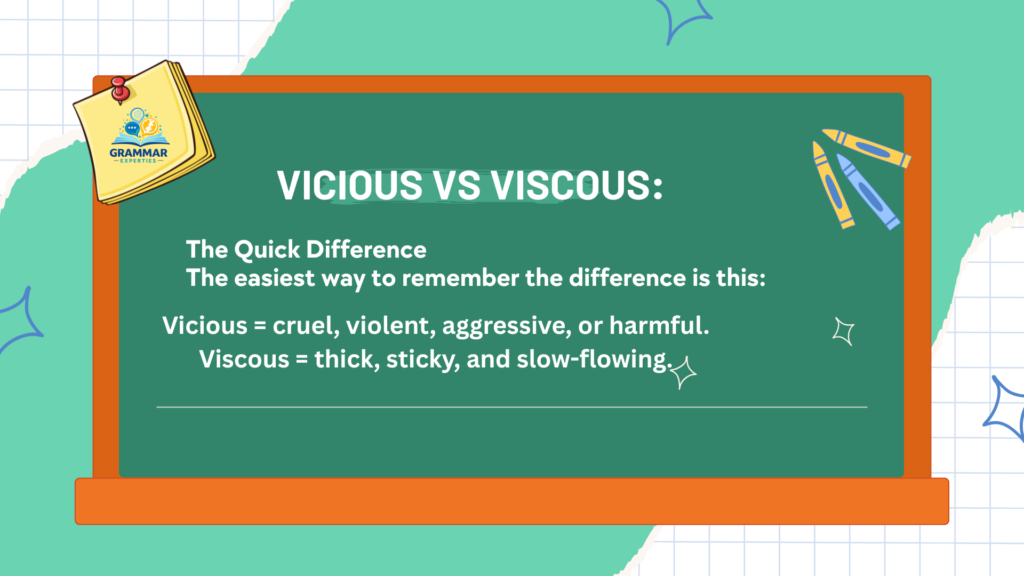
The easiest way to remember the difference is this:
- Vicious = cruel, violent, aggressive, or harmful.
- Viscous = thick, sticky, and slow-flowing.
For example:
The vicious dog chased the stranger.
Here, vicious describes aggressive behavior.
The viscous honey slowly dripped from the spoon.
Here, viscous describes the thick consistency of honey.
So, although the two words share several letters, they belong to completely different meaning groups.
| Word | Meaning | Common Use | Example |
|---|---|---|---|
| Vicious | Cruel, violent, aggressive, or harmful | People, animals, attacks, comments, behavior | It was a vicious attack. |
| Viscous | Thick, sticky, or resistant to flow | Liquids and materials | The syrup was viscous. |
| Vicious | Malicious or spiteful | Words, rumors, criticism | She spread a vicious rumor. |
| Viscous | Having high viscosity | Science and engineering | The oil became more viscous. |
What Does Vicious Mean?
Vicious is an adjective used to describe something cruel, violent, aggressive, malicious, or harmful.
Cambridge Dictionary explains that vicious people or actions show an intention or desire to hurt someone or something badly. It also uses vicious for things that cause serious physical or emotional pain.
Vicious Meaning and Definition
The most common meanings of vicious include:
- Violent or aggressive
- Cruel or savage
- Malicious or spiteful
- Extremely harmful
- Intense or damaging in certain expressions
For example:
- a vicious dog
- a vicious attack
- a vicious fight
- a vicious rumor
- a vicious comment
- a vicious cycle
Merriam-Webster also lists a specialized meaning in expressions such as vicious wage-price spiral, where the causes reinforce one another negatively.
Examples of Vicious in a Sentence
Here are some natural examples:
- The boxer delivered a vicious punch.
- The journalist received several vicious comments online.
- A vicious dog was roaming around the neighborhood.
- The two teams became involved in a vicious argument.
- She was the target of a vicious rumor.
- The storm caused a vicious cycle of flooding and damage.
- His vicious criticism hurt her feelings.
Notice that vicious generally relates to behavior, actions, words, conditions, or situations that are harmful, cruel, or aggressive.
What Does Viscous Mean?
Viscous is an adjective that describes a substance that is thick, sticky, and slow to flow.
Cambridge Dictionary defines viscous as describing a liquid that is thick and sticky and does not flow easily.
Viscous Meaning in Science and Everyday English
You’ll often see viscous used when talking about liquids and materials.
Common examples include:
- honey
- syrup
- molasses
- thick oil
- some gels
- certain industrial fluids
- lava
For example:
The viscous honey moved slowly down the side of the jar.
In science, viscous can have a more technical meaning. A viscous fluid has significant resistance to flow. The related noun viscosity refers to the property of a fluid that measures or describes its resistance to flow.
Examples of Viscous in a Sentence
- The honey became viscous in the cold weather.
- The scientist studied the behavior of a viscous liquid.
- The engine oil was too viscous to flow properly.
- The sauce had a thick, viscous texture.
- Molasses is more viscous than water.
- The laboratory measured the viscosity of the fluid.
- The lava became extremely viscous as it cooled.
The key point is simple: viscous describes physical consistency or resistance to flow, not cruelty or violence.
Vicious vs Viscous: Meaning, Pronunciation & Usage
One reason vicious vs viscous causes confusion is that both words begin with vis- and have similar-looking spellings. However, their pronunciation and meanings are different.
How to Pronounce Vicious vs Viscous
Vicious is pronounced approximately:
VISH-us
/ˈvɪʃ.əs/
Viscous is pronounced approximately:
VIS-kus
/ˈvɪs.kəs/
Cambridge gives the pronunciation of vicious as /ˈvɪʃ.əs/ and viscous as /ˈvɪs.kəs/.
The most useful pronunciation clue is the middle sound:
- vicious → “sh” sound
- viscous → “sk” sound
Try saying them slowly:
Vicious → VISH-us
Viscous → VIS-kus
That difference can help you recognize which word you need.
Vicious and Viscous Are Not Synonyms
These words should not be used interchangeably.
You cannot normally say:
The viscous dog attacked the man.
if you mean the dog was aggressive.
The correct sentence is:
The vicious dog attacked the man.
Likewise, you should not write:
The vicious honey was difficult to pour.
if you mean the honey was thick.
The correct sentence is:
The viscous honey was difficult to pour.
The spelling may be similar, but the meaning determines which word belongs in the sentence.
How to Remember the Difference Between Vicious and Viscous

A simple memory trick can make this confusing pair much easier.
Think “Vicious = Violence”
Both vicious and violence relate to harmful or aggressive behavior.
Think:
Vicious → Violence → Violent
For example:
- vicious attack
- vicious dog
- vicious fight
- vicious behavior
If someone or something is acting cruelly or aggressively, vicious is probably the word you need.
Think “Viscous = Viscosity”
This one is even easier.
Viscous → Viscosity → Thick liquid
If you’re describing honey, syrup, oil, molasses, or another slow-moving substance, think viscous.
For example:
The syrup is viscous.
The syrup has high viscosity.
The noun viscosity specifically refers to the quality of being viscous and, technically, the resistance of a fluid to flow.
A One-Line Memory Trick
Remember:
Vicious hurts. Viscous sticks.
This short phrase captures the basic distinction:
Vicious = harmful or cruel
Viscous = thick or sticky
Common Mistakes With Vicious and Viscous
Because these words look alike, spelling mistakes are common. The best way to avoid them is to identify what you are describing before choosing the word.
Mistake 1: Using Viscous for an Aggressive Person
Incorrect:
He is a viscous person.
Correct:
He is a vicious person.
Why? A person’s cruel or aggressive behavior can be described as vicious. Viscous relates to thickness or resistance to flow.
Mistake 2: Using Vicious for Thick Liquid
Incorrect:
The vicious syrup was difficult to pour.
Correct:
The viscous syrup was difficult to pour.
Why? Syrup can be thick and slow-flowing, so viscous is the appropriate adjective.
Mistake 3: Confusing Vicious With Viscosity
Incorrect:
The viciousness of the oil was high.
Correct:
The viscosity of the oil was high.
Viciousness means the quality of being vicious, while viscosity describes the thickness or resistance to flow of a fluid.
Mistake 4: Assuming Similar Spelling Means Similar Meaning
Words can look similar without having related meanings.
Compare:
- vicious → cruel or aggressive
- viscous → thick or sticky
- viscosity → resistance to flow
- viciousness → quality of being vicious
Always look at the context rather than relying only on spelling.
Vicious vs Viscous: A Real-Life Learning Example
Imagine a student named Sara writing a science report about honey.
She writes:
“The vicious honey moved slowly through the tube.”
Her teacher notices the mistake. Sara isn’t describing honey as cruel or aggressive. She is describing its physical consistency.
The corrected sentence is:
“The viscous honey moved slowly through the tube.”
Later, Sara writes a different sentence about a dog:
“The viscous dog suddenly attacked the cyclist.”
Again, the word is incorrect. This time, Sara is describing aggressive behavior, so she should write:
“The vicious dog suddenly attacked the cyclist.”
These two examples show why context matters more than appearance. In the first sentence, the subject is a liquid, so viscous fits. In the second, the subject is an animal displaying aggression, so vicious fits.
A useful editing technique is to ask one question before choosing the word: Am I describing behavior, or am I describing texture/flow?
If you’re describing cruelty, aggression, violence, or harmful behavior, choose vicious. If you’re describing a thick substance or resistance to flow, choose viscous.
This approach is especially helpful for students, writers, editors, and English learners because it focuses on meaning rather than memorizing spelling alone.
What Current Dictionary Data Shows About These Words
There is an important distinction between dictionary evidence and search-volume statistics. Major dictionaries provide authoritative definitions, pronunciations, historical information, and current examples, but they don’t publish a reliable 2025–2026 statistic showing how many people confuse vicious with viscous.
Still, current 2026 dictionary records provide useful evidence about how the words are defined and used.
- Merriam-Webster’s vicious entry was updated in March 2026 and continues to list meanings such as dangerously aggressive, malicious, and defective.
- Merriam-Webster’s viscous entry was updated in March 2026 and defines it as thick or sticky and, technically, resistant to flow.
- Merriam-Webster dates the first known use of both vicious and viscous to the 14th century, showing that these are long-established English words rather than modern spellings.
- Cambridge continues to distinguish the words clearly: vicious concerns harmful or violent behavior, while viscous concerns thick, sticky liquids and resistance to flow.
Therefore, the strongest current evidence supports a simple conclusion: the words remain distinct in modern standard English, even though their spelling can cause confusion.
Quick Comparison: Vicious vs Viscous
| Feature | Vicious | Viscous |
| Part of speech | Adjective | Adjective |
| Main meaning | Cruel, violent, aggressive, harmful | Thick, sticky, slow-flowing |
| Pronunciation | VISH-us | VIS-kus |
| Common subjects | People, animals, attacks, remarks, behavior | Liquids, oils, syrups, fluids, materials |
| Related noun | Viciousness | Viscosity |
| Memory clue | Violence | Viscosity |
| Example | A vicious attack | A viscous liquid |
Step-by-Step Way to Choose the Right Word
When you’re unsure, follow these three steps:
Step 1: Identify the subject.
Is it a person, animal, action, comment, or attack? Or is it a liquid/material?
Step 2: Identify the quality.
Does it describe cruelty or aggression? Choose vicious.
Does it describe thickness or slow flow? Choose viscous.
Step 3: Test the memory trick.
Ask yourself:
Does it hurt, or does it stick?
- Hurts → vicious
- Sticks → viscous
This simple test works in most everyday situations.
More Examples of Vicious and Viscous
Examples Using Vicious
- The vicious dog frightened everyone in the park.
- The politician faced a vicious attack from his opponents.
- She made a vicious remark during the argument.
- The article contained several vicious accusations.
- The two players became involved in a vicious fight.
- The company faced a vicious backlash online.
- His vicious behavior shocked his friends.
Examples Using Viscous
- The viscous honey poured slowly.
- The scientist examined a viscous liquid.
- Molasses is a highly viscous substance.
- The engine requires oil with a suitable level of viscosity.
- The sauce became thicker and more viscous as it cooled.
- The laboratory measured the fluid’s viscosity.
- The viscous material was difficult to spread evenly.
Mini Quiz:Vicious vs Viscous
- Spot the Right Word
The dog became ___ when the stranger approached.
A) Viscous
B) Vicious
Answer: B) Vicious - Honey Test
The ___ honey dripped slowly from the spoon.
A) Vicious
B) Viscous
Answer: B) Viscous - Attack Alert
The newspaper reported a ___ attack.
A) Viscous
B) Vicious
Answer: B) Vicious - Science Squad
Which word describes a thick, slow-flowing liquid?
A) Vicious
B) Viscous
Answer: B) Viscous - Quick Meaning Check
What does vicious usually mean?
A) Thick and sticky
B) Cruel or aggressive
C) Smooth and watery
Answer: B) Cruel or aggressive - Liquid Detective
Which sentence is correct?
A) The vicious syrup poured slowly.
B) The viscous syrup poured slowly.
Answer: B - Pronunciation Challenge
Which word sounds approximately like “VISH-us”?
A) Vicious
B) Viscous
Answer: A) Vicious - Pick the Perfect Word
The scientist studied the ___ properties of the oil.
A) Vicious
B) Viscous
Answer: B) Viscous - Rumor Round
She spread a ___ rumor about her coworker.
A) Viscous
B) Vicious
Answer: B) Vicious - Memory Trick Challenge
Complete the phrase: “Vicious hurts; ___ sticks.”
A) Vicious
B) Viscous
Answer: B) Viscous - Which One Doesn’t Belong?
Which word is related to violence?
A) Viscous
B) Vicious
C) Viscosity
Answer: B) Vicious - Texture Test
Molasses is typically described as:
A) Vicious
B) Viscous
Answer: B) Viscous - Drama Detector
His ___ comments were intended to hurt her feelings.
A) Viscous
B) Vicious
Answer: B) Vicious - Science or Behavior?
A thick liquid = ___; an aggressive dog = ___.
A) Vicious; viscous
B) Viscous; vicious
C) Vicious; vicious
Answer: B) Viscous; vicious - Noun Power-Up
What is the noun related to viscous?
A) Viciousness
B) Viscosity
C) Viscousness
Answer: B) Viscosity - Noun Challenge
What noun means the quality of being vicious?
A) Viscosity
B) Viciousness
C) Viscousness
Answer: B) Viciousness - Choose Carefully
The sauce had a thick, ___ consistency.
A) Vicious
B) Viscous
Answer: B) Viscous - Fight or Fluid?
A violent fight is ___, while a thick fluid is ___.
A) Viscous; vicious
B) Vicious; viscous
C) Viscous; viscous
Answer: B) Vicious; viscous - Pronunciation Pro
Which word is pronounced approximately “VIS-kus”?
A) Vicious
B) Viscous
Answer: B) Viscous - Grammar Grab
Choose the correct sentence:
A) The viscous man threatened everyone.
B) The vicious man threatened everyone.
Answer: B - Oil Expert Challenge
Engine oil can be described as ___ depending on its resistance to flow.
A) Vicious
B) Viscous
Answer: B) Viscous - One-Word Winner
Which word can describe a cruel comment?
A) Viscous
B) Vicious
Answer: B) Vicious - Complete the Sentence
As the lava cooled, it became more ___.
A) Vicious
B) Viscous
Answer: B) Viscous - Final Boss Challenge
Which pair is correctly matched?
A) Vicious = sticky; Viscous = violent
B) Vicious = aggressive; Viscous = thick
C) Vicious = watery; Viscous = cruel
Answer: B - Ultimate Memory Quiz
Which sentence uses both words correctly?
A) The vicious honey attracted the vicious dog.
B) The viscous honey was guarded by a vicious dog.
C) The viscous dog attacked the vicious honey.
Answer: B) The viscous honey was guarded by a vicious dog.
FAQs About Vicious vs Viscous
Q1:Is it vicious or viscous?
Both words are correct, but they have different meanings. Vicious means cruel, violent, aggressive, or harmful. Viscous means thick, sticky, or resistant to flow.
Q2:What is the easiest way to remember vicious vs viscous?
Remember: “Vicious hurts; viscous sticks.” Vicious relates to harmful or aggressive behavior, while viscous describes thick substances.
Q3:Is viscous a synonym for thick?
In many contexts, yes. Viscous can describe something thick and sticky, particularly a liquid that doesn’t flow easily. In technical contexts, it specifically relates to resistance to flow.
Does vicious mean violent?
It can. Vicious commonly describes violent, aggressive, cruel, or savage behavior. However, it can also mean malicious or spiteful, as in a vicious rumor or vicious comment.
Q4:What is the noun form of viscous?
The noun is viscosity. It refers to the quality of being viscous or, technically, a fluid’s resistance to flow.
Q5:What is the noun form of vicious?
The noun form is viciousness, meaning the quality or fact of being cruel, violent, or malicious. Cambridge lists viciousness as the noun related to vicious.
Q6:Are vicious and viscous pronounced the same?
No. Vicious is pronounced approximately “VISH-us,” while viscous is pronounced approximately “VIS-kus.” Cambridge lists /ˈvɪʃ.əs/ for vicious and /ˈvɪs.kəs/ for viscous.
Q7:Can viscous describe something other than a liquid?
Yes. Although it is especially common with liquids and fluids, viscous can also describe materials or substances characterized by thickness or resistance to flow. Its technical use is closely connected with viscosity.
Conclusion: Vicious vs Viscous Made Simple
The difference between vicious vs viscous becomes much easier once you connect each word with its core idea.
Vicious describes something cruel, violent, aggressive, malicious, or harmful.
Viscous describes something thick, sticky, or resistant to flow.
Remember the shortcut:
Vicious hurts. Viscous sticks.
So, you would describe an aggressive dog as vicious, but thick honey as viscous. You might read about a vicious attack, but a scientist may study a viscous fluid.
The next time these similar-looking words cause confusion, don’t focus only on their spelling. Look at the meaning and context first. If you’re describing behavior or harm, choose vicious. If you’re describing thickness or flow, choose viscous.
Keep exploring confusing English words and practical grammar guides to strengthen your vocabulary and write with greater confidence.
Explore more easy grammar lessons and improve your English with Grammar Expertise
References:

Maimoona Mughal is an English grammar enthusiast dedicated to simplifying confusing words, grammar rules, and vocabulary through clear, accurate, and learner-friendly content that helps readers write and communicate with confidence.