Introduction
Have you ever written optimisation and wondered whether you should have used optimization instead? Or perhaps your spell checker accepts one version but marks the other as incorrect.
The good news is that optimisation and optimization are both correct spellings. The main difference is regional English. Optimization is the standard form in American English, while optimisation is usually used in British English. Cambridge Dictionary specifically lists optimisation as the usual UK spelling of optimization.
So, which one should you use?
It depends on your audience and the English style you are following. In this guide, we’ll explain the difference, show real examples, look at related words such as optimise and optimize, and explain how to maintain consistent spelling in professional and online writing.
What Does Optimisation or Optimization Mean?
The Meaning Is the Same
Optimisation and optimization have exactly the same basic meaning: the process of making something as good, effective, or efficient as possible.
For example:
- British English: The company invested in website optimisation.
- American English: The company invested in website optimization.
Neither sentence changes the underlying meaning.
Cambridge Dictionary defines optimization as the act or process of making something as good or effective as possible and identifies optimisation as the usual UK form.
Where Is the Word Used?
The word is much broader than SEO. You can use it when discussing:
- Websites
- Search engines
- Software
- Business processes
- Engineering
- Mathematics
- Manufacturing
- Algorithms
- Energy use
- Mobile applications
- Data analysis
For example:
The engineers are working on the optimization of the manufacturing process.
Or, in British English:
The engineers are working on the optimisation of the manufacturing process.
Is One Spelling Incorrect?
No.
The difference is primarily a spelling convention rather than a difference in meaning. Calling optimisation a spelling mistake simply because American English uses optimization would be incorrect.
Collins also lists optimization and optimisation as noun forms associated with optimize/optimise.
Optimisation or Optimization: British vs American English
Optimisation Is Common in British English
Optimisation is the spelling commonly associated with British English.
You’ll often see it in British writing such as:
- Search engine optimisation
- Website optimisation
- Performance optimisation
- Process optimisation
- Image optimisation
- System optimisation
For example:
The marketing team is improving its search engine optimisation strategy.
Cambridge identifies optimisation as the usual UK form of optimization.
Optimization Is Standard in American English
Optimization is the standard American English spelling.
Examples include:
- Search engine optimization
- Website optimization
- Performance optimization
- Process optimization
- Image optimization
- System optimization
For example:
The marketing team is improving its search engine optimization strategy.
Cambridge’s US dictionary entry uses optimization and notes that the UK normally uses optimisation.
Quick Comparison
| Meaning | British English | American English |
|---|---|---|
| Noun | optimisation | optimization |
| Verb | optimise | optimize |
| Past tense | optimised | optimized |
| -ing form | optimising | optimizing |
| SEO phrase | search engine optimisation | search engine optimization |
| Correct? | Yes | Yes |
The key difference is the -s- / -z- spelling pattern.
Optimisation or Optimization: Which Spelling Should You Use?
Use “Optimization” for American English
Choose optimization when your content follows American English conventions.
This is appropriate for:
- US businesses
- American publications
- US-focused websites
- American academic writing
- US customers
- Documents following an American style guide
Example:
Our developers completed the optimization of the application.
Use “Optimisation” for British English
Choose optimisation when you are writing in British English.
For example:
Our developers completed the optimisation of the application.
This form fits naturally with other British spellings such as:
- organisation
- realisation
- specialisation
- modernisation
However, don’t assume that every British publisher follows exactly the same spelling system. Individual style guides can have their own preferences. When a publisher, university, employer, or client provides a style guide, follow that guide.
What About International English?
If you’re writing for an international audience, either spelling can work.
The important thing is consistency.
For example, don’t write:
Our website optimisation project improved the page speed and helped with search engine optimization.
Instead, choose one spelling system and maintain it throughout the document:
Our website optimisation project improved the page speed and helped with search engine optimisation.
Or:
Our website optimization project improved the page speed and helped with search engine optimization.
Consistency makes professional writing easier to read and edit.
Optimisation vs Optimization in Real-World Writing
Example 1: SEO
British:
Search engine optimisation helps websites improve their visibility in search results.
American:
Search engine optimization helps websites improve their visibility in search results.
Cambridge recognizes search engine optimization as the term and notes that British English usually uses optimisation.
Example 2: Business
British:
The company introduced a new process optimisation system.
American:
The company introduced a new process optimization system.
Both versions communicate the same idea.
Example 3: Technology
British:
The latest software update includes several performance optimisation improvements.
American:
The latest software update includes several performance optimization improvements.
Example 4: Academic Writing
British:
The research examines energy optimisation in industrial systems.
American:
The research examines energy optimization in industrial systems.
In academic writing, the institution’s or journal’s style guide should take priority.
Optimisation and Optimization: Related Word Forms
Optimise vs Optimize
The spelling difference doesn’t stop with the noun.
British English commonly uses:
optimise
American English uses:
optimize
For example:
British: We need to optimise the website.
American: We need to optimize the website.
Cambridge defines optimize as making something as good as possible and lists optimise as the usual UK form.
Optimised vs Optimized
The past tense follows the same pattern:
- British: optimised
- American: optimized
Example:
British: The website has been optimised for mobile users.
American: The website has been optimized for mobile users.
Optimising vs Optimizing
The present participle also changes:
- British: optimising
- American: optimizing
Example:
British: The team is optimising the checkout process.
American: The team is optimizing the checkout process.
Understanding these related forms makes the spelling difference much easier to remember.
A Practical Guide to Choosing the Correct Spelling
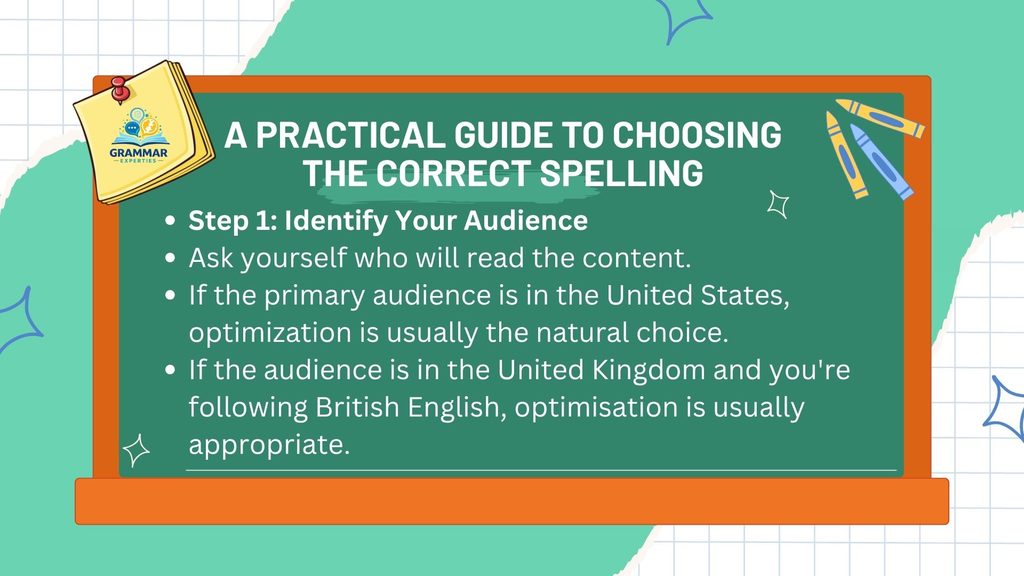
Step 1: Identify Your Audience
Ask yourself who will read the content.
If the primary audience is in the United States, optimization is usually the natural choice.
If the audience is in the United Kingdom and you’re following British English, optimisation is usually appropriate.
Step 2: Check the Required Style Guide
Some organizations have their own editorial standards.
A university may require a particular variety of English. A publisher may have a house style. A company may standardize all website content around one form.
When such guidance exists, follow it.
Step 3: Check the Surrounding Spelling
Look at other words in your document.
If you consistently write:
- organisation
- realise
- specialise
- modernisation
then optimisation may fit your British-style spelling system.
If you write:
- organization
- realize
- specialize
- modernization
then optimization fits the American pattern.
Step 4: Stay Consistent
Once you’ve selected one form, use it consistently.
| Writing situation | Common choice |
|---|---|
| US website | optimization |
| British website | optimisation |
| US academic paper | optimization |
| UK academic paper | optimisation, subject to style guide |
| American business | optimization |
| British business | optimisation |
| International website | Choose one consistent house style |
| Client project | Follow the client’s style guide |
2025–2026 Usage and Reference Data
What Current Dictionary Evidence Shows
Current dictionary evidence available in 2026 continues to recognize both forms.
Cambridge’s current entry defines optimization and explicitly labels optimisation as the usual UK spelling. Its related verb entry similarly identifies optimise as the usual UK form of optimize.
Collins likewise records optimization and optimisation as noun forms derived from optimize.
This is important because it demonstrates that the two spellings are not a case of one being a modern misspelling of the other.
What the Data Does Not Prove
There is no single authoritative 2025–2026 worldwide statistic that gives a definitive percentage split between optimization and optimisation across every type of English writing.
Search behavior, published books, websites, academic papers, and regional corpora measure different populations. Therefore, claims such as “X% of English speakers use optimization” should be treated cautiously unless the source clearly defines its dataset and methodology.
The reliable conclusion from current dictionary evidence is simpler: both forms remain established, while regional conventions determine which form is normally preferred.
Case Study: Choosing a Spelling for an International Website
Imagine a software company preparing a new website for customers in both the United States and the United Kingdom.
The marketing team initially writes the homepage using American English:
“Our platform provides powerful workflow optimization tools.”
The product team, however, is based in Britain and changes several pages to:
“Our platform provides powerful workflow optimisation tools.”
Neither team has introduced a meaning error. The problem is inconsistency.
A visitor reading the entire website may encounter optimization on one page and optimisation on another. While this doesn’t make the content grammatically wrong, it can make the company’s editorial style appear less controlled.
The team therefore decides to establish a house style. Because the company’s primary commercial audience is American, its main website uses optimization, optimize, optimized, and optimizing. The UK sales team keeps a British-English version of customer-facing materials and uses optimisation, optimise, optimised, and optimising.
This approach solves the actual problem: not deciding which spelling is universally “correct,” but deciding which spelling belongs to each audience and applying it consistently.
The lesson applies to blogs, software documentation, academic papers, newsletters, product descriptions, and business websites. Regional spelling is part of editorial consistency. When a specific client or publication gives you a style guide, that guide should take precedence.
Common Mistakes With Optimisation and Optimization
Mistake 1: Thinking “Optimisation” Is Wrong
This is one of the most common misunderstandings.
Optimisation is a valid spelling, especially in British English.
Mistake 2: Assuming “Optimization” Is Only a Technical Term
It isn’t.
Optimization can describe any process of making something more effective or efficient, including business processes, manufacturing, mathematics, software, and everyday systems.
Mistake 3: Mixing British and American Forms
Using optimisation in one paragraph and optimization in another isn’t automatically grammatically wrong, but unnecessary switching can make your writing inconsistent.
Mistake 4: Changing Only One Related Word
For example:
We need to optimise the website for better search engine optimization.
This combines British optimise with American optimization.
If you’re following American English:
We need to optimize the website for better search engine optimization.
If you’re following British English:
We need to optimise the website for better search engine optimisation.
Mistake 5: Treating Regional Spelling as a Difference in Meaning
There is no separate concept represented by the s spelling and another represented by the z spelling.
The basic meaning remains the same.
Optimisation or Optimization: Quick Comparison Checklist
Before publishing your content, ask:
- Who is my target audience?
- Am I using British or American English?
- Does my organization have a style guide?
- Does the publication require a particular spelling system?
- Have I used optimise/optimize consistently?
- Have I checked optimised/optimized?
- Have I checked optimising/optimizing?
- Have I kept related terms consistent?
- Have I avoided treating the alternative spelling as an error?
- Have I checked the final document for mixed regional spellings?
This simple checklist can prevent many unnecessary editing problems.
Mini Quiz:Optimisation or Optimization
1. Which spelling is standard in American English?
A. Optimisation
B. Optimization
C. Optimizasion
D. Optimisasion
Answer: B. Optimization
2. Which spelling is commonly used in British English?
A. Optimization
B. Optimisation
C. Optimizetion
D. Optimazation
Answer: B. Optimisation
3. Are “optimisation” and “optimization” different in meaning?
A. Yes, completely
B. Yes, slightly
C. No, they have the same basic meaning
D. Only in technical writing
Answer: C. No, they have the same basic meaning
4. Complete the British English sentence: “The team is ___ the website.”
A. optimizing
B. optimising
C. optimazing
D. optimizating
Answer: B. optimising
5. Complete the American English sentence: “The team is ___ the website.”
A. optimising
B. optimazing
C. optimizing
D. optimisation
Answer: C. optimizing
6. Which noun is preferred in British English?
A. Optimise
B. Optimising
C. Optimisation
D. Optimized
Answer: C. Optimisation
7. Which noun is preferred in American English?
A. Optimisation
B. Optimization
C. Optimise
D. Optimising
Answer: B. Optimization
8. Which sentence follows British English spelling consistently?
A. We need to optimize the website for search engine optimisation.
B. We need to optimise the website for search engine optimisation.
C. We need to optimisation the website for search engine optimize.
D. We need to optimized the website for search engine optimisation.
Answer: B. We need to optimise the website for search engine optimisation.
9. Which sentence follows American English spelling consistently?
A. We need to optimise the website for search engine optimization.
B. We need to optimization the website for search engine optimize.
C. We need to optimize the website for search engine optimization.
D. We need to optimising the website for search engine optimisation.
Answer: C. We need to optimize the website for search engine optimization.
10. What is the main difference between “optimisation” and “optimization”?
A. Meaning
B. Pronunciation
C. Regional spelling convention
D. Part of speech
Answer: C. Regional spelling convention
11. Which form is associated with British English?
A. Optimise
B. Optimize
C. Optimized
D. Optimization
Answer: A. Optimise
12. Which form is associated with American English?
A. Optimise
B. Optimisation
C. Optimize
D. Optimised
Answer: C. Optimize
13. Which spelling would normally appear in a British-English article about SEO?
A. Search engine optimization
B. Search engine optimisation
C. Search engine optimazation
D. Search engine optimizasion
Answer: B. Search engine optimisation
14. Which spelling would normally appear in an American-English article about SEO?
A. Search engine optimisation
B. Search engine optimising
C. Search engine optimization
D. Search engine optimise
Answer: C. Search engine optimization
15. Which sentence uses “optimization” correctly?
A. The company improved its optimization process.
B. The company improved its optimisation process.
C. The company optimization its website.
D. The company is optimization the software.
Answer: A. The company improved its optimization process.
16. Which sentence uses “optimisation” correctly?
A. The company optimisation its website.
B. The company is optimisation the software.
C. The company improved its optimisation process.
D. The company has optimisation the application.
Answer: C. The company improved its optimisation process.
17. Which spelling is correct in this American English sentence?
“The software has been ___ for better performance.”
A. optimised
B. optimized
C. optimisation
D. optimising
Answer: B. optimized
18. Which spelling is correct in this British English sentence?
“The software has been ___ for better performance.”
A. optimized
B. optimization
C. optimised
D. optimizing
Answer: C. optimised
19. If a British publisher has a house style requiring British English, which form should you normally choose?
A. Optimization
B. Optimisation
C. Both randomly
D. Neither
Answer: B. Optimisation
20. If an American company uses American English throughout its website, which spelling is more consistent?
A. Optimisation
B. Optimizing only
C. Optimization
D. Optimise
Answer: C. Optimization
21. True or False: “Optimisation” is an incorrect spelling.
Answer: False
Explanation: Optimisation is a standard spelling, particularly in British English.
22. True or False: “Optimization” is commonly used in American English.
Answer: True
Explanation: Optimization is the standard American English spelling.
23. Which pair correctly shows the British and American verb forms?
A. British: optimise — American: optimize
B. British: optimize — American: optimise
C. British: optimiz — American: optimis
D. British: optimisation — American: optimise
Answer: A. British: optimise — American: optimize
24. Which pair correctly shows the British and American noun forms?
A. British: optimize — American: optimise
B. British: optimisation — American: optimization
C. British: optimized — American: optimised
D. British: optimizing — American: optimising
Answer: B. British: optimisation — American: optimization
25. What is the best rule for choosing between “optimisation” and “optimization”?
A. Always use optimisation
B. Always use optimization
C. Choose the form that matches your English variety and keep it consistent
D. Use both forms in the same paragraph
Answer: C. Choose the form that matches your English variety and keep it consistent
Frequently Asked Questions
Q1:Is optimisation or optimization correct?
Both are correct. Optimization is the standard American English spelling, while optimisation is usually used in British English. Cambridge explicitly identifies optimisation as the usual UK form.
Q2:Is optimisation British or American English?
Optimisation is primarily associated with British English. American English normally uses optimization.
Q3:Is optimization American English?
Yes. Optimization is the standard American English spelling. British English usually uses optimisation.
Q4:Do optimisation and optimization have the same meaning?
Yes. Both refer to the process of making something as good, effective, or efficient as possible.
Should I write SEO optimisation or SEO optimization?
Use the version that matches your English variety:
- British English: SEO optimisation
- American English: SEO optimization
Cambridge’s entry for search engine optimization notes that British English usually uses optimisation.
Q5:Is “optimise” or “optimize” correct?
Both are correct. Optimise is the usual British spelling, while optimize is the standard American spelling.
Q6:Can I use optimisation in an American English article?
You can, but if the article is intended to follow standard American English, optimization is the more consistent choice.
Q7:Which spelling should I use for an international website?
Either can work. The important thing is to establish a consistent editorial style. If your website has separate regional versions, you can use the spelling appropriate to each audience.
Conclusion: Optimisation or Optimization?
So, optimisation or optimization—which is correct?
Both are correct.
Use optimization when following American English conventions, and use optimisation when following British English conventions. The two forms have the same meaning; the main difference is the regional spelling convention. Cambridge Dictionary confirms this distinction in its current dictionary entries.
Remember the related forms:
- American: optimize → optimization → optimized → optimizing
- British: optimise → optimisation → optimised → optimising
The best approach is simple: choose the English variety that fits your audience, follow the relevant style guide, and remain consistent.
If you’re writing a blog, academic paper, business document, or website, checking regional spelling before publishing can make your content clearer and more professional.
Explore more easy grammar lessons and improve your English with Grammar Expertise
References

Maimoona Mughal is an English grammar enthusiast dedicated to simplifying confusing words, grammar rules, and vocabulary through clear, accurate, and learner-friendly content that helps readers write and communicate with confidence.