Have you ever wondered whether tie or tye is the correct spelling? You’re not alone. These words look almost identical and are pronounced the same, so it’s easy to type “tye” when you actually mean “tie.”
The good news is that the answer is simple: “tie” is the correct spelling for the ordinary modern English word. You use it when talking about fastening something, wearing a necktie, describing an equal score, or referring to a connection between people or things.
But there’s an interesting twist. “Tye” isn’t completely meaningless. Historical dictionaries record tye in several specialized senses, including an obsolete form related to tie, a British mining term, and a dialect word for a pasture or common. Merriam-Webster currently lists these specialized meanings separately.
So, should you ever write tye? Let’s explore the difference, history, meanings, examples, and modern usage so you can choose the right spelling with confidence.
Tie vs Tye: Quick Answer
Which spelling should you use?
For almost every situation in modern everyday English, use tie.
Tie is the standard spelling used as both a noun and a verb. It can refer to fastening something, a piece of clothing worn around the neck, an equal score, or a relationship or connection. Cambridge Dictionary lists all of these common meanings.
Tye, by contrast, is a rare word with specialized or historical meanings. Merriam-Webster records tye as an obsolete word for a small box, a British term connected with ore washing, a dialectal English word for a large pasture or common, and a nautical term for a rope or chain used with a yard.
Quick comparison
| Feature | Tie | Tye |
|---|---|---|
| Standard modern English | Yes | Generally no |
| Common everyday word | Yes | No |
| Verb meaning “fasten” | Yes | No in ordinary modern English |
| Piece of neckwear | Yes | No |
| Equal score | Yes | No |
| Historical/dialectal meanings | Some | Yes |
| Used as a name | Sometimes | Yes |
| Common in modern writing | Very common | Very rare |
Simple rule: If you’re talking about tying your shoes, wearing a necktie, or a game ending with equal scores, choose tie.
What Does “Tie” Mean?
The word tie is remarkably versatile. It’s used as both a noun and a verb and appears in everyday conversation, academic writing, business communication, sports, music, and many other contexts.
Tie as a verb
As a verb, tie generally means to fasten, connect, or secure something.
For example:
- Please tie your shoelaces.
- She tied the package with string.
- He tied the ribbon into a bow.
- They tied the boat to the dock.
- I need to tie these cables together.
Cambridge Dictionary defines tie as fastening things together with string or another long, thin material.
The word can also have a figurative meaning:
- The job ties him to the city.
- Financial responsibilities tied her to the company.
- Strong traditions tie the community together.
So, the basic idea behind the verb is connection, fastening, or restriction.
Tie as a noun
As a noun, tie has several common meanings.
It can describe something used to fasten things:
The package was secured with a plastic tie.
It can describe clothing:
He wore a blue tie with his gray suit.
It can describe an equal result:
The game ended in a tie.
And it can describe a relationship or connection:
The two families have strong ties.
These meanings are all established in modern English dictionaries.
Common phrases with “tie”
You may already use tie in many familiar expressions:
- tie your shoes
- tie a knot
- tie the knot
- tie someone down
- tie something together
- tie in with
- family ties
- business ties
- a tie game
- black tie
For example:
The new evidence ties in with the earlier report.
Cambridge describes tie in as expressing a close connection or agreement between ideas or statements.
What Does “Tye” Mean?
Here’s where the comparison gets more interesting.
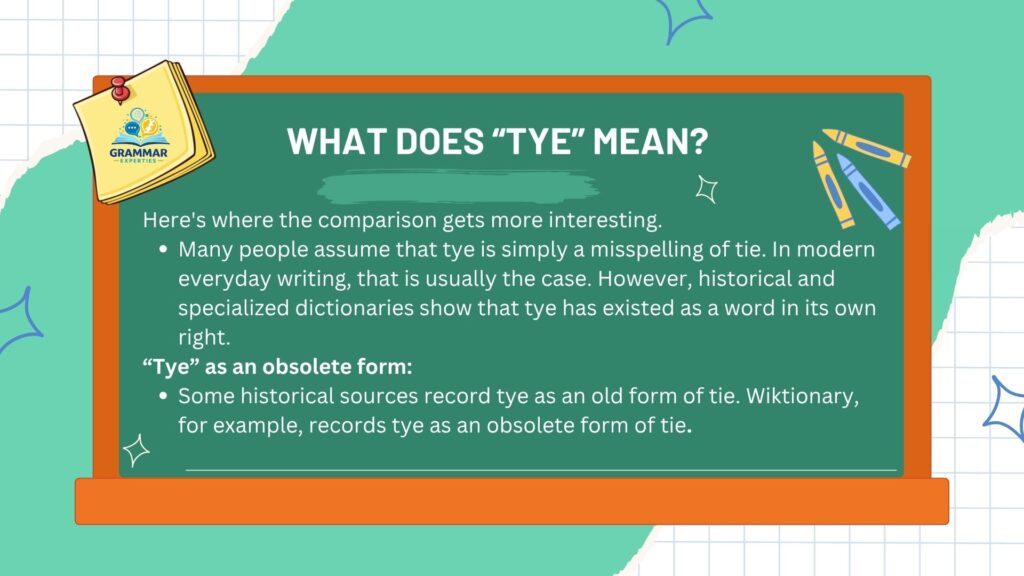
Many people assume that tye is simply a misspelling of tie. In modern everyday writing, that is usually the case. However, historical and specialized dictionaries show that tye has existed as a word in its own right.
“Tye” as an obsolete form
Some historical sources record tye as an old form of tie. Wiktionary, for example, records tye as an obsolete form of tie.
Older English spelling was far less standardized than modern spelling. Writers could use different spellings for similar sounds, and forms that look unusual today sometimes appear in historical documents.
That doesn’t mean you should revive the spelling in ordinary writing.
If you’re writing:
I need to tye my shoes.
change it to:
I need to tie my shoes.
“Tye” in dialect and specialized English
Modern dictionaries also record other meanings of tye that have nothing to do with ordinary shoe-tying.
Merriam-Webster lists tye as a British mining term for a launder used for washing ores. It also records a dialectal English sense meaning a large pasture or common. Another specialized sense refers to a nautical chain or rope used to raise or lower a yard.
Collins similarly identifies tye as a British dialect word associated with mining and the separation of valuable material from dross.
These meanings are extremely specialized. Most English learners will never need to use them.
“Tye” in names and places
You may also encounter Tye as a personal or geographic name.
For example:
- Tye Anderson
- Tye Road
- High Tye
In these cases, Tye should not automatically be “corrected” to “Tie.” Proper names preserve their official spelling even when that spelling differs from an ordinary English word.
This distinction is important:
He wore a red tie. ✅
but:
Tye Anderson arrived at noon. ✅
The first sentence uses the common noun tie. The second uses Tye as a proper name.
Tie vs Tye: History and Word Origins
The history of tie helps explain why older forms such as tye can appear in historical sources.
Where does “tie” come from?
Merriam-Webster traces the noun tie through Middle English forms such as teg and tye to Old English tēag, with connections to Old Norse taug, meaning rope. Merriam-Webster gives the first known use of tie as before the 12th century.
The Online Etymology Dictionary similarly traces the noun through Middle English forms such as teie and tie to Old English teag, referring to a cord, band, or something used for binding.
The verb developed from related Old English forms meaning to bind, fasten, join, or connect.
Why did spelling change?
English spelling wasn’t always governed by the consistent rules we expect today.
Before spelling became more standardized, the same word could appear in multiple written forms. Historical records therefore contain spellings that look strange to modern readers.
Merriam-Webster’s modern entry for tie is especially revealing because its etymology itself mentions the Middle English form tye.
In other words, “tye” has a genuine historical connection to “tie,” but that doesn’t make it the preferred modern spelling.
The evolution from older forms to modern English
A simplified way to think about the development is:
Old English → Middle English variations → standardized modern English → tie
Older spellings didn’t necessarily disappear because they were “wrong.” Many simply stopped being the preferred form as English spelling became more standardized.
This is why historical documents may contain tye even though modern writers normally use tie.
How to Use “Tie” Correctly in Modern English
The easiest way to avoid the tie vs tye mistake is to look at the meaning you want to express.
For fastening something
Use tie when you mean to fasten, bind, or secure something.
Correct:
Please tie the rope securely.
She tied the ribbon around the box.
Don’t forget to tie your shoelaces.
Incorrect in ordinary modern English:
Please tye the rope securely.
She tyed the ribbon around the box.
The standard forms are tie, ties, tied, tying.
Notice that the present participle is tying, not tieing in ordinary standard usage.
For clothing
Use tie when referring to neckwear.
Examples:
He bought a new tie for the interview.
Her blue tie matched her shirt.
I forgot to pack my formal tie.
Cambridge defines a tie as a long, thin piece of material worn under a shirt collar and tied at the front.
For an equal score
Use tie when two competitors finish with the same score.
Examples:
The teams finished in a tie.
The match ended in a 2–2 tie.
Both players tied for first place.
Cambridge specifically recognizes tie as a competition result in which people finish with the same score or result.
For relationships and connections
Tie can also describe a bond or connection.
Examples:
They have strong family ties.
The two countries have close economic ties.
She has a strong tie to her hometown.
This sense is often used in the plural:
ties = relationships or connections
Common Mistakes With Tie and Tye
Because the two words sound identical, spelling mistakes are easy to make.
Mistake 1: “Tye your shoes”
❌ Tye your shoes before you leave.
✅ Tie your shoes before you leave.
The everyday verb is tie.
Mistake 2: “He wore a black tye”
❌ He wore a black tye.
✅ He wore a black tie.
When referring to neckwear, always use tie.
Mistake 3: “The game ended in a tye”
❌ The game ended in a tye.
✅ The game ended in a tie.
The word for an equal score is tie.
Mistake 4: Assuming “tye” is a British spelling
❌ Tye is the British spelling of tie.
✅ Tie is the standard spelling in modern British English as well as American English.
Cambridge’s British and American dictionary entries use tie for the common word.
Tye does have British dialectal and specialized dictionary meanings, but it isn’t the normal British spelling of the everyday verb tie.
Tie vs Tye: 2025–2026 Usage and Dictionary Check
Current dictionary evidence gives us a useful snapshot of how these words are treated today.
What current dictionaries show
As of 2026, Merriam-Webster maintains a full modern entry for tie, including noun and verb meanings and historical information. Its entry gives the first known use of tie as before the 12th century.
Merriam-Webster also has a separate tye entry containing four numbered dictionary senses: an obsolete small box, a British mining term, a dialectal term for a pasture/common, and a specialized nautical term.
That distinction is useful: tye isn’t simply a nonexistent sequence of letters, but its dictionary meanings are specialized, obsolete, or dialectal rather than the everyday meaning most writers intend.
A practical usage summary
| 2026 usage situation | Recommended form |
|---|---|
| Fasten your shoes | tie |
| Tie a package | tie |
| Piece of neckwear | tie |
| Equal sports score | tie |
| Family connection | tie/ties |
| Historical text | tye may appear |
| British dialect/mining context | tye may appear |
| Person or place named Tye | Tye |
| Ordinary school or business writing | tie |
This is more useful than assigning an unsupported percentage to the two spellings. Dictionary entries tell us what meanings exist, but they don’t by themselves provide a reliable percentage of modern written usage.
Google’s current people-first content guidance also emphasizes giving readers complete, trustworthy information rather than creating content simply to manipulate rankings.
Real-Life Example: A Student Catches the “Tye” Mistake
Imagine a student named Daniel preparing an English assignment about common spelling mistakes. While writing, he types:
“You should always tye your shoelaces before running.”
The sentence looks reasonable at first glance because tye and tie sound exactly alike. Daniel might even wonder whether tye is an alternative spelling.
Before submitting the assignment, he checks a dictionary. The result clears up the confusion: tie is the standard modern verb meaning to fasten something, while tye has only specialized historical, dialectal, or technical meanings. Cambridge gives examples such as tying a ribbon or tying shoelaces, while Merriam-Webster separately identifies the unusual meanings of tye.
Daniel changes the sentence to:
“You should always tie your shoelaces before running.”
He then notices another sentence in his assignment:
“The final match ended in a tye.”
That needs correction too:
“The final match ended in a tie.”
Finally, Daniel writes about a fictional character named Tye. This time, he keeps the spelling because it’s a proper name.
This example highlights the main lesson: context matters, but for ordinary modern English, “tie” is the spelling you want.
A Simple Memory Trick for Tie vs Tye
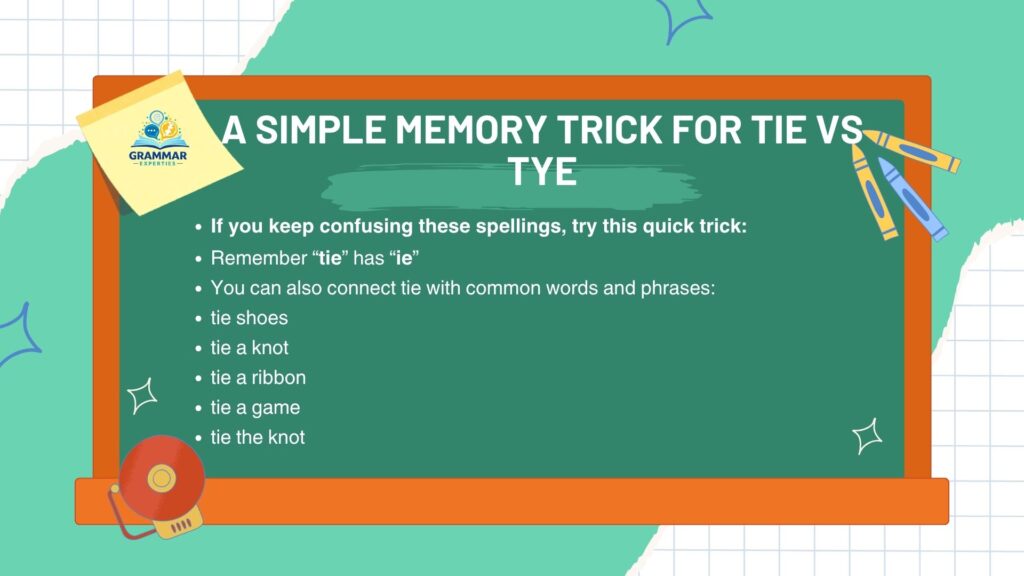
If you keep confusing these spellings, try this quick trick:
Remember “tie” has “ie”
Think of the phrase:
Tie your tie.
Both words use tie.
You can also connect tie with common words and phrases:
- tie shoes
- tie a knot
- tie a ribbon
- tie a game
- tie the knot
- necktie
- family ties
If you’re writing one of these everyday expressions, tie is almost certainly the spelling you need.
When should you remember “Tye”?
Think of Tye as something you may encounter in a name, historical source, dialect, or specialized dictionary entry.
That distinction keeps the two forms from getting mixed up.
British English vs American English: Tie or Tye?
Another common question is whether tye might be a British spelling while tie is American.
The answer is no for the ordinary word.
British English
Modern British English uses:
tie
Examples:
I need to tie my shoes.
He wore a tie to work.
American English
American English also uses:
tie
Examples:
Please tie the package.
The game ended in a tie.
The spelling doesn’t change between these two major varieties of English for the everyday meanings discussed in this article. Cambridge provides both UK and US definitions using tie.
What about British “tye”?
This is where nuance matters.
Tye can occur in British dialectal or specialized vocabulary. Collins, for example, records a British dialect meaning associated with mining.
Therefore, it’s misleading to say that tye is simply “wrong everywhere.” A better explanation is:
Tye is not the standard spelling of the ordinary modern English word “tie,” but it survives in some specialized, historical, dialectal, and proper-name contexts.
Tie Synonyms and Related Words
Depending on the meaning, tie has several related words.
When “tie” means fasten
Possible alternatives include:
- bind
- fasten
- secure
- attach
- knot
- connect
Example:
Tie the rope to the post.
Could become:
Fasten the rope to the post.
When “tie” means an equal result
Related words include:
- draw
- deadlock
- equality
- level score
For example:
The match ended in a tie.
In some sports and varieties of English, draw may be preferred:
The match ended in a draw.
When “tie” means a relationship
Related words include:
- connection
- bond
- link
- relationship
- association
For example:
They have strong family ties.
This could also be expressed as:
They have a strong family bond.
However, these words aren’t always perfect substitutes. The exact choice depends on context.
When Is “Tye” Actually Correct?
This is the question that prevents an oversimplified answer.
Historical writing
If you’re quoting or discussing an old text in which tye appears, preserve the original spelling.
For example:
The manuscript uses the historical spelling tye.
Don’t modernize a historical quotation unless your editorial rules require it.
Dialect research
In linguistic or historical research, tye may represent a documented regional word.
Historical dialect sources record tye in connection with pasture or common land. A historical glossary of the Essex dialect, for example, records tye as a strip of pasture.
Specialized technical contexts
Merriam-Webster records tye as a specialized nautical term for a chain or rope used in raising or lowering a yard.
It also records the word in connection with British ore washing.
These are legitimate dictionary senses, but they’re not meanings most English learners need for daily communication.
Names and proper nouns
If someone’s official name is Tye, keep it as Tye.
For example:
Tye will present the report tomorrow.
Changing it to Tie would change the person’s name.
The same principle applies to official place names and business names.
Tie vs Tye: Quick Checklist
Before you type the word, ask yourself these questions:
- Am I talking about fastening something? → Tie
- Am I talking about shoelaces? → Tie
- Am I talking about a necktie? → Tie
- Am I describing an equal score? → Tie
- Am I describing a relationship or connection? → Tie
- Am I quoting an old historical source? → Tye may appear
- Am I discussing a dialect or specialized term? → Tye may be appropriate
- Is Tye someone’s official name? → Tye
- Is Tye part of an official place name? → Tye
- Am I writing a normal email, essay, article, or school assignment? → Tie
If you’re unsure and you’re talking about the everyday word, tie is the safe choice.
Mini Quiz: Tie vs Tye
- Which spelling is correct when you mean to fasten something with a knot?
A) Tie
B) Tye
C) Tiy
D) Tey
Answer: A) Tie - Choose the correct spelling: “Please ____ your shoelaces.”
A) Tye
B) Tie
C) Tei
D) Tyi
Answer: B) Tie - Which word names a piece of neckwear worn with a shirt?
A) Tye
B) Tey
C) Tie
D) Tiy
Answer: C) Tie - Which sentence is correct?
A) He wore a blue tie.
B) He wore a blue tye.
C) He wore a blue tei.
D) He wore a blue tiye.
Answer: A) He wore a blue tie. - What word describes a game in which competitors finish with the same score?
A) Tye
B) Tie
C) Tey
D) Tiy
Answer: B) Tie - Which sentence is correct?
A) The match ended in a tie.
B) The match ended in a tye.
C) The match ended in a tei.
D) The match ended in a tiye.
Answer: A) The match ended in a tie. - Choose the correct phrase: “strong family ____.”
A) Tye
B) Tie
C) Tei
D) Tyi
Answer: B) Tie - Which sentence correctly describes a connection between two countries?
A) The countries have strong economic ties.
B) The countries have strong economic tyes.
C) The countries have strong economic teis.
D) The countries have strong economic tyis.
Answer: A) The countries have strong economic ties. - Which form is correct? “Yesterday, she ____ the ribbon.”
A) Tyed
B) Tied
C) Teid
D) Tiyed
Answer: B) Tied - Choose the correct form: “She is ____ing a ribbon.”
A) Tyeing
B) Tieing
C) Tying
D) Teying
Answer: C) Tying - Which sentence is spelled correctly?
A) I will tie the package.
B) I will tye the package.
C) I will tei the package.
D) I will tiye the package.
Answer: A) I will tie the package. - Which spelling is normally used in modern British and American English?
A) Tye
B) Tie
C) Tey
D) Tiy
Answer: B) Tie - Which statement about “tye” is most accurate?
A) It is always the preferred spelling of tie.
B) It is the standard American spelling.
C) It appears in some historical and specialized contexts.
D) It is never found as a real word.
Answer: C) It appears in some historical and specialized contexts. - If “Tye” is someone’s official first name, which spelling should you use?
A) Tie
B) Tye
C) Tey
D) Tiy
Answer: B) Tye - Which word completes the phrase “____ the knot”?
A) Tye
B) Tie
C) Tei
D) Tyi
Answer: B) Tie - Which sentence correctly uses the past tense?
A) The teams tied at 2–2.
B) The teams tyed at 2–2.
C) The teams teid at 2–2.
D) The teams tiyed at 2–2.
Answer: A) The teams tied at 2–2. - Which phrase is correctly spelled?
A) Tye your shoes
B) Tie your shoes
C) Tei your shoes
D) Tiye your shoes
Answer: B) Tie your shoes - Which word is correct in “a neck ____”?
A) Tye
B) Tie
C) Tey
D) Tiy
Answer: B) Tie - Which spelling should you normally use in a school essay about fastening a rope?
A) Tye
B) Tie
C) Tey
D) Tiy
Answer: B) Tie - Which sentence is correct?
A) She tied the ribbon neatly.
B) She tyed the ribbon neatly.
C) She teid the ribbon neatly.
D) She tiyed the ribbon neatly.
Answer: A) She tied the ribbon neatly. - Which word belongs in “strong family ____”?
A) Tye
B) Tie
C) Tey
D) Tiy
Answer: B) Tie - Choose the correct form: “They are ____ing the cables together.”
A) Tying
B) Tyeing
C) Tieing
D) Teying
Answer: A) Tying - Which statement best distinguishes “tie” from “tye”?
A) Tie is common; tye is rare and specialized.
B) Tye is common; tie is obsolete.
C) Both are equally common today.
D) Neither appears in modern English.
Answer: A) Tie is common; tye is rare and specialized. - Which sentence should you choose for standard modern English?
A) Please tye the parcel securely.
B) Please tie the parcel securely.
C) Please tei the parcel securely.
D) Please tiye the parcel securely.
Answer: B) Please tie the parcel securely. - You are writing a normal email and mean “fasten.” Which spelling should you use?
A) Tye
B) Tie
C) Tey
D) Tiy
Answer: B) Tie
Frequently Asked Questions About Tie vs Tye
Q1:Is “tie” or “tye” correct?
Tie is the correct spelling for the ordinary modern English word. Use it for fastening, neckwear, equal scores, and relationships. Tye survives in specialized, historical, dialectal, and proper-name contexts.
Q2:Is “tye” a real word?
Yes, but it isn’t normally the word you want in everyday English. Dictionaries record several specialized meanings of tye, including obsolete, dialectal, mining, and nautical senses.
Q3:Is “tye” an old spelling of “tie”?
In some historical contexts, yes. Historical English used spelling variants, and dictionaries record tye as an obsolete form related to tie.
Q4:Is “tye” the British spelling of “tie”?
No. Tie is the standard modern spelling in both British and American English. Tye does occur in some British dialectal and specialized contexts, but it isn’t the normal British spelling of the everyday word.
Q5:Should I write “tye your shoes”?
No. The correct sentence is:
Tie your shoes.
The verb meaning “fasten with a knot or cord” is tie.
Q6:Should I write “a red tye” for clothing?
No. The correct spelling is:
a red tie
A tie is a piece of neckwear worn with a shirt.
Q7:Can “Tye” be a person’s name?
Yes. Tye can be used as a personal name or surname. When it is someone’s official name, keep the spelling Tye.
Q8:What is the easiest way to remember tie vs tye?
Remember:
Tie your tie.
If you’re talking about shoes, knots, clothing, equal scores, or ordinary connections, choose tie. Reserve Tye for names and specialized or historical contexts.
Conclusion: Tie Is the Right Choice for Modern English
So, tie vs tye: which spelling is correct?
For ordinary modern English, the answer is clear: tie.
Use tie when you mean to fasten something, make a knot, wear neckwear, describe an equal score, or talk about a relationship or connection. It is the standard spelling used in modern British and American English.
Tye is different. It has a real history and appears in dictionaries, but mainly in obsolete, dialectal, mining, nautical, historical, or proper-name contexts.
The easiest rule is:
Everyday English → tie.
Historical, specialized, or proper-name context → tye may be correct.
When you’re writing an email, essay, article, assignment, or social media post, don’t overthink it. If you mean tie, write tie.
Explore more easy grammar lessons and improve your English with Grammar Expertise
References

Maimoona Mughal is an English grammar enthusiast dedicated to simplifying confusing words, grammar rules, and vocabulary through clear, accurate, and learner-friendly content that helps readers write and communicate with confidence.