Introduction
Have you ever typed “realy” and stopped to wonder whether you forgot an l? You’re not alone. The difference between really vs realy is only one letter, but that small difference determines whether your spelling is correct.
The answer is simple: really is the correct spelling. Realy is a misspelling and isn’t accepted as the standard English form.
The word really is an adverb used to mean truly, actually, very, or very much. It can also express surprise or ask whether something is true. Cambridge Dictionary lists several of these uses, including emphasis, truth, certainty, and surprise.
In this guide, you’ll learn why really has two Ls, what it means, how to use it correctly, why people write “realy,” and how to remember the spelling every time.
Really vs Realy: Which Spelling Is Correct?
The correct spelling is really, with two Ls.
Realy is simply a spelling error. It isn’t a separate English word with its own meaning.
| Spelling | Correct? | Meaning | Example |
|---|---|---|---|
| Really | ✅ Yes | Truly, actually, very, or very much | I really enjoyed the book. |
| Realy | ❌ No | No standard English meaning | I realy enjoyed the book. ❌ |
So, when you’re writing an email, essay, message, article, application, or social media post, use really.
How Do You Spell Really?
The spelling is:
R-E-A-L-L-Y
A useful way to remember it is:
real + ly = really
The base word is real, and the adverbial suffix -ly gives us really.
For example:
- real → really
- usual → usually
- final → finally
- actual → actually
Don’t remove one of the Ls when writing really.
Is “Realy” a Word?
No, realy is not the standard English spelling of the word.
If someone writes “realy,” readers will generally understand that they intended to write really. However, spelling it incorrectly can make formal writing look careless.
A historical and corpus-based example also shows realy appearing as an error that is normalized to really, reinforcing that the one-L form can occur as a spelling variation or mistake rather than as the standard modern spelling.
What Does Really Mean?
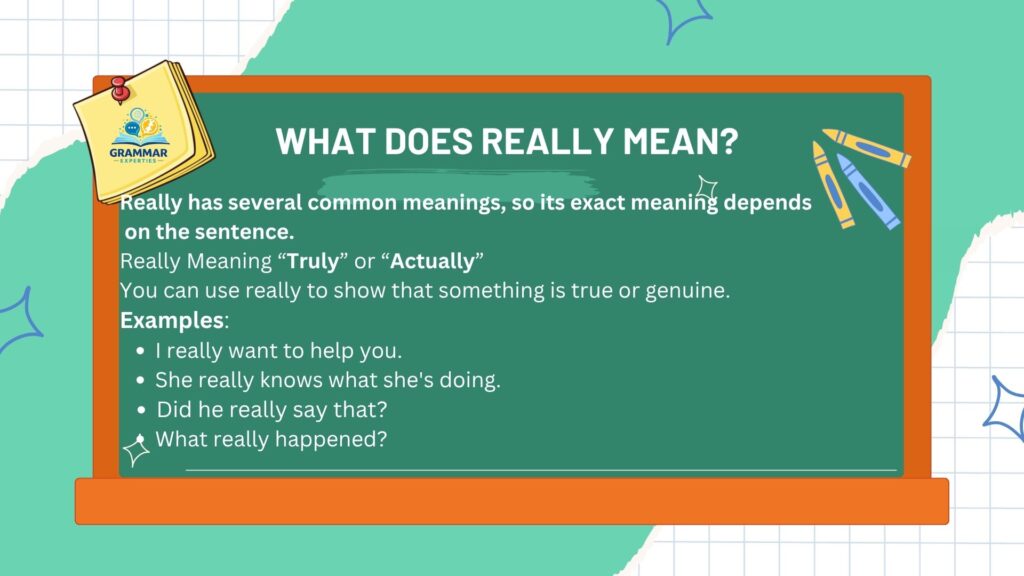
Really has several common meanings, so its exact meaning depends on the sentence.
Really Meaning “Truly” or “Actually”
You can use really to show that something is true or genuine.
Examples:
- I really want to help you.
- She really knows what she’s doing.
- Did he really say that?
- What really happened?
Here, really adds the idea of truth or reality.
Cambridge Dictionary defines this use in terms such as “in fact” and uses really to refer to what is true about a situation.
Really Meaning “Very” or “Very Much”
Really can also strengthen an adjective, adverb, or verb.
Examples:
- That movie was really good.
- The water is really cold.
- I really like this song.
- She is really happy today.
In these sentences, really adds emphasis.
For example:
The test was difficult.
becomes:
The test was really difficult.
The second sentence gives the adjective difficult more emphasis.
Really as an Expression of Surprise
You can also use really? by itself when you’re surprised or interested in something someone has said.
For example:
A: I’m moving to Canada next month.
B: Really? That’s exciting!
This use is common in everyday conversation and informal writing. Cambridge specifically identifies really? as an expression of interest, surprise, or annoyance.
Why Does Really Have Two Ls?
One of the biggest reasons people write realy is that they remember the base word real but forget what happens when -ly is added.
Really vs Realy: Remember “Real + Ly”
Think of the word as:
REAL + LY = REALLY
Notice what happens at the boundary:
reaL + Ly
That gives you:
reaLLy
So the two Ls aren’t something you need to guess. They come from the spelling of real followed by -ly.
A simple memory sentence is:
If it is real, it becomes really.
For example:
- real → really
- real good → really good
- real important → really important
The spelling realy drops one of the Ls and therefore isn’t the standard form.
A Simple Memory Trick
Try this:
“Really is really real.”
The word really contains the word real and keeps its L.
Another trick is to remember:
REAL + LY = REALLY
Whenever you hesitate, mentally split the word into those two parts.
Common Spelling Mistakes
People may accidentally write:
- ❌ realy
- ❌ relly
- ❌ realley
- ❌ reallly
The correct form is:
- ✅ really
The most common mistake in this comparison is realy, because the writer remembers real but doesn’t retain both Ls when adding -ly.
How to Use Really Correctly in a Sentence
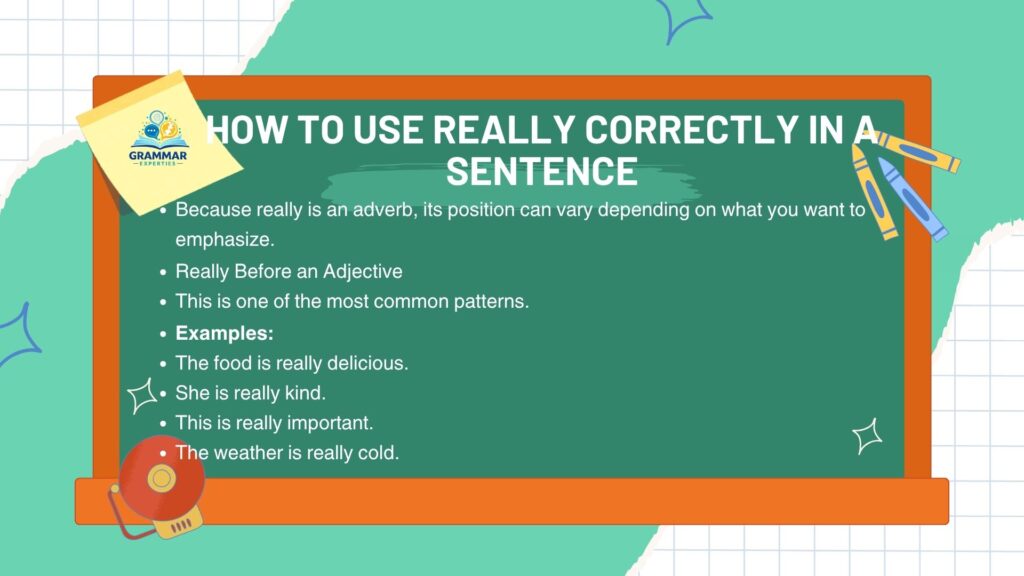
Because really is an adverb, its position can vary depending on what you want to emphasize.
Really Before an Adjective
This is one of the most common patterns.
Examples:
- The food is really delicious.
- She is really kind.
- This is really important.
- The weather is really cold.
Here, really modifies the adjective that follows it.
Really Before a Verb
You can also place really before a main verb.
Examples:
- I really like your idea.
- We really need more time.
- She really enjoys reading.
- They really want to win.
In each example, really strengthens the action or feeling.
Really at the Beginning or End of a Sentence
Sometimes really appears at the beginning or end of a sentence for emphasis or conversational effect.
Examples:
- Really, I don’t know what happened.
- Really, you shouldn’t worry.
- I don’t know, really.
- That’s surprising, really.
The position can influence emphasis, but the spelling remains really.
Really vs Realy in Everyday Writing
A spelling mistake may seem small, but context matters. If you’re writing something important, one incorrect letter can distract the reader.
In Emails
Correct:
I really appreciate your help with this project.
Incorrect:
I realy appreciate your help with this project. ❌
In Academic Writing
Correct:
The results are really important to the study.
However, in formal academic writing, you may sometimes want a more precise word such as particularly, significantly, or especially, depending on what you mean.
In Social Media and Text Messages
Correct:
I really love this picture!
Because informal messages are often typed quickly, realy can easily appear as a typo. Even so, the standard spelling remains really.
In Professional Writing
Correct:
We really appreciate your feedback.
For professional communication, proofreading is worthwhile because spelling mistakes can affect how polished your message appears.
A Real-Life Example: How One Missing Letter Causes Confusion
Imagine that Sara is preparing an important email to a potential employer. She wants to thank the hiring manager after an interview, so she writes:
“I realy appreciate the opportunity to discuss the position with you.”
The message is understandable. The hiring manager will almost certainly know that Sara meant really. However, the spelling mistake is still noticeable because realy isn’t the standard form.
Before sending the email, Sara reads it again and spots the problem. She remembers the simple rule real + ly = really and changes the sentence to:
“I really appreciate the opportunity to discuss the position with you.”
The corrected sentence sounds exactly the same when spoken, but the written version looks more polished.
This example shows why spelling matters even when a reader can understand your intended meaning. In casual texting, a typo may not matter much. In an application, school assignment, business email, or published article, accuracy carries more weight.
The lesson is straightforward: don’t treat really and realy as two spelling choices. They aren’t. Really is the standard form, while realy is an error. When you’re unsure, break the word apart: real + ly = really.
2025–2026 Data and Usage Snapshot
Current language references continue to recognize really as an established English adverb. Cambridge Dictionary currently provides several meanings and grammatical uses for the word, including very, in fact, certainty, and expressions of surprise.
There is also direct corpus evidence that realy occurs as a misspelling of really. The Cambridge Write & Improve Corpus includes an original learner sentence containing “realy” and shows the corrected form as “really.”
A useful caution about modern usage data is that not every online frequency source provides current-year statistics. For example, historical corpus datasets and search-frequency tools cover different time periods and measure different things. Therefore, it would be misleading to invent a precise “2026 misspelling rate” for realy without a reliable dataset specifically measuring that error.
For an SEO and language guide, the strongest evidence is therefore the combination of current dictionary definitions, learner-corpus evidence, and established spelling conventions rather than an unsupported search-volume number.
Google’s current Search guidance also recommends creating helpful, reliable, people-first content and emphasizes accurate, trustworthy information rather than content created merely to attract search traffic.
Quick Checklist: How to Always Spell Really Correctly
Use this checklist whenever you’re unsure.
- Step 1: Start with the base word real.
- Step 2: Add -ly.
- Step 3: Keep both Ls.
- Step 4: Write really.
- Step 5: Proofread before submitting important writing.
The One-Line Rule
real + ly = really
If you remember that formula, you won’t need to guess between really and realy.
Mini Quiz: Really vs Realy
1. I usually drink coffee ____.
A) in the morning
B) on the morning
C) at the morning
D) by the morning
Answer: A) in the morning
2. Which sentence correctly refers to a specific morning connected to an exam?
A) I was nervous in the morning of the exam.
B) I was nervous on the morning of the exam.
C) I was nervous at the morning of the exam.
D) I was nervous by the morning of the exam.
Answer: B) on the morning of the exam
3. Choose the natural sentence for a general statement about productivity.
A) I am productive on the morning.
B) I am productive at the morning.
C) I am productive in the morning.
D) I am productive by the morning.
Answer: C) I am productive in the morning.
4. Which phrase correctly completes the sentence?
“____ of July 15, the roads were empty.”
A) In the morning
B) On the morning
C) At the morning
D) By the morning
Answer: B) On the morning
5. Which sentence describes a repeated morning routine?
A) She exercises in the morning.
B) She exercises on the morning.
C) She exercises at the morning.
D) She exercises by the morning.
Answer: A) She exercises in the morning.
6. Choose the correct sentence about one particular wedding day.
A) On the morning of the wedding, it rained.
B) In the morning of the wedding, it rained.
C) At the morning of the wedding, it rained.
D) By the morning of the wedding, it rained.
Answer: A) On the morning of the wedding, it rained.
7. Which sentence is most natural when the exact date is unimportant?
A) I’ll call you in the morning.
B) I’ll call you on the morning.
C) I’ll call you at the morning.
D) I’ll call you by the morning.
Answer: A) I’ll call you in the morning.
8. Which phrase correctly identifies the morning of a meeting?
A) in the morning of the meeting
B) on the morning of the meeting
C) at the morning of the meeting
D) by the morning of the meeting
Answer: B) on the morning of the meeting
9. Complete the sentence naturally:
“My children are usually energetic ____.”
A) in the morning
B) on the morning
C) at the morning
D) by the morning
Answer: A) in the morning
10. Which sentence correctly refers to a particular morning when someone arrived?
A) In the morning she arrived, everyone cheered.
B) On the morning she arrived, everyone cheered.
C) At the morning she arrived, everyone cheered.
D) By the morning she arrived, everyone cheered.
Answer: B) On the morning she arrived, everyone cheered.
11. Which sentence uses “in the morning” correctly?
A) We usually walk in the morning.
B) We usually walk on the morning.
C) We usually walk at the morning.
D) We usually walk by the morning.
Answer: A) We usually walk in the morning.
12. Which sentence is correct for a specific date?
A) In the morning of May 6, the team left.
B) On the morning of May 6, the team left.
C) At the morning of May 6, the team left.
D) By the morning of May 6, the team left.
Answer: B) On the morning of May 6, the team left.
13. Which expression is best for a general preference?
A) I prefer studying in the morning.
B) I prefer studying on the morning.
C) I prefer studying at the morning.
D) I prefer studying by the morning.
Answer: A) I prefer studying in the morning.
14. Which sentence correctly refers to the morning of a particular interview?
A) I felt nervous in the morning of my interview.
B) I felt nervous on the morning of my interview.
C) I felt nervous at the morning of my interview.
D) I felt nervous by the morning of my interview.
Answer: B) I felt nervous on the morning of my interview.
15. Choose the correct phrase:
“____, I usually check my email.”
A) In the morning
B) On the morning
C) At the morning
D) By the morning
Answer: A) In the morning
16. Which sentence correctly uses a day plus morning?
A) I’ll see you in Monday morning.
B) I’ll see you on Monday morning.
C) I’ll see you at Monday morning.
D) I’ll see you by Monday morning.
Answer: B) I’ll see you on Monday morning.
17. Which sentence describes a general morning condition?
A) The streets are quieter in the morning.
B) The streets are quieter on the morning.
C) The streets are quieter at the morning.
D) The streets are quieter by the morning.
Answer: A) The streets are quieter in the morning.
18. Which phrase is correct for a specific ceremony?
A) in the morning of the ceremony
B) on the morning of the ceremony
C) at the morning of the ceremony
D) by the morning of the ceremony
Answer: B) on the morning of the ceremony
19. Which sentence is best for a regular study habit?
A) I study English in the morning.
B) I study English on the morning.
C) I study English at the morning.
D) I study English by the morning.
Answer: A) I study English in the morning.
20. Which sentence correctly identifies one morning through a date?
A) In the morning of August 10, the flight departed.
B) On the morning of August 10, the flight departed.
C) At the morning of August 10, the flight departed.
D) By the morning of August 10, the flight departed.
Answer: B) On the morning of August 10, the flight departed.
21. Which sentence sounds most natural in everyday conversation?
A) I’ll see you in the morning.
B) I’ll see you on the morning.
C) I’ll see you at the morning.
D) I’ll see you by the morning.
Answer: A) I’ll see you in the morning.
22. Which sentence correctly contrasts a habit with a specific event?
A) I exercise in the morning, but I was tired on the morning of the race.
B) I exercise on the morning, but I was tired in the morning of the race.
C) I exercise at the morning, but I was tired by the morning of the race.
D) I exercise by the morning, but I was tired at the morning of the race.
Answer: A) I exercise in the morning, but I was tired on the morning of the race.
23. Which option correctly completes the sentence?
“____ of the conference, the speaker arrived early.”
A) In the morning
B) On the morning
C) At the morning
D) By the morning
Answer: B) On the morning
24. Which sentence correctly uses “in the morning” for an unspecified future time?
A) We’ll discuss the issue in the morning.
B) We’ll discuss the issue on the morning.
C) We’ll discuss the issue at the morning.
D) We’ll discuss the issue by the morning.
Answer: A) We’ll discuss the issue in the morning.
25. What is the easiest rule for choosing between the two expressions?
A) Use in for general mornings and on for specific mornings.
B) Use on for all mornings and in only for dates.
C) Use at for general mornings and on for clock times.
D) Use in and on interchangeably in every context.
Answer: A) Use in for general mornings and on for specific mornings.
FAQs About Really vs Realy
Q1:Is “realy” correct?
No. Realy is a misspelling. The correct standard English spelling is really.
Q2:How do you spell really correctly?
Spell it R-E-A-L-L-Y.
A simple way to remember it is real + ly = really.
Q3:Why does really have two Ls?
The word is formed from real and the suffix -ly. Keeping the L from real and adding the L at the beginning of -ly produces really.
Q4:What is the difference between real and really?
Real is normally an adjective meaning genuine, actual, or not imaginary. Really is an adverb commonly meaning truly, actually, very, or very much.
For example:
- This is a real problem.
- This problem is really serious.
Q5:Is really an adverb?
Yes. Really is an adverb. It can modify verbs, adjectives, and other parts of a sentence.
Examples:
- I really like it.
- It is really beautiful.
- She really wanted to go.
Q6:Can I use really in formal writing?
Yes. Really is a standard English word and can be used in formal writing. However, depending on your sentence, a more precise word may sometimes communicate your meaning better.
Q7:Is “realy” ever acceptable in English?
Not as the standard spelling of really. In ordinary English writing, use really with two Ls.
Q8:What is the easiest way to remember really?
Remember:
REAL + LY = REALLY
Think of the two Ls as belonging together. If you’re writing the adverb, don’t drop one.
Conclusion: Really vs Realy — Choose the Correct Spelling
When it comes to really vs realy, there isn’t a difficult choice to make.
Really is the correct spelling, while realy is a misspelling.
The word really can mean truly, actually, very, or very much, and it can also express surprise in questions such as “Really?” Its spelling becomes easier to remember when you break it into:
real + ly = really
So the next time you hesitate, don’t guess. Remember the two Ls and choose really.
Explore more easy grammar lessons and improve your English with Grammar Expertise
Authority references
- Cambridge Dictionary — “really”
- Google Search Central — Creating Helpful, Reliable, People-First Content

Maimoona Mughal is an English grammar enthusiast dedicated to simplifying confusing words, grammar rules, and vocabulary through clear, accurate, and learner-friendly content that helps readers write and communicate with confidence.