Have you ever wondered whether “you are very welcome” is correct English? If someone says, “Thank you so much,” can you naturally reply, “You are very welcome”?
Yes. “You are very welcome” is grammatically correct English. It is a polite response to someone who thanks you, and adding “very” gives the expression extra warmth or emphasis.
However, there’s a small difference between being grammatically correct and sounding natural in every situation. In casual conversation, “you’re welcome” is usually shorter and more natural. In professional, formal, or especially appreciative situations, “you are very welcome” can sound warmer and more deliberate.
In this guide, you’ll learn the meaning, grammar, tone, correct usage, examples, common mistakes, and differences between “you are very welcome,” “you’re very welcome,” and “you’re welcome.”
Is “You Are Very Welcome” Correct?
Yes, “you are very welcome” is grammatically correct.
It follows a straightforward English sentence structure:
- You = subject
- are = linking verb
- very = adverb/intensifier
- welcome = adjective
The phrase is especially natural when welcome means that someone is gladly received or that their presence, request, or action is accepted.
Dictionaries also recognize welcome as an adjective. Merriam-Webster, for example, defines welcome as something received gladly and specifically identifies “you’re welcome” as a response to thanks.
What Does “You Are Very Welcome” Mean?
“You are very welcome” is an emphasized or warmer version of “you are welcome.”
For example:
“Thank you very much for helping me.”
“You are very welcome.”
The response tells the other person that you were happy to help and that their thanks are appreciated.
The word “very” adds emphasis. Compare:
- You’re welcome. → Neutral and polite.
- You’re very welcome. → Warmer and more emphatic.
- You are very welcome. → Warm, deliberate, and potentially more formal.
Cambridge Dictionary describes “you’re welcome” as a polite response when someone thanks you.
Is “Very” Necessary?
No. You don’t need “very” for the sentence to be correct.
Both are correct:
- “You are welcome.”
- “You are very welcome.”
The difference is mainly tone and emphasis, not grammar.
For a simple “Thanks,” “You’re welcome” is usually enough. If someone expresses strong gratitude, “You’re very welcome” can make your response sound more heartfelt.
What Does “You Are Very Welcome” Mean?
The meaning depends slightly on context, but when used as a response to “thank you,” it means something like:
“I’m happy to have helped, and your thanks are appreciated.”
It can communicate politeness, friendliness, warmth, or sincere willingness to help.
The Literal Meaning
The adjective welcome can describe someone or something that is gladly received.
For example:
- “You are always welcome here.”
- “Your advice is very welcome.”
- “That was a welcome change.”
- “You are very welcome to join us.”
Oxford Learner’s Dictionaries also gives examples of welcome functioning as an adjective and notes that very can modify it.
Therefore, there is nothing grammatically strange about placing very before welcome.
The Meaning After “Thank You”
When someone says:
“Thank you for helping me.”
You can reply:
“You are very welcome.”
Here, the phrase functions as a conventional polite response.
It doesn’t literally mean that the person is “extremely welcome” in the same way as saying “You are a very welcome guest.” Instead, it has become a conventional expression used to respond to gratitude.
Why Does “Very” Add Warmth?
Consider these two conversations:
Conversation 1
“Thanks for your help.”
“You’re welcome.”
Conversation 2
“Thank you so much. I really couldn’t have finished this without you.”
“You’re very welcome. I’m glad I could help.”
The second response matches the stronger emotion in the person’s thank-you.
That is why “very” can be useful: it helps your response match the situation.
Grammar of “You Are Very Welcome”
Understanding the grammar makes it easier to see why the expression is correct.
“You” Is the Subject
In “you are very welcome,” the pronoun you functions as the subject.
Examples:
- You are kind.
- You are helpful.
- You are welcome.
- You are very welcome.
The grammatical pattern is completely normal.
“Are” Is the Linking Verb
The verb are connects the subject you with the adjective welcome.
This is similar to:
- You are happy.
- You are helpful.
- You are appreciated.
- You are welcome.
The verb doesn’t describe an action here. Instead, it links you with a description.
“Very” Is an Intensifier
Very is an adverb used to strengthen an adjective.
Compare:
- very happy
- very kind
- very helpful
- very grateful
- very welcome
Because welcome can function as an adjective, using very before it is grammatically acceptable.
So:
You + are + very + welcome
is a valid grammatical structure.
When Should You Use “You Are Very Welcome”?
The phrase is correct in many situations, but the best choice depends on the tone you want.
When Someone Thanks You Sincerely
This is the most obvious situation.
Example:
“Thank you so much for helping me prepare for the interview.”
“You are very welcome. I’m glad I could help.”
Here, the phrase sounds warm and sincere.
In Professional Communication
You can use “you are very welcome” in professional situations, particularly when you want to sound courteous.
For example:
“Thank you for sending the documents so quickly.”
“You are very welcome. Please let me know if you need anything else.”
However, professional writing often benefits from choosing the response that best matches the relationship.
Other possibilities include:
- “You’re very welcome.”
- “My pleasure.”
- “Happy to help.”
- “Glad I could help.”
- “It was my pleasure.”
In Customer Service
Customer-facing communication is another situation where the expression can work well.
For example:
Customer: “Thank you for resolving the issue so quickly.”
Representative: “You are very welcome. I’m glad we could resolve it for you.”
The phrase communicates politeness without being overly complicated.
When Someone Says “Thank You So Much”
The stronger the expression of gratitude, the more natural an emphasized response can feel.
For example:
“Thank you so much for staying late.”
“You’re very welcome.”
That sounds perfectly natural.
Is “You Are Very Welcome” Formal or Informal?
“You are very welcome” can work in both formal and informal English, but its full form may sound more deliberate than “you’re very welcome.”
The context matters.
In Formal Situations
The full form “you are” can sound slightly more formal or careful.
Example:
“Thank you for your assistance with the project.”
“You are very welcome. I’m pleased I could assist.”
This works particularly well in a polite professional exchange.
In Casual Conversation
In everyday speech, most people would usually choose the contraction:
“You’re very welcome!”
For example:
Friend: “Thanks for bringing me coffee.”
You: “You’re very welcome!”
That feels relaxed and friendly.
In Text Messages
For quick messages, the shorter expressions often sound more natural:
- “You’re welcome!”
- “No problem!”
- “Anytime!”
- “Of course!”
- “My pleasure!”
You can write “You are very welcome,” but depending on the conversation, it may sound more formal than necessary.
“You’re Welcome” vs “You’re Very Welcome” vs “You Are Very Welcome”
These expressions are all understandable, but their tone isn’t identical.
| Expression | Grammar | Tone | Best Use |
|---|---|---|---|
| You’re welcome. | Correct | Neutral, polite | Everyday situations |
| You’re very welcome. | Correct | Warm, friendly | Strong appreciation |
| You are very welcome. | Correct | Warm, deliberate | Professional/formal contexts |
| My pleasure. | Correct | Polite, professional | Work and service |
| No problem. | Correct | Casual | Friends and informal settings |
| Anytime! | Correct | Casual, friendly | Friends and familiar people |
Which One Sounds Most Natural?
For everyday conversation, “you’re welcome” is usually the safest choice.
For a warmer response:
“You’re very welcome.”
For a more deliberate or formal response:
“You are very welcome.”
There isn’t one expression that is always better. The right choice depends on your audience, relationship, and situation.
“You Are Very Welcome” vs “You’re Very Welcome”
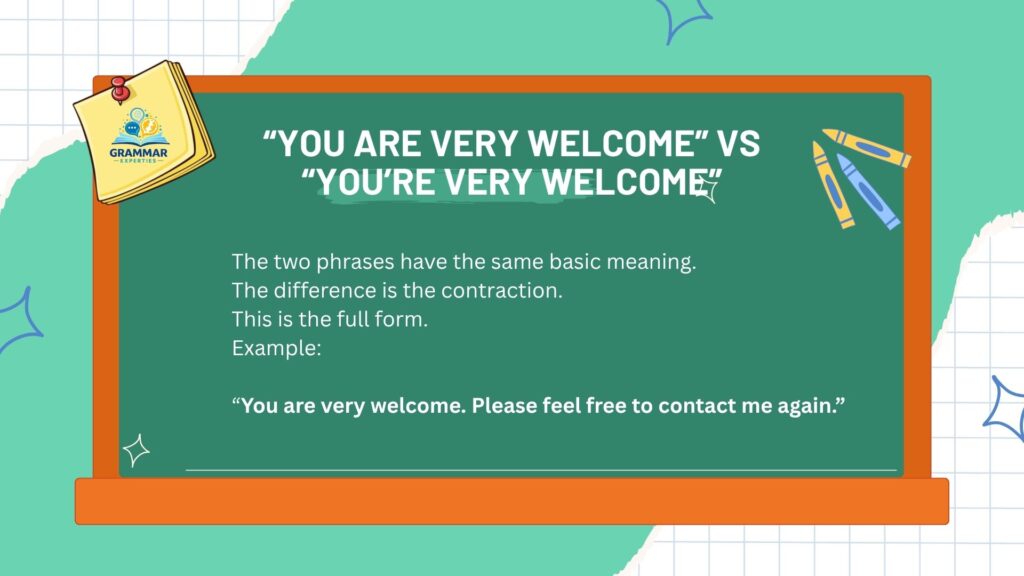
The two phrases have the same basic meaning.
The difference is the contraction.
“You Are Very Welcome”
This is the full form.
Example:
“You are very welcome. Please feel free to contact me again.”
It can sound slightly more formal, careful, or emphatic.
“You’re Very Welcome”
This is the contracted form of “you are very welcome.”
Example:
“Thanks for everything!”
“You’re very welcome!”
This is generally more conversational.
Which Should You Choose?
Use “you’re very welcome” when speaking naturally in everyday situations.
Use “you are very welcome” when you want the full form to sound more deliberate, especially in careful writing or formal speech.
Remember, though, that contractions aren’t automatically “wrong” in professional writing. The appropriate choice depends on the style and context.
Real-Life Case Study: Choosing the Right Response
Imagine that Sarah works as a customer-support specialist for a software company.
A customer contacts her because a billing problem has prevented an important subscription from renewing. Sarah spends several minutes checking the account, identifies the issue, and helps the customer restore the subscription.
After everything is fixed, the customer writes:
“Thank you so much for your patience and for fixing this so quickly. I really appreciate your help.”
Sarah has several possible responses.
Option 1:
“You’re welcome.”
This is correct, but it is brief. It doesn’t necessarily match the customer’s unusually strong appreciation.
Option 2:
“You’re very welcome! I’m glad I could help.”
This sounds warmer and directly acknowledges the customer’s gratitude.
Option 3:
“You are very welcome. I’m pleased we were able to resolve the issue.”
This sounds more deliberate and polished. It could be suitable for a formal customer-service email.
Option 4:
“No worries!”
This is friendly but considerably more casual. It may work in a relaxed customer-service environment, but it might not fit every company’s communication style.
The lesson is important: grammar alone doesn’t determine whether a phrase is the best choice. Tone matters too.
Sarah isn’t choosing between a correct and incorrect sentence. She’s choosing between different levels of warmth, formality, and conversational style.
That is why “you are very welcome” can be perfectly correct while still sounding slightly too formal in some casual situations.
2025–2026 Language Data & Usage Evidence
There isn’t a single authoritative 2025–2026 database that gives a universal percentage for how often English speakers choose “you are very welcome” over “you’re welcome.” Claims that assign an exact current percentage without a transparent corpus methodology should therefore be treated cautiously.
However, current dictionary evidence provides useful measurable reference points.
What Current Dictionaries Show
Cambridge Dictionary classifies “you’re welcome” as an A2-level idiomatic expression, defining it as a polite response when someone thanks you.
Merriam-Webster’s current dictionary entry identifies welcome as an adjective and specifically records its use in the expression “you’re welcome” as a response to thanks. The entry also gives the word’s earliest known use as before the 12th century.
Oxford Learner’s Dictionaries likewise records welcome as an adjective and shows very among the adverbs that can modify it, with examples such as “Your letter was very welcome.”
Together, these sources support two important conclusions:
- “You’re welcome” is an established English politeness expression.
- “Very welcome” is grammatically legitimate because “welcome” can function as an adjective modified by “very.”
So, as of 2026, there is no grammatical reason to label “you are very welcome” incorrect.
Common Mistakes With “You Are Very Welcome”
Although the phrase itself is correct, learners sometimes make mistakes around it.
Mistake 1: Writing “You Are Welcomed”
Don’t use “you are welcomed” as the normal response to “thank you.”
For example:
❌ “Thank you for your help.”
❌ “You are welcomed.”
Better:
✅ “You are welcome.”
The adjective welcome is the conventional form in this expression.
Mistake 2: Thinking “Very Welcome” Is Grammatically Wrong
Some learners assume that very cannot appear before welcome.
That’s incorrect.
Examples such as:
- “Your help is very welcome.”
- “You are very welcome.”
- “It was a very welcome change.”
show that very welcome can be grammatically sound.
Mistake 3: Using an Overly Formal Reply in Every Conversation
Correct grammar doesn’t automatically mean perfect style.
If your friend texts:
“Thanks for the snacks!”
Replying:
“You are very welcome.”
might sound unusually formal depending on your relationship and the rest of the conversation.
A more natural response could be:
“You’re welcome!”
or:
“Anytime!”
Mistake 4: Assuming “You’re” and “Your” Are the Same
Remember:
You’re = you are
Your = possessive determiner
Therefore:
✅ “You’re very welcome.”
❌ “Your very welcome.”
The second sentence is incorrect because your doesn’t mean you are.
How to Use “You Are Very Welcome” Naturally
A simple rule can make the choice easier.
Use It When You Want Warmth
If someone has expressed genuine or strong appreciation, “you are very welcome” can be a thoughtful response.
“Thank you so much for helping me move.”
“You’re very welcome. I’m glad I could help.”
Use the Contraction for Conversation
When you’re speaking casually, “you’re very welcome” often feels more natural.
“Thanks for the advice!”
“You’re very welcome!”
Choose Another Expression When the Context Is Very Casual
Sometimes you don’t need a formal-sounding reply.
Instead of:
“You are very welcome.”
you might say:
- “No problem!”
- “Anytime!”
- “Of course!”
- “No worries!”
- “Happy to help!”
The goal isn’t to use the longest or most formal expression. The goal is to sound appropriate for the situation.
Examples of “You Are Very Welcome”
Here are practical examples showing how the phrase works.
Everyday Examples
Example 1
“Thank you for carrying my bag.”
“You are very welcome.”
Example 2
“Thanks so much for explaining that.”
“You’re very welcome.”
Example 3
“Thank you for waiting for me.”
“You’re very welcome. Take your time.”
Professional Examples
Example 4
“Thank you for sending the report ahead of schedule.”
“You are very welcome. I’m glad I could help.”
Example 5
“Thank you for your assistance with the presentation.”
“You’re very welcome. Please let me know if you need anything else.”
Customer-Service Examples
Example 6
“Thank you for resolving my issue.”
“You are very welcome. We’re glad we could assist.”
Example 7
“I really appreciate your help.”
“You’re very welcome. Have a great day!”
Friendly Examples
Example 8
“Thanks for picking me up!”
“You’re very welcome!”
Example 9
“Thank you for the birthday gift.”
“You’re very welcome. I hope you like it!”
Better Alternatives to “You Are Very Welcome”
Sometimes another phrase will fit your conversation better.
“You’re Welcome”
This is the standard choice.
“Thanks for your help.”
“You’re welcome.”
“My Pleasure”
This sounds warm and professional.
“Thank you for your assistance.”
“My pleasure.”
“Happy to Help”
This emphasizes your willingness to assist.
“Thanks for helping me with the project.”
“Happy to help!”
“Glad I Could Help”
This is friendly and natural.
“Thank you for fixing the problem.”
“Glad I could help.”
“Anytime”
This is casual and suggests that you’re willing to help again.
“Thanks for helping me move.”
“Anytime!”
Quick Decision Guide
Use this simple checklist before choosing your response:
- Quick everyday thanks? → “You’re welcome.”
- Strong or heartfelt thanks? → “You’re very welcome.”
- Professional interaction? → “You’re very welcome,” “My pleasure,” or “Happy to help.”
- Formal written communication? → “You are very welcome” can work.
- Close friend? → “Anytime,” “No problem,” or “Of course.”
- Customer service? → “You’re very welcome” or “My pleasure.”
- Want to emphasize sincerity? → “You are very welcome.”
The best response is the one that matches the tone of the conversation.
Mini Quiz: “You Are Very Welcome”
1. Which sentence is grammatically correct?
A. You is very welcome.
B. You are very welcome.
C. Your are very welcome.
D. You are very welcomed.
Answer: B
2. What does “You are very welcome” usually mean?
A. I am happy to help.
B. You must leave.
C. I disagree with you.
D. You should apologize.
Answer: A
3. What is the contraction of “you are very welcome”?
A. Your very welcome
B. Yours very welcome
C. You’re very welcome
D. You very’re welcome
Answer: C
4. What does “very” add to “you are welcome”?
A. Negation
B. Emphasis
C. Past tense
D. A question
Answer: B
5. What is the most common neutral response to “Thanks”?
A. You’re welcome.
B. You are welcomed.
C. Your welcome.
D. You welcomed.
Answer: A
6. Which sentence correctly uses “you’re”?
A. Your very welcome.
B. You’re very welcome.
C. Yours very welcome.
D. Your’re very welcome.
Answer: B
7. When is “You’re very welcome” especially appropriate?
A. After someone gives heartfelt thanks
B. When asking a question
C. When introducing yourself
D. When correcting spelling
Answer: A
8. Which form is normally used in the expression after “thank you”?
A. Welcome
B. Welcomed
C. Welcoming
D. Welcomes
Answer: A
9. Which response sounds most casual?
A. I am pleased to assist you.
B. You are very welcome.
C. Anytime!
D. Your thanks are acknowledged.
Answer: C
10. Which response can appropriately be used in a professional email?
A. You are very welcome.
B. Your very welcomed.
C. You is welcome.
D. You very welcomes.
Answer: A
11. Which phrase has essentially the same basic meaning as “You are very welcome”?
A. You’re very welcome.
B. You were welcomed.
C. Your welcome is very.
D. You welcome very.
Answer: A
12. Which response fits “Thank you so much for your help”?
A. Your very welcome.
B. You’re very welcome.
C. You’re very welcomes.
D. You are very welcomed.
Answer: B
13. In “You are very welcome,” what is “are”?
A. Noun
B. Adjective
C. Linking verb
D. Preposition
Answer: C
14. In “You are very welcome,” what is “very”?
A. Pronoun
B. Adverb
C. Noun
D. Conjunction
Answer: B
15. Which response has the most professional tone?
A. Cool, no worries!
B. Yep, anytime!
C. You are very welcome. Please let us know if we can assist further.
D. Thanks back!
Answer: C
16. Which statement about “You are very welcome” is correct?
A. It is grammatically correct.
B. It is always incorrect.
C. It can only be a question.
D. It can only describe a place.
Answer: A
17. Which reply is most natural between close friends?
A. I am pleased to have assisted you.
B. No problem!
C. Your assistance is acknowledged.
D. You are hereby welcomed.
Answer: B
18. Which sentence correctly uses “welcome” as an adjective?
A. Your help is very welcome.
B. Your help is very welcomes.
C. Your help is very welcomeds.
D. Your help very welcome is.
Answer: A
19. Which punctuation is most natural for a warm standalone response?
A. You’re very welcome!
B. You’re very welcome?
C. You’re very welcome,
D. You’re very welcome:
Answer: A
20. What does “you’re” mean?
A. Your
B. You are
C. Yours are
D. You were
Answer: B
21. Which response emphasizes that you were happy to help?
A. You’re very welcome. I’m glad I could help.
B. Your help is declined.
C. You must thank me again.
D. I refuse to assist.
Answer: A
22. Which is the safest neutral choice when you’re unsure about formality?
A. You’re welcome.
B. You are hereby welcomed.
C. I acknowledge your gratitude.
D. Your thanks have been received.
Answer: A
23. Which sentence works well in a friendly text message?
A. You are hereby welcome.
B. Your very welcomed.
C. You’re very welcome!
D. You is welcome very.
Answer: C
24. What is the main difference between “You’re welcome” and “You’re very welcome”?
A. The second adds emphasis.
B. The first is past tense.
C. The second changes the subject.
D. The first is a question.
Answer: A
25. What is the best overall conclusion about “You are very welcome”?
A. It is correct, but the tone depends on context.
B. It is always incorrect.
C. It should never be used.
D. It can only be used in academic writing.
Answer: A
Frequently Asked Questions
Q1:Is it correct to say “you are very welcome”?
Yes. “You are very welcome” is grammatically correct. It is a polite and slightly emphasized response to someone who thanks you.
Q2:Is “you’re very welcome” correct English?
Yes. “You’re very welcome” is the contracted form of “you are very welcome.” It is especially natural in everyday spoken English.
Q3:Is “you are very welcome” formal?
It can sound somewhat more formal or deliberate than “you’re very welcome,” particularly because it uses the full form “you are.” However, it isn’t restricted to formal situations.
Q4:Is “you’re welcome” better than “you are very welcome”?
Neither is universally better. “You’re welcome” is shorter and neutral, while “you are very welcome” adds warmth and emphasis.
Q5:Can I say “you are very welcome” in an email?
Yes. It is grammatically correct in professional emails. However, depending on the context, alternatives such as “My pleasure,” “Happy to help,” or “Glad I could help” may sound more natural.
Q6:Is “you are welcomed” correct as a response to “thank you”?
No. The conventional response is “you are welcome,” not “you are welcomed.”
Q7:Is “you’re very welcome” too formal for friends?
Not necessarily. Friends can certainly use it. However, in very casual conversations, “no problem,” “anytime,” “of course,” or simply “you’re welcome” may sound more relaxed.
Q8:What is the difference between “you are welcome” and “you are very welcome”?
The word “very” adds emphasis. “You are welcome” is neutral and polite, while “you are very welcome” sounds warmer or more emphatic.
Final Verdict: Is “You Are Very Welcome” Correct?
Yes, “you are very welcome” is completely correct English.
The phrase uses a standard grammatical structure: you + are + very + adjective. Here, welcome functions as an adjective, while very intensifies it.
The main issue isn’t correctness. It’s tone.
For everyday conversation, “you’re welcome” is usually the simplest and most natural response. When you want to sound warmer or respond to especially sincere gratitude, “you’re very welcome” is an excellent choice. The full “you are very welcome” can work particularly well when you want a more deliberate or polished tone.
So don’t worry about using it. Just remember one simple rule:
Choose the expression that matches the situation, the person, and the level of warmth you want to communicate.
Explore more easy grammar lessons and improve your English with Grammar Expertise
References
Cambridge Dictionary: You’re Welcome
Oxford Learner’s Dictionaries: Welcome

Maimoona Mughal is an English grammar enthusiast dedicated to simplifying confusing words, grammar rules, and vocabulary through clear, accurate, and learner-friendly content that helps readers write and communicate with confidence.