If you’re unsure whether to write “people do” or “people does,” you’re not alone. This is a common English grammar mistake, especially for English learners who are still mastering subject-verb agreement.
The correct form is “people do” when people refers to more than one person. For example, “People do make mistakes” is correct, while “People does make mistakes” is incorrect in standard English.
The reason is simple: people is normally a plural noun, so it takes a plural verb. Cambridge Dictionary specifically identifies people as a plural noun and gives examples such as “Many people never do any exercise.”
In this guide, you’ll learn the difference between people do vs people does, why one is correct, how to use each form, how to make questions and negative sentences, and how to avoid similar subject-verb agreement mistakes.
People Do vs People Does: Which Is Correct?
“People do” is correct when people means multiple individuals.
The word people is normally the plural form used to refer to human beings. Because it is plural, it takes do, not does, in the present simple.
The Basic Grammar Rule
The easiest rule to remember is:
One person does. Many people do.
For example:
- A person does the work.
- People do the work.
- One student does the assignment.
- Students do the assignment.
- She does her homework.
- They do their homework.
Cambridge’s grammar guidance states that people is a plural noun and takes a plural verb.
So, compare these sentences:
- ✅ People do different things.
- ❌ People does different things.
The first sentence follows standard subject-verb agreement. The second incorrectly pairs a plural subject with the third-person singular form does.
Why Is “People Does” Incorrect?
The answer becomes obvious when you replace people with the pronoun they.
People do their best.
Replace people with they:
They do their best.
That sounds natural because they do is correct.
Now try the incorrect version:
People does their best.
Replace people with they:
They does their best.
The error becomes easy to hear.
A useful memory trick is therefore:
People = they = do
This works in most ordinary sentences where people refers to multiple human beings.
Person vs. People
One reason this mistake happens is that learners confuse person and people.
Person is singular.
People is normally plural.
| Subject | Number | Correct Form | Example |
|---|---|---|---|
| a person | Singular | does | A person does the job. |
| one person | Singular | does | One person does everything. |
| people | Plural | do | People do different things. |
| many people | Plural | do | Many people do this. |
| he | Singular | does | He does his work. |
| she | Singular | does | She does her work. |
| they | Plural | do | They do their work. |
Cambridge likewise explains that person is used for one human being, while people is used for groups of human beings or humans generally.
Understanding the Subject-Verb Agreement Rule
The difference between people do and people does is really a question of subject-verb agreement.
What Is Subject-Verb Agreement?
Subject-verb agreement means that the verb must agree with the subject in grammatical number.
In simple terms:
- Singular subject → singular verb form
- Plural subject → plural verb form
For example:
The student works hard.
But:
The students work hard.
The same principle applies to do and does:
He does his homework.
They do their homework.
Grammarly explains the same general principle: English verbs generally distinguish between third-person singular forms and the standard form used with plural subjects.
When Do We Use “Does”?
Use does with a third-person singular subject in the present simple.
Common examples include:
- he
- she
- it
- a person
- someone
- everyone
- everybody
- each student
- the teacher
- the child
Examples:
- He does his job well.
- She does her homework.
- A person does what they believe is right.
- Someone does know the answer.
- Everyone does something differently.
- Each student does the exercise.
Notice that everyone refers to many people, but grammatically it is singular. Therefore, we say:
Everyone does their best.
We do not say:
❌ Everyone do their best.
When Do We Use “Do”?
Use do with plural subjects and with I, you, we, and they in the present simple.
Examples include:
- people
- they
- we
- students
- workers
- parents
- children
- employees
- friends
Examples:
- People do strange things sometimes.
- They do their best.
- We do what we can.
- Students do their assignments.
- Workers do different jobs.
- Parents do a lot for their children.
Cambridge’s present-simple grammar reference shows the basic distinction clearly: do is used with I, you, we, and they, while does is used with he, she, and it.
The Special Role of “Do” as an Auxiliary Verb
The verb do has another important job in English. It can act as an auxiliary verb when forming questions, negatives, and emphatic statements.
For example:
Do people understand the rule?
People don’t always agree.
People do make mistakes.
Cambridge explains that do can function as both a main verb and an auxiliary verb, including in questions, negatives, and emphatic statements.
This is why understanding do vs. does helps you form many other English sentences correctly.
How to Use People Do in Statements, Questions, and Negatives
Once you know that people is plural, the different sentence structures become much easier.
“People Do” in Affirmative Sentences
Use people do in affirmative sentences when people is the subject.
Examples:
- People do make mistakes.
- People do change over time.
- People do learn from experience.
- People do care about their families.
- People do respond differently to criticism.
Sometimes do is used for emphasis.
Compare:
People make mistakes.
with:
People do make mistakes.
The second sentence emphasizes the fact that people really do make mistakes.
Cambridge notes that emphatic do can add force to an affirmative statement.
“Do People” in Questions
When people is the subject of a present-simple question, use do, not does.
Correct:
- Do people understand this rule?
- Do people like this idea?
- Do people need more information?
- Why do people make this mistake?
- Where do people usually go?
- How do people learn English?
Incorrect:
- ❌ Does people like this idea?
- ❌ Does people understand this rule?
- ❌ Why does people make this mistake?
The basic structure is:
Do + people + base verb?
For example:
Do people agree?
Not:
❌ Does people agree?
Cambridge gives the same present-simple question pattern: do/does + subject + base verb, with do used for plural subjects and does for third-person singular subjects.
“People Don’t” in Negative Sentences
The negative form is:
People do not…
or, more naturally in everyday English:
People don’t…
Examples:
- People don’t always agree.
- People don’t know everything.
- People don’t behave the same way.
- People don’t always understand grammar rules.
- People don’t make the same choices.
Incorrect:
❌ People doesn’t always agree.
Correct:
✅ People don’t always agree.
Compare:
He doesn’t agree.
with:
People don’t agree.
The difference is caused by the grammatical number of the subject.
“People Do” for Emphasis
You can also use do to emphasize a statement.
For example:
People make mistakes.
This is neutral.
People do make mistakes.
This gives the statement more emphasis, perhaps because someone has just denied it.
Another example:
People care about grammar.
People do care about grammar.
The second sentence sounds more forceful.
This use is completely grammatical and is especially common in conversation.
Common Mistakes With People Do and People Does
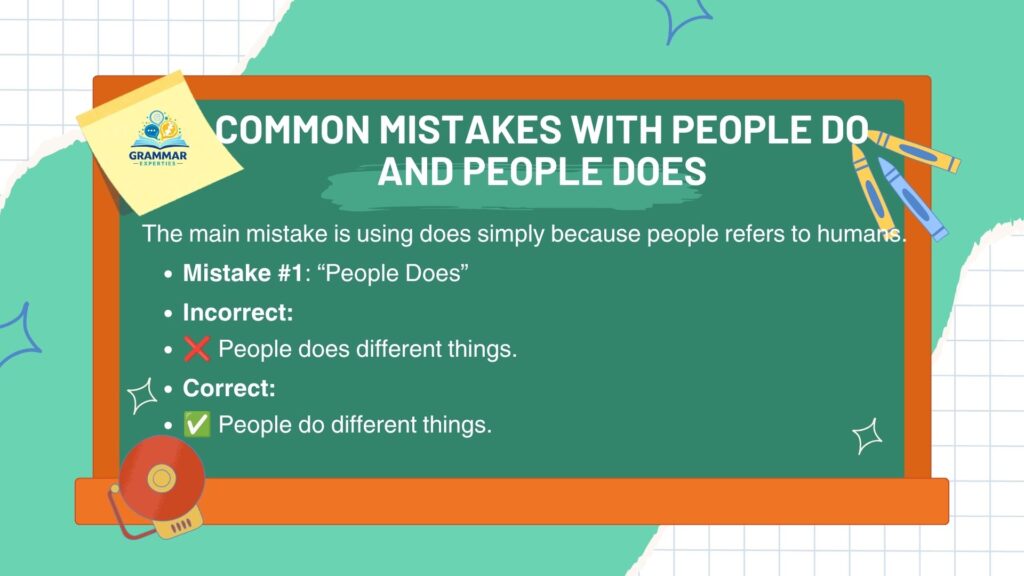
The main mistake is using does simply because people refers to humans. However, grammatical number matters more than the meaning of the word.
Mistake #1: “People Does”
Incorrect:
❌ People does different things.
Correct:
✅ People do different things.
Why?
Because people is plural.
A simple comparison helps:
A person does.
People do.
Mistake #2: “Does People?”
Incorrect:
❌ Does people like coffee?
Correct:
✅ Do people like coffee?
Compare:
Does she like coffee?
with:
Do people like coffee?
The subject determines whether you use do or does.
Mistake #3: “People Doesn’t”
Incorrect:
❌ People doesn’t always agree.
Correct:
✅ People don’t always agree.
Remember:
People do → People don’t
while:
He does → He doesn’t
When do or does is used as the auxiliary verb, it is the auxiliary—not the following main verb—that carries the singular/plural distinction.
For example:
People don’t like it.
Not:
❌ People doesn’t likes it.
After do/does/don’t/doesn’t, the main verb remains in its base form.
Mistake #4: “People Does” Because the Sentence Contains a Singular Word
Consider:
People in my neighborhood do this regularly.
Some learners mistakenly focus on neighborhood and think the verb should be singular.
But neighborhood isn’t the subject.
The subject is people.
Therefore:
People do this.
Another example:
People who work from home do different jobs.
The phrase who work from home adds information about the people. It doesn’t change the main subject.
The structure is still:
People do different jobs.
Mistake #5: Confusing “People” and “Everyone”
This is an especially common source of confusion.
Compare:
People do what they want.
and:
Everyone does what they want.
Why?
Because people is normally plural, while everyone is grammatically singular.
Other words that normally take does include:
- everybody
- someone
- somebody
- anyone
- anybody
- each person
- every student
For example:
Everybody does something differently.
But:
People do things differently.
The actual number of people being discussed isn’t the only factor. The grammatical form of the subject determines the verb.
People Do vs People Does: A Quick Comparison Guide
Use this table whenever you’re unsure which form to choose.
| Expression | Correct? | Example |
|---|---|---|
| People do | ✅ | People do their best. |
| People does | ❌ | People does their best. |
| Do people | ✅ | Do people understand? |
| Does people | ❌ | Does people understand? |
| People don’t | ✅ | People don’t always agree. |
| People doesn’t | ❌ | People doesn’t always agree. |
| A person does | ✅ | A person does the work. |
| A person do | ❌ | A person do the work. |
| Everyone does | ✅ | Everyone does their best. |
| Everyone do | ❌ | Everyone do their best. |
| They do | ✅ | They do their homework. |
| They does | ❌ | They does their homework. |
The Three-Second Test
If you’re writing quickly, use this simple test:
Step 1: Find the subject.
Step 2: Ask whether it means one or more than one.
Step 3: Choose the verb.
For example:
People ___ many things.
Subject = people
People = more than one person
Therefore:
People do many things.
Another example:
A person ___ many things.
Subject = a person
A person = one individual
Therefore:
A person does many things.
The “They” Test
There’s another useful shortcut.
Replace people with they.
People do this.
→ They do this.
Because they do is correct, people do is correct.
This technique can help when you’re writing an email, essay, blog post, report, or social media caption and don’t have time to think through the entire grammar rule.
A Real-Life Example: Correcting “People Does” in Writing
Imagine you’re writing a school essay about how people learn from their experiences.
Your first draft says:
“People does not always understand their mistakes. Sometimes people does the same thing again because they don’t know how to change their behavior.”
The meaning is clear, but the sentence contains two subject-verb agreement errors.
The corrected version is:
“People do not always understand their mistakes. Sometimes people do the same thing again because they don’t know how to change their behavior.”
Now the verbs agree with the plural subject people.
Let’s look more closely.
The first incorrect phrase is:
People does not understand…
Because people is plural, it should be:
People do not understand…
The second is:
People does the same thing…
Again, people is plural:
People do the same thing…
Notice that the third part is already correct:
they don’t know…
That’s because they is also plural.
This example demonstrates a practical editing method: don’t decide whether to use do or does based on the words immediately before the verb. First identify the subject, then determine whether that subject is singular or plural.
The same approach works beyond people. Consider:
The student does the work.
The students do the work.
Everyone does the work.
People do the work.
Once you start identifying subjects this way, subject-verb agreement becomes much more predictable.
2025–2026 Grammar Reference Check: What the Current Evidence Shows
Grammar rules aren’t normally measured by yearly statistics in the way that search traffic, inflation, or population figures are. Therefore, it would be misleading to invent a “2026 percentage” claiming that a particular number of writers use people do correctly.
Instead, the most useful current evidence comes from authoritative English dictionaries and grammar references.
Current 2026 Reference Evidence
As checked against current reference material:
- Cambridge Dictionary classifies people as a plural noun when it means human beings.
- Cambridge’s grammar guidance explicitly states that people takes a plural verb.
- Cambridge’s present-simple reference shows do with I, you, we, they and does with he, she, it.
- Cambridge explains that does is the third-person singular present form of do.
- Grammarly’s subject-verb agreement guidance likewise explains that singular and plural subjects require matching verb forms.
Therefore, the current 2026 grammar evidence supports this straightforward rule:
People → do
A person → does
The rule hasn’t suddenly changed in 2026. What has changed is how easily writers can encounter nonstandard grammar online. Seeing “people does” in a web search, social media post, comment, or informal text doesn’t make it the standard form.
For reliable writing, follow established grammar references rather than assuming that frequent online usage is automatically correct.
Special Case: Can “People” Ever Be Singular?
There is an important but uncommon exception.
In ordinary English, people meaning multiple human beings is plural:
People are different.
People do different things.
However, a people can be used as a singular noun to mean a particular nation, ethnic group, or cultural community.
For example:
A people does not lose its identity easily.
Here, a people is being treated as one collective cultural group.
This construction is quite different from everyday sentences such as:
People do what they think is best.
For normal conversation, school assignments, websites, emails, and professional writing, you almost certainly want the ordinary plural meaning:
People do
So don’t let this specialized usage make the basic rule seem more complicated than it is.
Mini Quiz: People Do vs People Does
1. Choose the correct sentence:
A) People does make mistakes.
B) People do make mistakes.
C) People doing make mistakes.
D) People do makes mistakes.
Answer: B
2. People ___ different opinions.
A) does
B) do
C) doing
D) done
Answer: B
3. Which question is correct?
A) Does people like music?
B) Do people like music?
C) Do people likes music?
D) Does people likes music?
Answer: B
4. Choose the correct negative sentence:
A) People doesn’t always agree.
B) People don’t always agree.
C) People don’t always agrees.
D) People doesn’t always agrees.
Answer: B
5. One person ___ the job, but many people ___ the jobs.
A) do / does
B) does / do
C) does / does
D) do / do
Answer: B
6. Why ___ people make mistakes?
A) does
B) do
C) is
D) has
Answer: B
7. Which sentence sounds grammatically correct?
A) People does what they want.
B) People do what they want.
C) People does what they wants.
D) People do what they wants.
Answer: B
8. Everyone ___ mistakes sometimes.
A) do
B) does
C) doing
D) done
Answer: B
9. Complete the rule: “One person ___, but many people ___.”
A) do / does
B) does / do
C) does / does
D) do / do
Answer: B
10. Pick the correct sentence:
A) People do not always understand each other.
B) People does not always understand each other.
C) People do not always understands each other.
D) People does not always understands each other.
Answer: A
11. People ___ their best when they practice.
A) does
B) do
C) does doing
D) doing
Answer: B
12. Which sentence is correct?
A) People does different jobs.
B) People do different jobs.
C) People does different job.
D) People do different jobss.
Answer: B
13. ___ people need more time?
A) Does
B) Do
C) Is
D) Has
Answer: B
14. Choose the correct sentence:
A) People doesn’t always agree with you.
B) People don’t always agree with you.
C) People don’t always agrees with you.
D) People doesn’t always agrees with you.
Answer: B
15. Which subject correctly takes “does”?
A) People
B) They
C) Everyone
D) We
Answer: C
16. People ___ learn from experience.
A) does
B) do
C) is
D) has
Answer: B
17. Many people ___ this mistake.
A) does
B) do
C) doing
D) has
Answer: B
18. Which pair is correct?
A) A person do / people does
B) A person does / people do
C) A person does / people does
D) A person do / people do
Answer: B
19. People ___ not always think alike.
A) does
B) do
C) is
D) has
Answer: B
20. People who work here ___ many tasks every day.
A) does
B) do
C) doing
D) has
Answer: B
21. Everyone ___ something differently.
A) do
B) does
C) doing
D) done
Answer: B
22. People ___ what they believe is right.
A) does
B) do
C) doing
D) has
Answer: B
23. Which sentence is correct?
A) People normally does this.
B) People normally do this.
C) People normally doing this.
D) People normally does these.
Answer: B
24. People ___ change over time.
A) does
B) do
C) doing
D) has
Answer: B
25. What is the easiest rule to remember?
A) One person do; people does.
B) One person does; people do.
C) Everyone do; people does.
D) People does; they does.
Answer: B
Frequently Asked Questions About People Do vs People Does
Q1:Is “people do” grammatically correct?
Yes. People do is grammatically correct when people refers to multiple individuals.
Example:
People do make mistakes.
Cambridge specifically identifies people as a plural noun that takes a plural verb.
Q2:Is “people does” grammatically correct?
Generally, no. People does is incorrect in standard English when people means multiple individuals.
Use:
People do
instead of:
❌ People does
There are specialized contexts involving the singular construction a people, but that is not the ordinary use.
Q3:Which is correct: “Do people” or “Does people”?
Do people is correct.
For example:
Do people like this restaurant?
Do people understand the rule?
Because people is plural, the auxiliary verb is do.
Q4:Which is correct: “People don’t” or “People doesn’t”?
People don’t is correct.
Examples:
People don’t always agree.
People don’t know everything.
People don’t behave exactly the same way.
Use doesn’t with a third-person singular subject:
He doesn’t agree.
Q5:Why do we say “people do” but “everyone does”?
Because people is normally plural, while everyone is grammatically singular.
Therefore:
People do their best.
Everyone does their best.
This distinction is an important part of English subject-verb agreement.
Q6:Is “people does” ever acceptable?
Only in unusual or specialized grammatical contexts, such as when a people is being treated as a singular collective noun.
For ordinary use, however, write:
People do
not:
People does
Q6:Which is correct: “What people do” or “What people does”?
What people do is correct.
For example:
I understand what people do in this situation.
The subject of the clause is people, so the verb is do.
Q7:Can “people do” be used in formal writing?
Absolutely. People do is standard English and is appropriate in formal, academic, professional, and informal writing.
For example:
People do respond differently to changes in their environment.
There’s no need to replace it simply to make your writing sound more formal.
Final Conclusion: People Do vs People Does
The answer to “people do vs people does: which is correct?” is clear:
People do is correct when people means multiple individuals.
The reason is that people is normally a plural noun, so it takes the plural form do.
Remember this simple pattern:
- A person does.
- People do.
- He does.
- She does.
- They do.
- Everyone does.
- People do.
For questions:
Do people understand?
For negative sentences:
People don’t always agree.
And if you ever hesitate, use the they test:
People do → They do ✅
People does → They does ❌
Once you identify the subject before choosing the verb, this common grammar mistake becomes much easier to avoid.
So, the next time you’re choosing between people do vs people does, remember the golden rule:
One person does; people do.
Explore more easy grammar lessons and improve your English with Grammar Expertise
References

Maimoona Mughal is an English grammar enthusiast dedicated to simplifying confusing words, grammar rules, and vocabulary through clear, accurate, and learner-friendly content that helps readers write and communicate with confidence.