Have you ever wondered whether you should say “safe travel” or “safe travels” when someone is leaving for a trip? You’re not alone. The two phrases look almost identical, but they serve different purposes in everyday English.
The short answer is simple: “safe travels” is the natural choice when you’re wishing someone a safe journey. However, “safe travel” can also be grammatically correct when you’re talking about travel as a general activity or concept.
Understanding the difference helps you sound more natural in conversations, emails, social media posts, and professional writing. In this guide, you’ll learn the meaning, grammar, differences, examples, and best alternatives to safe travel vs safe travels.
Safe Travel vs Safe Travels: Quick Answer
If you’re saying goodbye to someone who is about to leave, use “safe travels.”
For example:
- Correct and natural: “Safe travels! I hope you have a great trip.”
- Correct in a general context: “Safe travel is important for international tourists.”
- Less natural as a farewell: “Safe travel!”
The key difference is context.
“Travel” is normally an uncountable noun when it means the activity of going from one place to another. Cambridge Dictionary lists travel as an uncountable noun in this sense. It also recognizes “travels” as a plural noun meaning journeys or trips.
So, if you’re wishing an individual well before a trip, “safe travels” is the better and more idiomatic expression.
Safe Travels Is the Better Farewell
When someone is about to fly, drive, take a train, or begin a long journey, “safe travels” works naturally.
Examples:
“You’re flying to London tomorrow? Safe travels!”
“Have a wonderful vacation. Safe travels!”
“Safe travels, and text me when you arrive.”
The expression is essentially a short way of saying “I hope your travels are safe.”
Safe Travel Works in General Statements
“Safe travel” is more appropriate when travel itself is the subject.
For example:
“Safe travel practices can reduce accidents.”
“The organization promotes safe travel for international students.”
“Passengers should follow the airline’s safe travel guidelines.”
Here, you aren’t saying goodbye to one person. You’re discussing travel safety as a general concept.
What Does “Safe Travels” Mean?
“Safe travels” is a friendly expression used to wish someone safety and a pleasant experience during a journey.
It can apply to almost any type of trip, including flights, road trips, vacations, business travel, train journeys, and long-distance moves.
Meaning of Safe Travels
The phrase communicates a simple message:
“I hope you travel safely and arrive at your destination without problems.”
It can also express warmth and goodwill.
For example:
“Thanks for visiting us. Safe travels home!”
This means:
“I hope you get home safely.”
The plural “travels” is not necessarily asking you to count several separate vacations. Cambridge defines travels as journeys or trips, which explains why the plural form works naturally in expressions about someone’s journeys.
Why Do People Say “Safe Travels”?
English contains many expressions that have become conventional over time. Their meaning depends not only on individual words but also on how speakers commonly use the complete expression.
Think about phrases such as:
- “Best wishes”
- “Warm regards”
- “Happy holidays”
- “Safe travels”
The plural form can sound natural even when you’re talking about one particular occasion.
For example:
“I’m heading to Spain tomorrow.”
“That’s exciting! Safe travels!”
Nobody expects the speaker to be counting several trips. It simply functions as a friendly farewell.
Is “Safe Travels” Grammatically Correct?
Yes. “Safe travels” is grammatically acceptable and widely understood in modern English.
The phrase uses travels as a plural noun meaning journeys. Cambridge specifically gives travels as the plural form used for journeys.
Therefore, there’s no need to avoid the phrase because it contains an -s.
Safe Travel vs Safe Travels: What’s the Difference?
The easiest way to understand safe travel vs safe travels is to look at what you’re talking about.
| Phrase | Main use | Meaning | Example |
|---|---|---|---|
| Safe travels | Farewell or well-wish | Wishing someone a safe journey | “Safe travels to Paris!” |
| Safe travel | General topic | Traveling safely as an activity | “Safe travel is important.” |
| Have a safe trip | Farewell | Wishing someone safety on a particular trip | “Have a safe trip home.” |
| Travel safely | Direct advice/wish | Telling someone to travel safely | “Travel safely and call me.” |
| Safe journey | Farewell | Wishing someone a safe journey | “Have a safe journey.” |
The important point is that both “safe travel” and “safe travels” can be valid, but they don’t normally appear in exactly the same situations.
When to Use Safe Travels
Use “safe travels” when speaking directly to someone who is traveling.
Examples:
- “Safe travels on your business trip!”
- “Safe travels home.”
- “Have fun in Italy. Safe travels!”
- “Safe travels, everyone!”
- “Wishing you safe travels.”
- “Safe travels and enjoy your vacation.”
This is the phrase you’ll generally want for a text message, farewell, card, email, or social media comment.
When to Use Safe Travel
Use “safe travel” when discussing the idea or practice of traveling safely.
Examples:
- “The company has a safe travel policy.”
- “Safe travel should be a priority during the holiday season.”
- “The guide provides advice about safe travel abroad.”
- “Safe travel is especially important during severe weather.”
Notice that these sentences aren’t directly wishing someone well.
A Simple Rule to Remember
Here’s an easy memory trick:
Talking to a traveler? → “Safe travels.”
Talking about travel in general? → “Safe travel.”
For example:
“My brother is leaving for Canada tomorrow. Safe travels!”
But:
“Good planning contributes to safe travel.”
That distinction will solve most safe travel vs safe travels questions.
How to Use “Safe Travels” in Real-Life Situations
The phrase works in many everyday situations, but the tone can change slightly depending on who you’re speaking to.
Safe Travels in Casual Conversation
With friends and family, “safe travels” sounds warm and natural.
Examples:
“Have an amazing trip. Safe travels!”
“Safe travels, buddy. Send me some pictures!”
“Enjoy your vacation, and safe travels!”
It can stand alone, too:
“Safe travels!”
This is perfectly understandable as a short farewell.
Safe Travels in Professional Emails
You can also use “safe travels” with colleagues and business contacts.
For example:
“It was great meeting with you. Safe travels home!”
Or:
“Good luck at the conference, and safe travels!”
It is friendly without being overly casual.
However, in very formal correspondence, “I wish you a safe journey” may sound more polished.
Safe Travels on Social Media
“Safe travels” is also useful for social posts and comments.
Examples:
“Have an incredible adventure. Safe travels!”
“Enjoy your European tour. Safe travels!”
“Wishing you safe travels on your next adventure.”
Because the phrase is short, it works particularly well in captions and comments.
Case Study: Choosing the Right Phrase in Everyday Communication
Imagine that Sarah is leaving her hometown to attend a week-long conference in another country. Her coworker wants to send her a message before she leaves.
He considers writing:
“Safe travel!”
The sentence isn’t impossible to understand, but it sounds less natural as a personal farewell. A more idiomatic choice would be:
“Safe travels, Sarah! I hope you have a productive and enjoyable trip.”
Why does this work better?
The message is directed to Sarah, who is about to begin a journey. The speaker is expressing a personal good wish rather than discussing travel safety as a general subject. Therefore, the plural noun “travels” fits the conventional expression.
Now imagine that Sarah’s employer is creating a workplace policy. The document might say:
“Employees should follow safe travel procedures when attending international conferences.”
Here, “safe travel” makes sense because the document is discussing travel as a general activity. It isn’t a farewell.
This example shows why simply asking which phrase is “correct” can be misleading. The context determines the better choice.
The same principle applies to texts, emails, workplace communication, travel websites, social media posts, and educational writing. When the sentence means “I hope your journey goes safely,” choose “safe travels.” When the sentence describes travel safety as a broader concept, “safe travel” can be appropriate.
What Current Travel Data Tells Us About the Phrase’s Context
The distinction matters because travel remains a major part of everyday communication.
UN Tourism reported in January 2026 that international tourist arrivals increased by 4% in 2025, reaching an estimated 1.52 billion international tourists worldwide. The organization said the increase reflected strong global travel demand.
Google’s 2025 Travel Trends also showed strong interest in travel-related searches. For example, searches for “travel hacks” reached an all-time high in the United States, while searches for “travel hacks for long flights” increased by 150% in the first quarter of 2025.
These figures don’t prove that one grammatical expression is more correct than another. Instead, they provide useful context: people continue to discuss trips, journeys, vacations, and travel experiences frequently, so natural travel vocabulary remains relevant.
Google also reported that conversational “How do I…” searches reached an all-time high in 2025, increasing by 25% year over year. That trend reinforces the value of clear, direct answers to everyday language questions.
What This Means for English Learners
For English learners, the safest practical approach is:
Use “safe travels” when saying goodbye to a traveler.
Use “safe travel” when discussing travel safety generally.
This isn’t about memorizing a complicated grammar rule. It’s about understanding how native English speakers commonly use the two forms.
Common Mistakes With Safe Travel and Safe Travels
Even advanced English learners sometimes hesitate over these expressions.
Mistake 1: Using “Safe Travel” as a Farewell
You might see:
“My friend is going to Dubai. I told him safe travel.”
A more natural version is:
“My friend is going to Dubai. I told him, ‘Safe travels!’”
The second version sounds much more like a conventional English farewell.
Mistake 2: Thinking “Travels” Must Mean Multiple Trips
Some people assume that “safe travels” must mean that the person is taking several separate trips.
That’s not how the expression normally works.
The word travels can refer to someone’s journeys or travel experiences. Cambridge gives examples such as someone’s travels around a region or country.
So:
“Safe travels!”
doesn’t require the person to have five different vacations planned.
Mistake 3: Treating Both Phrases as Completely Interchangeable
Although both forms can be grammatically meaningful, replacing one with the other can change how natural the sentence sounds.
Compare:
“Safe travels!” ✅
“Safe travel!” ⚠️ Less natural as a farewell
But:
“Safe travel practices are important.” ✅
The surrounding words make the intended meaning clear.
Better Alternatives to “Safe Travels”
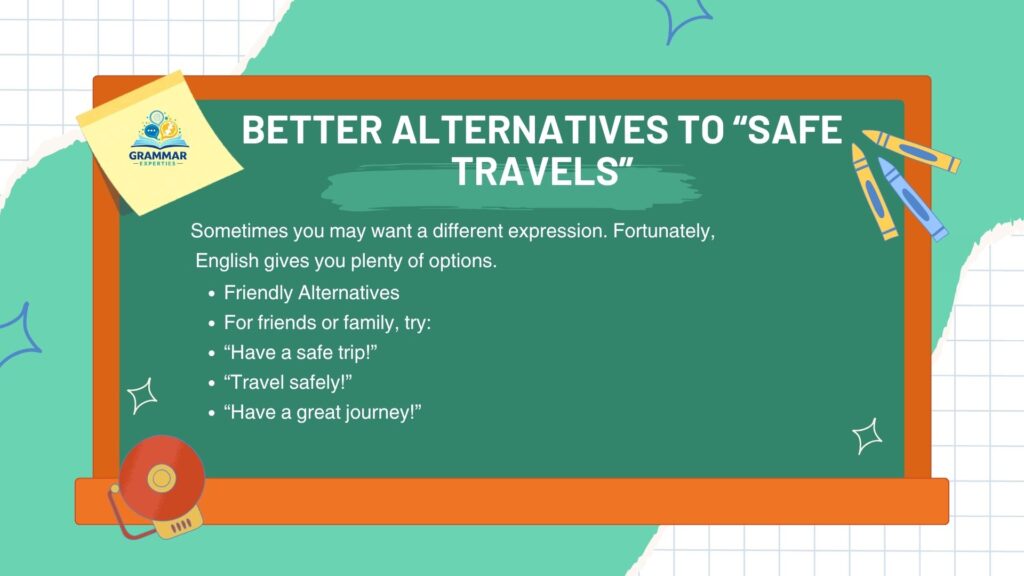
Sometimes you may want a different expression. Fortunately, English gives you plenty of options.
Friendly Alternatives
For friends or family, try:
- “Have a safe trip!”
- “Travel safely!”
- “Have a great journey!”
- “Take care on the way!”
- “Have a good trip!”
- “Enjoy your travels!”
Example:
“Have a safe trip to New York!”
This is especially useful when you want to sound direct and conversational.
Professional Alternatives
For coworkers or clients, you can use:
- “Wishing you a safe journey.”
- “Have a safe trip.”
- “Wishing you a pleasant journey.”
- “I hope you have a safe journey.”
- “Travel safely.”
For example:
“Thank you for your time today. Wishing you a safe journey home.”
This sounds polished without being overly formal.
Formal Alternatives
In more formal communication, consider:
“I wish you a safe and pleasant journey.”
or:
“Wishing you a safe journey and a successful trip.”
These options may work better in official correspondence than the short phrase “Safe travels.”
Mini Quiz: Safe Travel vs Safe Travels
1. Which phrase is most natural when saying goodbye to someone leaving for vacation?
A) Safe travel
B) Safe travels
C) Safety travel
D) Safely travel
Answer: B) Safe travels
2. Choose the correct sentence:
A) Safe travels! Have a wonderful trip.
B) Safe travel! Have a wonderful trip.
C) Safety travels! Have a wonderful trip.
D) Safely travels! Have a wonderful trip.
Answer: A) Safe travels! Have a wonderful trip.
3. Which phrase is better for discussing travel safety in general?
A) Safe travels
B) Safe travel
C) Safely travels
D) Safety travels
Answer: B) Safe travel
4. “You’re flying to London tomorrow. _____!”
A) Safe travel
B) Safe travels
C) Safety travels
D) Safely travel
Answer: B) Safe travels
5. Which sentence uses “safe travel” correctly?
A) Safe travel practices can protect passengers.
B) Safe travel! Enjoy your vacation.
C) I wished him safe travel yesterday.
D) Safe travel, everyone!
Answer: A) Safe travel practices can protect passengers.
6. Which expression means “I hope your journey is safe”?
A) Safe travels
B) Travel safety
C) Safety travel
D) Safe traveling
Answer: A) Safe travels
7. Complete the sentence: “Have a great vacation and _____!”
A) safe travel
B) safe travels
C) safety travel
D) safely travels
Answer: B) safe travels
8. Which is more natural in a farewell text to a friend?
A) Safe travel, buddy!
B) Safe travels, buddy!
C) Safety travels, buddy!
D) Safely travels, buddy!
Answer: B) Safe travels, buddy!
9. Which sentence discusses travel as a general activity?
A) Safe travels, Maria!
B) Safe travel is important for tourists.
C) Safe travels home!
D) Wishing you safe travels.
Answer: B) Safe travel is important for tourists.
10. Which phrase would you use before someone’s flight?
A) Safe travels
B) Safety travel
C) Safely travels
D) Safe traveling
Answer: A) Safe travels
11. Choose the correct professional email phrase:
A) Safe travel on your business trip!
B) Safe travels on your business trip!
C) Safety travels on your business trip!
D) Safely travels on your business trip!
Answer: B) Safe travels on your business trip!
12. Which sentence is grammatically appropriate?
A) Safe travel tips are useful for tourists.
B) Safe travels tips are useful for tourists.
C) Safety travels tips are useful for tourists.
D) Safely travels tips are useful for tourists.
Answer: A) Safe travel tips are useful for tourists.
13. What should you say to someone driving home after a vacation?
A) Safe travels home!
B) Safety travel home!
C) Safe traveling home!
D) Safely travels home!
Answer: A) Safe travels home!
14. Which phrase is commonly used as a friendly farewell?
A) Safe travel
B) Safe travels
C) Travel safety
D) Safety traveling
Answer: B) Safe travels
15. “The website provides advice about _____ abroad.”
A) safe travels
B) safe travel
C) safely travels
D) safety travels
Answer: B) safe travel
16. Which sentence is best for a farewell card?
A) Wishing you safe travels!
B) Wishing you safe travel!
C) Wishing you safety travels!
D) Wishing you safely travels!
Answer: A) Wishing you safe travels!
17. Which phrase can refer to someone’s journeys or trips?
A) Travels
B) Travelly
C) Travelingly
D) Safeties
Answer: A) Travels
18. Which sentence is correct?
A) She wrote about her travels around Europe.
B) She wrote about her safe travel around Europe.
C) She wrote about her safety travels around Europe.
D) She wrote about her safely travels around Europe.
Answer: A) She wrote about her travels around Europe.
19. Which is the best alternative to “Safe travels”?
A) Have a safe trip.
B) Have a safety trip.
C) Have a safely trip.
D) Have safe traveling trip.
Answer: A) Have a safe trip.
20. If you’re talking about travel safety policies, which phrase fits best?
A) Safe travels policies
B) Safe travel policies
C) Safely travels policies
D) Safety travels policies
Answer: B) Safe travel policies
21. “My sister is leaving for Canada tomorrow.” What is the best response?
A) Safe travel!
B) Safe travels!
C) Safety travel!
D) Safely travels!
Answer: B) Safe travels!
22. Which sentence is NOT the natural choice for a personal farewell?
A) Safe travels!
B) Have a safe trip!
C) Travel safely!
D) Safe travel!
Answer: D) Safe travel!
23. Which sentence correctly describes general travel safety?
A) Safe travel should be a priority for tourists.
B) Safe travels should be a priority for tourists.
C) Safely travels should be a priority for tourists.
D) Safety travels should be a priority for tourists.
Answer: A) Safe travel should be a priority for tourists.
24. What is the easiest rule to remember?
A) Personal farewell → Safe travels
B) Personal farewell → Safe travel
C) General topic → Safe travels only
D) Both phrases are always interchangeable
Answer: A) Personal farewell → Safe travels
25. Which statement is correct?
A) “Safe travels” is commonly used as a farewell, while “safe travel” can describe travel safety generally.
B) “Safe travel” is always incorrect.
C) “Safe travels” can only refer to multiple vacations.
D) The two expressions always have exactly the same use.
Answer: A) “Safe travels” is commonly used as a farewell, while “safe travel” can describe travel safety generally.
Frequently Asked Questions About Safe Travel vs Safe Travels
Q:1Is “safe travels” grammatically correct?
Yes. “Safe travels” is grammatically correct and widely used as a farewell expression. Here, travels is a plural noun meaning journeys or trips. Cambridge lists travels as a plural noun meaning journeys.
Q2:Is “safe travel” grammatically correct?
Yes. “Safe travel” can be correct, particularly when travel refers to the general activity of traveling. Cambridge identifies travel as an uncountable noun when it means the activity of going from one place to another.
Q3:Should I say “safe travel” or “safe travels”?
If you’re wishing someone well before a journey, choose “safe travels.”
If you’re discussing travel safety as a general topic, “safe travel” can be appropriate.
Q4:Can I say “safe travels” for one trip?
Yes. You can absolutely say “safe travels” to someone taking one trip.
For example:
“You’re flying to Paris tomorrow? Safe travels!”
The expression is a conventional farewell, so it doesn’t require multiple separate trips.
Q5:Is “safe travels” formal or informal?
“Safe travels” is generally friendly and conversational, but it can also work in professional communication.
For highly formal writing, “I wish you a safe journey” or “Wishing you a safe journey” may sound more appropriate.
Q6:What is another way to say “safe travels”?
Common alternatives include:
- “Have a safe trip.”
- “Travel safely.”
- “Have a safe journey.”
- “Wishing you a safe journey.”
- “Have a good trip.”
- “Enjoy your travels.”
The best choice depends on the relationship and level of formality.
Q7:Can I write “safe travels” in an email?
Yes. It’s perfectly suitable for many friendly or professional emails.
For example:
“Thanks for the update. Safe travels, and I look forward to speaking with you when you return.”
For very formal correspondence, you may prefer “Wishing you a safe journey.”
Q8:What should I reply when someone says “safe travels”?
A simple “Thank you!” is enough.
You could also say:
“Thanks! I appreciate it.”
Or:
“Thank you! I’ll see you when I get back.”
Final Verdict: Safe Travel or Safe Travels?
So, safe travel vs safe travels isn’t really a case where one phrase is always right and the other is always wrong.
The better choice depends on your meaning.
Use “safe travels” when you’re wishing someone a safe journey.
“Safe travels!”
Use “safe travel” when talking about travel safety as a general idea.
“Safe travel should be a priority for international tourists.”
Cambridge’s treatment of travel as an uncountable noun for the activity and travels as a plural noun meaning journeys helps explain this difference.
If you’re writing a text, farewell message, email, or social media comment to someone who is leaving, “safe travels” is almost always the natural choice.
The easiest rule to remember is:
Personal farewell → Safe travels.
General topic → Safe travel.
Once you understand that distinction, you’ll never have to second-guess the phrase again.
Explore more easy grammar lessons and improve your English with Grammar Expertise
References

Maimoona Mughal is an English grammar enthusiast dedicated to simplifying confusing words, grammar rules, and vocabulary through clear, accurate, and learner-friendly content that helps readers write and communicate with confidence.